


South Korean government officials are struggling to confirm persistent reports from North Korea of the recent death of its leader Kim Jong Il's favorite mistress, a former dancer who was elevated in the communist state's pantheon to the status of "respected mother."
The woman, Koh Young Hee, a Japanese-born Korean dancer, was treated in Paris last spring for advanced cancer. Over the summer, Koh, the 51-year-old mother of two of Kim's sons, was flown back to the North Korean capital, Pyongyang, where she fell into a coma. The Japanese newspaper Sankei Shimbun reported recently that North Korean diplomats in Paris purchased an "extremely expensive" coffin and shipped it to Pyongyang by charter flight.
In signs that something might be amiss, North Korea two weeks ago unexpectedly closed its northern border to foreign tourists, a major source of foreign exchange. Then on Sunday, local telephone service in the Pyongyang area inexplicably went out of service. By Thursday, some telephones had been restored.
"The intelligence sectors on North Korea in South Korea, the United States and Japan have shared a common assessment that North Korean dictator Kim Jong Il's wife has died of illness," Cho Gab-je, a South Korean journalist who specializes in the North, said on his Web site on Tuesday. "Some say this death would have serious psychological effects on Kim.
Kim, who has heart problems, had been refraining from drinking on Koh's advice."
Kim Duk Hong, a high-ranking North Korean defector who maintains a North Korean information network in China's border area, said in an interview on Thursday: "I am sure Koh Young Hee is now deceased. But since calls made and received by North Korea residents are cut off, I can only guess that North Korea is trying to block the news from spreading."
Kim speculated that the leadership of North Korea would close the country more than usual in order to announce the death in their own way and to maintain order during a time of uncertainty over which of the three sons of Kim Jong Il, 62, might be chosen as his successor.
A delicate beauty, Koh caught the eye of Kim Jong Il when her dance troupe performed at one of his private parties. Enchanted, Kim, who already had two mistresses at the time, installed her at one of his villas.
"Koh Young Hee has his heart, he loves her very much," a Japanese sushi chef, who worked until 2001 for Kim Jong Il, said in an interview in Tokyo last month. "I don't think he has another woman."
"I once was walking on the beach and I saw him sitting on a chair, and Koh Young Hee was cutting his hair," continued the chef, whose latest book, Kim Jong Il's Private Life, was published last month in Japanese under the pseudonym of Kenji Fujimoto. "It was such a sweet scene that I asked my wife to cut my hair."
"She was the only one who could tell him `no,"' continued the chef who worked for 13 years for the North's ruling family. "I have never seen anyone say no to Kim Jong Il, not even high-ranking officials."
In addition to removing a brake on the mercurial leader's impulses, the death of North Korea's "great woman" complicates the succession issue in the communist world's first dynasty.
Two years ago, North Korea's military propaganda machine started to promote Kim Jong Il's favorite mistress, prompting speculation that one of her two sons, Kim Jong Chul, 23, or Kim Jong Woon, 21, was being groomed as the North Korean leader's heir-apparent.
"If Koh Young Hee had not died at this moment, one of her two sons would be a high candidate for successor," said Kim, who defected in 1997. "But now that she is dead, all three sons are in the same position."

Four contenders are squaring up to succeed Antonio Guterres as secretary-general of the UN, which faces unprecedented global instability, wars and its own crushing budget crisis. Chile’s Michelle Bachelet, Argentina’s Rafael Grossi, Costa Rica’s Rebeca Grynspan and Senegal’s Macky Sall are each to face grillings by 193 member states and non-governmental organizations for three hours today and tomorrow. It is only the second time the UN has held a public question-and-answer, a format created in 2016 to boost transparency. Ultimately the five permanent members of the UN’s top body, the Security Council, hold the power, wielding vetoes over who leads the

A humanoid robot that won a half-marathon race for robots in Beijing on Sunday ran faster than the human world record in a show of China’s technological leaps. The winner from Honor, a Chinese smartphone maker, completed the 21km race in 50 minutes and 26 seconds, said a WeChat post by the Beijing Economic-Technological Development Area, also known as Beijing E-Town, where the race began. That was faster than the human world record holder, Ugandan Jacob Kiplimo, who finished the same distance in about 57 minutes in March at the Lisbon road race. The performance by the robot marked a significant step forward

An earthquake registering a preliminary magnitude of 7.7 off northern Japan on Monday prompted a short-lived tsunami alert and the advisory of a higher risk of a possible mega-quake for coastal areas there. The Cabinet Office and the Japan Meteorological Agency said there was a 1% chance for a mega-quake, compared to a 0.1% chance during normal times, in the next week or so following the powerful quake near the Chishima and Japan trenches. Officials said the advisory was not a quake prediction but urged residents in 182 towns along the northeastern coasts to raise their preparedness while continuing their daily lives. Prime
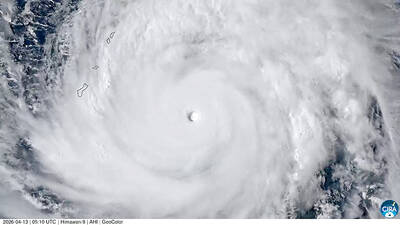
HAZARDOUS CONDITION: The typhoon’s sheer size, with winds extending 443km from its center, slowed down the ability of responders to help communities, an official said The US Coast Guard was searching for six people after losing contact with their disabled boat off the coast of Guam following Typhoon Sinlaku. The crew of the 44m dry cargo vessel, the US-registered Mariana, on Wednesday notified the coast guard that the boat had lost its starboard engine and needed assistance, Petty Officer 3rd Class Avery Tibbets said yesterday. The coast guard set up a one-hour communication schedule with the vessel, but lost contact on Thursday. A Coast Guard HC-130 Hercules aircraft was launched to search for the six people on board, but it had to return to Guam because of


 RSS
RSS