


Just three years ago, the last prisoners shuffled out of Schloss Hoheneck, a glowering fortress that squats on a bluff overlooking this eastern German village. Today, Bernhard Freiberger's fondest dream is to fill its empty cells with paying customers.
Freiberger, a western German investor whose jaunty bow tie and quicksilver smile suggest a wheeler-dealer rather than a warden, bought the 140-year-old women's jail in 2003, drawn by its forbidding reputation as a lockup for women who were political prisoners during communist times.
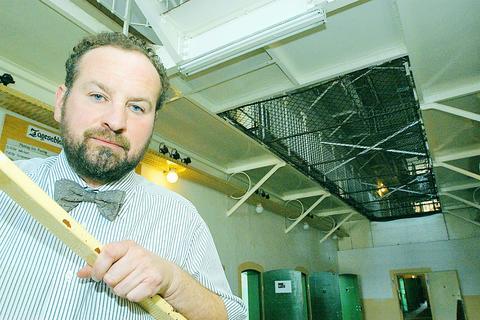
PHOTO: NY TIMES
Now he is promoting the chance to spend a night like a dissident, lying on a hard bed in a dank cell, subsisting on abysmal food and soaking up, as his Web site puts it, that "irresistible jail-house-feeling." The cost: 100 euros per person, or US$123.50 (stripes not included).
"It's important to make people feel what happened here," said Freiberger, as he showed off horrors like a pitch-dark, underground chamber where prisoners were hung waist-deep in frigid water for days at a time. "You don't understand it by looking at an exhibit in a museum."
Whether Freiberger, 44, manages to create a welcoming Gulag guesthouse in this secluded corner of the former East Germany is anyone's guess. He claims to have lined up 800 bookings for next month.
The trouble is, he ran into a wall of fury from women who stayed in Hoheneck before it began accepting major credit cards. Though Freiberger insists he will plow ahead, he abruptly canceled the first "Weekend in Jail" after a group of former political prisoners protested.
Renting rooms in Hoheneck trivializes their experience, they charge, turning a grim chapter of postwar German history into a Stasi theme park. They view it as crass exploitation of the current nostalgia for the communist East, which has been stoked by the popular recent film "Goodbye, Lenin!" and has inspired plans for an actual East German theme park near Berlin.
"He's making fun of our suffering," said Leni Koehler, 77, as she recited the sales pitch from Freiberger's site, her voice thick with anger. "You'd think we'd had some kind of wonderful life up there."
Fifty years after her release, Koehler still recalls her three years at Hoheneck with a shiver. Arrested in 1950 by the Soviet occupying troops, who accused her of helping Russian soldiers escape to West Germany, Koehler was forced to sleep on a concrete floor while pregnant.
She was sentenced to 25 years and transferred to Hoheneck, where her cellmates were murderers and other hardcore convicts. Political prisoners were at the bottom of the pecking order, making life a daily struggle. Weakened by the filthy conditions and lack of food, she contracted tuberculosis.
Victims of communist tyranny in East Germany have been largely forgotten in the euphoria that followed reunification in 1990. In the vast moral reckoning that is modern German history, their suffering is overshadowed by those who felt the Nazi boot.
Koehler's friend and fellow inmate Annemarie Krause noted that Freiberger would never have been allowed to convert a Nazi concentration camp like Buchenwald into a hotel.
Krause, 72, was arrested by the Soviets in 1948 because of her clandestine love affair with a Russian soldier. She and the young man plotted to defect to the West. As harshly as the Soviets treated her, she said, the East Germans, who took over in 1950, were worse.
Krause and Koehler helped create an exhibit about their experience in Stollberg's library. But the mayor, Marcel Schmidt, said it drew only 400 visitors a year, mostly local people. To realize his ambition of turning the town into a tourism center requires something more tantalizing.
Critics note that other communist-era prisons, like the notorious one in Bautzen, attract thousands of visitors with exhibits that document their abuses without crossing the line into schadenfreude.
"For me, this is a little macabre," said Anne Kaminsky, the director of a state-supported foundation that researches the East German dictatorship.
She has sent a letter to Freiberger, demanding that he shelve the plan. Human rights groups have protested as well.
The outcry has left Freiberger in a foul mood. The prison weekends, he notes, are only part of an ambitious plan that would turn the 14-acre complex into a center for concerts and cultural events. He is also planning a 200-bed, four-star hotel -- presumably without bars on the doors -- a garage to store vintage cars, and a restaurant serving, of all things, Tex-Mex cuisine.
Freiberger will not say how much he paid for the prison, which he bought from the state of Saxony. Nor will he say how much he plans to invest. But he has hired a historian to document its history and installed a sound system to pipe creepy music into the deserted cells.
"People have to understand: we can publicize the crimes that were committed here," he said, surveying the bleak prison yard. "How could we do more for the victims of Hoheneck? I can't imagine."

MONEY MATTERS: Xi was to highlight projects such as a new high-speed railway between Belgrade and Budapest, as Serbia is entirely open to Chinese trade and investment Serbian President Aleksandar Vucic yesterday said that “Taiwan is China” as he made a speech welcoming Chinese President Xi Jinping (習近平) to Belgrade, state broadcaster Radio Television of Serbia (RTS) said. “We have a clear and simple position regarding Chinese territorial integrity,” he told a crowd outside the government offices while Xi applauded him. “Yes, Taiwan is China.” Xi landed in Belgrade on Tuesday night on the second leg of his European tour, and was greeted by Vucic and most government ministers. Xi had just completed a two-day trip to France, where he held talks with French President Emmanuel Macron as the

With the midday sun blazing, an experimental orange and white F-16 fighter jet launched with a familiar roar that is a hallmark of US airpower, but the aerial combat that followed was unlike any other: This F-16 was controlled by artificial intelligence (AI), not a human pilot, and riding in the front seat was US Secretary of the Air Force Frank Kendall. AI marks one of the biggest advances in military aviation since the introduction of stealth in the early 1990s, and the US Air Force has aggressively leaned in. Even though the technology is not fully developed, the service is planning
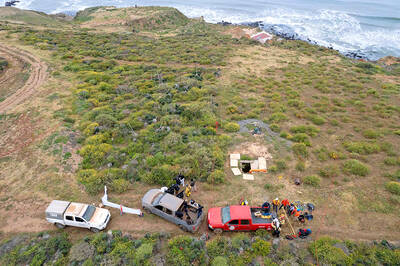
INTERNATIONAL PROBE: Australian and US authorities were helping coordinate the investigation of the case, which follows the 2015 murder of Australian surfers in Mexico Three bodies were found in Mexico’s Baja California state, the FBI said on Friday, days after two Australians and an American went missing during a surfing trip in an area hit by cartel violence. Authorities used a pulley system to hoist what appeared to be lifeless bodies covered in mud from a shaft on a cliff high above the Pacific. “We confirm there were three individuals found deceased in Santo Tomas, Baja California,” a statement from the FBI’s office in San Diego, California, said without providing the identities of the victims. Australian brothers Jake and Callum Robinson and their American friend Jack Carter

CUSTOMS DUTIES: France’s cognac industry was closely watching the talks, fearing that an anti-dumping investigation opened by China is retaliation for trade tensions French President Emmanuel Macron yesterday hosted Chinese President Xi Jinping (習近平) at one of his beloved childhood haunts in the Pyrenees, seeking to press a message to Beijing not to support Russia’s war against Ukraine and to accept fairer trade. The first day of Xi’s state visit to France, his first to Europe since 2019, saw respectful, but sometimes robust exchanges between the two men during a succession of talks on Monday. Macron, joined initially by EU Commission President Ursula von der Leyen, urged Xi not to allow the export of any technology that could be used by Russia in its invasion


 RSS
RSS