


They trigger fires, prey on the elderly and thrive in the cement jungles of Japanese cities. But the latest urban predators aren't delinquents or gang members, but big city rats.
Complaints about the rodents have soared over the last decade, and cities have devoted officials to the task of wiping them out. Tokyo last month hosted its first "anti-rat" symposium.
The vermin nibble electrical wires that spark fires, nest in the homes of Japanese cities' growing elderly and infirm population and wake residents when they noisily scurry around crawl spaces and through plumbing.
They're also making more regular appearances in Japan's urban commercial districts. Hideaki Okuzawa, who fills soda vending machines in Tokyo, says he often encounters the creatures.
"A colleague found a nest with a baby rat when he opened a vending machine," Okuzawa said, grimacing in disgust. "I wouldn't be able to stand it."
Rats are hardly a new phenomenon in the world's big metropolitan areas -- the plague in medieval Europe was spread by fleas from rats.
But Japanese officials think the surge in rat-sightings in their cities is being fueled by the spread of so-called roof rats -- known scientifically as rattus rattus.
Roof rats are agile building climbers and used to living in urban environments near humans. Officials say they are more resistant to pesticides than the Norway rats that have long trolled Japanese gutters and sewer pipes.
"Roof rats are well adapted to living inside buildings," said Fumiko Matsuda, an official handling rat problems for the Tokyo Metropolitan Government. "They're also escaping from old buildings that are being torn down and moving into surrounding residences."
Japanese officials have no estimates on the total rat population. But complaints about rats in Tokyo have increased from 10,241 in 1995 to nearly 20,000 in 2001, though the number dropped to about 16,000 in the last fiscal year. In Osaka, city hall received about 9,200 complaints last year, up 28 percent from 1996.
It's not just a aesthetic problem. The Tokyo Fire Department said there have been 115 fires linked to rats since 1995, causing 22 injuries and ?353 million (US$3.2 million) in damage. Many were caused by chewed wiring.
Rat watchers say a rapidly aging society provides a haven for rodents, who find shelter and food in cluttered and unkempt homes.
At the Tokyo rat symposium last month, officials described troubling scenes of infestation: a rat that stole candy from the plate of an 83-year-old woman with Parkinson's disease, and a 78-year-old widow who discovered a rat in her bed.
Matsuda said officials may have only scratched the surface of the rat problem, speculating that infestation in supermarkets, department stores and railways has yet to be fully revealed.
Moves are afoot to stamp out the critters. Tokyo is scheduled to come up with anti-rat guidelines.
One department store noticed a spike in requests for rat-killing products a few years ago, and now they have a full line of devices, from traditional mousetraps to a high-tech contraption that uses a rat-scaring sensor. It sells for ?52,500 (US$480).
But the best way to keep rats out may simply be discipline.
"If you leave the trash out long, they'll come," store clerk Kazuhiro Yoshiki warned.
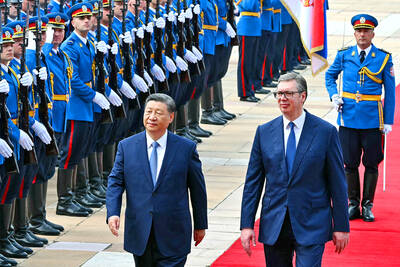
MONEY MATTERS: Xi was to highlight projects such as a new high-speed railway between Belgrade and Budapest, as Serbia is entirely open to Chinese trade and investment Serbian President Aleksandar Vucic yesterday said that “Taiwan is China” as he made a speech welcoming Chinese President Xi Jinping (習近平) to Belgrade, state broadcaster Radio Television of Serbia (RTS) said. “We have a clear and simple position regarding Chinese territorial integrity,” he told a crowd outside the government offices while Xi applauded him. “Yes, Taiwan is China.” Xi landed in Belgrade on Tuesday night on the second leg of his European tour, and was greeted by Vucic and most government ministers. Xi had just completed a two-day trip to France, where he held talks with French President Emmanuel Macron as the

With the midday sun blazing, an experimental orange and white F-16 fighter jet launched with a familiar roar that is a hallmark of US airpower, but the aerial combat that followed was unlike any other: This F-16 was controlled by artificial intelligence (AI), not a human pilot, and riding in the front seat was US Secretary of the Air Force Frank Kendall. AI marks one of the biggest advances in military aviation since the introduction of stealth in the early 1990s, and the US Air Force has aggressively leaned in. Even though the technology is not fully developed, the service is planning
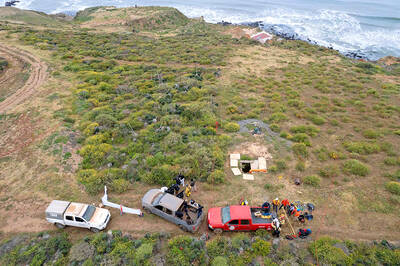
INTERNATIONAL PROBE: Australian and US authorities were helping coordinate the investigation of the case, which follows the 2015 murder of Australian surfers in Mexico Three bodies were found in Mexico’s Baja California state, the FBI said on Friday, days after two Australians and an American went missing during a surfing trip in an area hit by cartel violence. Authorities used a pulley system to hoist what appeared to be lifeless bodies covered in mud from a shaft on a cliff high above the Pacific. “We confirm there were three individuals found deceased in Santo Tomas, Baja California,” a statement from the FBI’s office in San Diego, California, said without providing the identities of the victims. Australian brothers Jake and Callum Robinson and their American friend Jack Carter
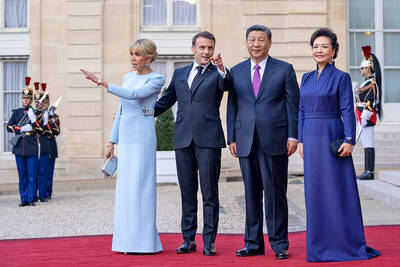
CUSTOMS DUTIES: France’s cognac industry was closely watching the talks, fearing that an anti-dumping investigation opened by China is retaliation for trade tensions French President Emmanuel Macron yesterday hosted Chinese President Xi Jinping (習近平) at one of his beloved childhood haunts in the Pyrenees, seeking to press a message to Beijing not to support Russia’s war against Ukraine and to accept fairer trade. The first day of Xi’s state visit to France, his first to Europe since 2019, saw respectful, but sometimes robust exchanges between the two men during a succession of talks on Monday. Macron, joined initially by EU Commission President Ursula von der Leyen, urged Xi not to allow the export of any technology that could be used by Russia in its invasion


 RSS
RSS