


Iran tested a ballistic missile to strengthen its defense in the face of threats by Israel amid a simmering row over Iran's nuclear ambitions, a senior Iranian security official said on Thursday.
Iran's Supreme National Security Council Secretary, Hassan Rowhani, said his country's nuclear program was aimed solely at generating electricity and not at building nuclear weapons.
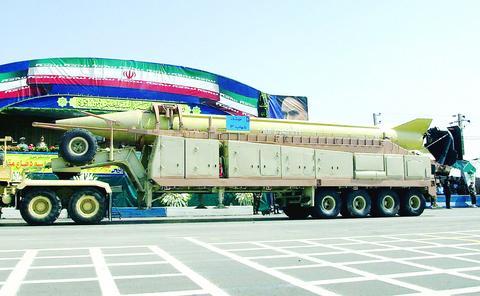
PHOTO: AP
Tehran tested a Shahab-3 medium-range ballistic missile on Wednesday and defense experts said the weapon could reach Israel or US bases in the Gulf. Last month Iran resumed making parts for uranium enrichment centrifuges, which can create bomb materials.
"Iran has been threatened by some Israeli officials. It's very natural that when our country is being threatened by a foreign country we have to prepare ourselves," Rowhani told a news conference.
"But Iran is totally opposed to weapons of mass destruction. The accusations and allegations raised by some of the countries against the Islamic Republic of Iran -- all of them are totally baseless and unfounded," he said during a visit to Australia's capital, Canberra.
Middle East media have speculated that Israel might try to halt Iran's nuclear program by carrying out air strikes on some atomic facilities in Iran. Iranian officials have said Tehran would retaliate promptly and strongly to any such attack.
The US has been pressing the 35-nation International Atomic Energy Agency (IAEA) board to report Iran to the UN Security Council for hiding its uranium enrichment program from the IAEA for nearly two decades.
But Rowhani said Iran did not feel threatened by the US, which led the invasion of Iraq last year in a bid to find weapons of mass destruction. These have not been unearthed.
He said the US was now struggling to stop Iraq from spiralling into anarchy.
"I think the experience of Iraq would be sufficient for the Americans for years to come not to think of invasion against any other country," Rowhani said.
During his three-day visit, Rowhani met Australian Prime Minister John Howard -- a staunch ally of US President George W. Bush -- and Foreign Minister Alexander Downer, who urged Iran to cooperate with the UN nuclear watchdog.
"We are going to continue with our cooperation with the IAEA," Rowhani said.
"The Islamic Republic of Iran is fully committed to all disarmament treaties and conventions. At the same time we have also our determination for the applications of nuclear technology for peaceful objectives," he said.
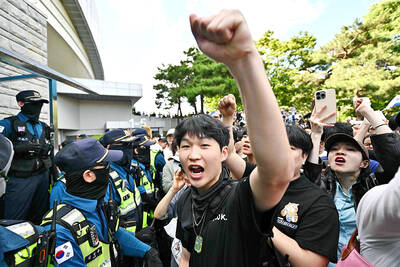
‘ABSURD MISTAKE’: The election commission said that there had been a failure to anticipate turnout after 14 polling stations ran short of ballot papers South Korean riot police yesterday cleared protesters from a Seoul polling station after a 35-hour blockade sparked by a shortage of ballot papers during local elections earlier this week. Wednesday’s election was the first nationwide vote since South Korean President Lee Jae-myung took office following the ouster of Yoon Suk-yeol over his short-lived martial law declaration. Lee’s ruling Democratic Party swept most races, but failed to flip the crucial Seoul mayoral seat. The South Korean National Election Commission apologized, blaming a failure to anticipate turnout after 14 polling stations in Seoul ran short of ballot papers. Some polling stations stayed open until 10pm to

France experienced its hottest spring on record, the French weather service said on Tuesday, after an exceptional early heat wave that also broke highs for the season in England and Wales. Meteo-France said the average nationwide temperature over March to May was 13.8°C — about 1.7°C above the norm, and surpassing records set in 2011 and 2020. “The warmest spring since records began in 1900,” it said in a bulletin. All three months were warmer than average, but the onset of an “unprecedented heatwave” late last month pushed the mercury to highs typically seen at the height of the summer. “Our country had never
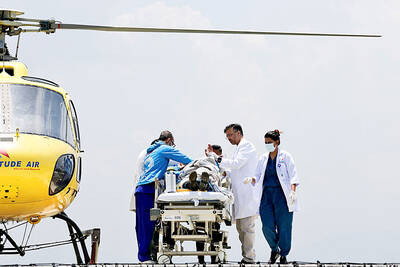
A Sherpa guide was found crawling to base camp on Mount Everest a week after he went missing and was reunited with his family, who had given up hope he would return. Dawa Sherpa was last seen on Friday last week descending the mountain, but he did not reach base camp even though his client did. The pair were among the last climbers on the mountain as the climbing season came to an end and the route was dismantled. Dawa was located by a cleaning crew on Thursday morning as he was crawling down the snowy slopes around the Khumbu Icefall, just above
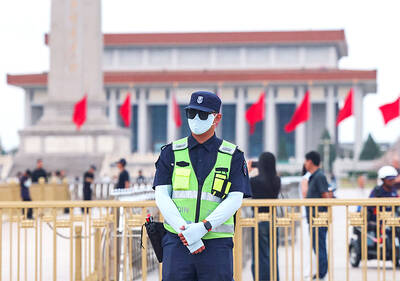
Chinese authorities are snuffing out any remembrance of the deadly 1989 military crackdown on student-led pro-democracy protests in Tiananmen Square, which happened 37 years ago yesterday, in a further tightening of a years-long campaign to erase what happened from public memory. Police told relatives of the victims they would not be allowed to visit a cemetery in Beijing on the anniversary of the crackdown, a person with knowledge of the matter said. Relatives of the victims visited the cemetery on the anniversary for more than 30 years to read memorial statements with police keeping watch, Amnesty International said. Hundreds of people,


 RSS
RSS