


The Bush administration's policy of barring news photographs of the flag-covered coffins of service members killed in Iraq won the backing of the Republican-controlled Senate on Monday when lawmakers defeated a Democratic measure to instruct the Pentagon to allow pictures.
The 54-39 vote came after little formal debate, with seven Democrats joining 47 Republicans to defeat the provision.
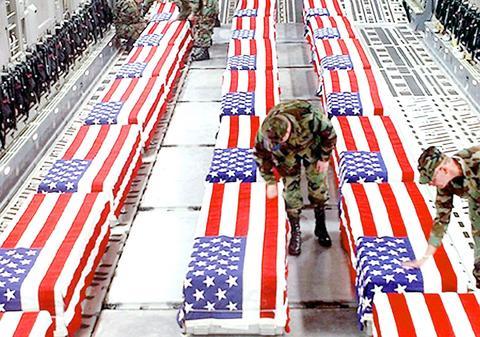
PHOTO: EPA
Two Republicans, senators Olympia J. Snowe of Maine and John McCain of Arizona, voted in favor of letting news photographers have access to Dover Air Force Base in Delaware, where coffins containing the war dead from Iraq arrive.
"These caskets that arrive at Dover are not named; we just see them," said McCain, a former Navy pilot who was a prisoner of war for five years in Vietnam. He added, "I think we ought to know the casualties of war."
But President Bush has insisted that the policy banning the photography protects the privacy of the families of the dead, a view reiterated by lawmakers who opposed the measure.
Some Republicans, including Senator Charles E. Grassley of Iowa, complained that Democrats were trying to score election-year points with the effort. Grassley noted that the policy had been in place since the first Bush administration, in 1991. "This policy has been in place for 13 years," he said. "Nobody has raised a complaint about it until now."
But the policy has not been consistently followed; President Bill Clinton took part in numerous ceremonies honoring dead servicemen. In March 2003, just as the US embarked on its war with Iraq, the Pentagon issued a directive stating that there would be no news coverage of "deceased military personnel returning to or departing from" air bases.
The measure defeated on Monday was proposed by Senator Frank R. Lautenberg of New Jersey, as an amendment to a US$447.2 billion Pentagon spending plan for 2005 now under consideration in the Senate. Lawmakers hope to finish work on the bill on Tuesday.
Lautenberg's amendment would have instructed the Department of Defense to work out a new protocol letting the news media cover the arrival of the war dead in a manner that protected families' privacy.
"A majority of the Senate are now working on behalf of the president to conceal from the American people the true costs of this war," Lautenberg said in a statement after the vote. He said his amendment "would bring an end to the shroud of secrecy cloaking the hard, difficult truth about war and the sacrifices of our soldiers."
The issue of pictures of the war dead has been a delicate one for the administration in recent months. In April, a collection of more than 300 images of coffins landing at Dover were made available after a Web site, www.thememoryhole.org, filed a Freedom of Information Act request for any pictures of coffins arriving at Dover from Iraq.
The images were taken by Air Force photographers and released by the Air Force Mobility Command. The Pentagon later said the release of the pictures was wrong. But Senator Gordon H. Smith of Oregon, who voted against Lautenberg's amendment on the ground that it would interfere with families' privacy, said he thought the Air Force photographs "were fine." He added, "I thought that was done very respectfully."
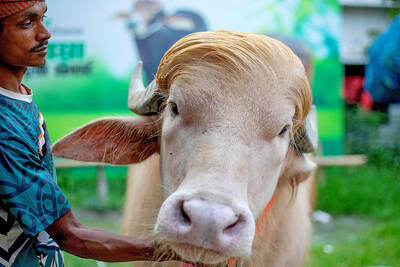
Crowds in Bangladesh are flocking to snap photographs with an unlikely social media star — an albino buffalo with flowing blond hair nicknamed “Donald Trump” that is due to be sacrificed within days. Owner Zia Uddin Mridha, 38, said his brother named the 700kg bull over its flowing helmet of hair resembling the signature look of the US president. “My younger brother picked this name because of the buffalo’s extraordinary hair,” he said at his farm in Narayanganj, just outside the capital, Dhaka. Mridha said that a constant stream of curious visitors — social media fans, onlookers and children — have come throughout

It began as a satirical online project. Now millions of young people in India are flocking to it as an outlet for their frustration. A parody political party called the Cockroach Janta Party, with the insect as its symbol, has exploded across India’s social media by turning absurdist humor into protest. Memes and short videos mocking corruption, joblessness and political dysfunction have flooded social media sites, where millions of users are embracing the cockroach — known for its ability to survive harsh conditions — as a tongue-in-cheek symbol of endurance. The online movement’s rise has been unusually rapid. The Cockroach Janta Party (CJP)
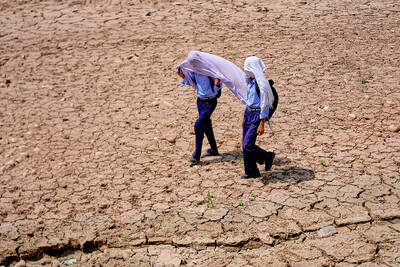
HOTTER: While Indians are accustomed to summer heat, climate change has caused northwestern India to warm faster than other parts of the country, an academic said Roads and markets have emptied during afternoons and some farmers have switched to nighttime work to avoid scorching temperatures as a heat wave grips large parts of India. The India Meteorological Department forecast maximum temperatures for yesterday of about 45°C in the capital, New Delhi, where authorities have opened temporary “cooling zones” to help people cope. The weather department warned that conditions would likely persist across several northern regions in the coming days, with temperatures staying well above seasonal averages. Authorities urged people to stay indoors during the hottest hours and take precautions against heat-related illnesses. India declares a heat wave whenever maximum temperatures
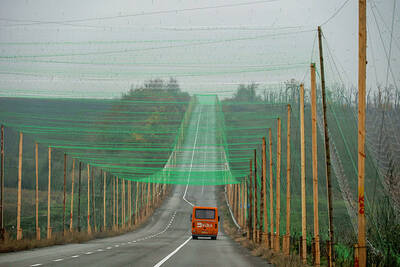
BIGGER ROLE: Beijing has said it maintains an impartial stance on the war in Ukraine, but by training Russian troops, China is far more involved than previously known China’s armed forces secretly trained about 200 Russian military personnel in China late last year, and some have since returned to fight in Ukraine, according to three European intelligence agencies and documents seen by Reuters. While China and Russia have held a number of joint military exercises since Moscow’s full-scale invasion of Ukraine in 2022, Beijing has repeatedly said that it is neutral in the conflict and presents itself as a peace mediator. The covert training sessions, which predominantly focused on the use of drones, were outlined in a dual-language Russian-Chinese agreement signed by senior Russian and Chinese officers in Beijing on


 RSS
RSS