


The Australian government has turned its back on global efforts to reduce the greenhouse gases that drive climate change and announced plans to meet its electricity needs by burning coal and oil.
The 10-year energy blueprint Prime Minister John Howard presented to parliament this week was cheered by the captains of industry but deplored by environmentalists.
Rather than embrace solar and other renewable energy sources, Howard put forward a national energy plan that offered the coal industry an enormous subsidy to tinker with untested and uncosted technology for turning carbon dioxide from coal-fired power plants into a liquid and then pumping it into holes in the ground.
At the same time, it hammered the commercial prospects of companies established to develop and sell technologies for harnessing the energy of the wind and sun.
"The reality is that the older fuels, of which we have large supplies, are going to contribute the bulk of our energy needs," Howard said. "The energy advantage provided by our resources is something that Australia must not throw away."
The coal industry employs 120,000 Australians and its exports bring in A$24 billion (US$16 billion) a year. It will be the biggest benefactor of a A$500 million (US$350 million) fund to spur technologies to reduce emissions.
The renewable energy sector, its luminaries attest, will go to the wall because the policy caps at 1 percent the amount that electricity retailers must source from generators of solar and wind power. In Europe and in California, the target has been set at 10 percent or more.
Reactions on both sides to Howard's statement were entirely predictable.
"We believe the plan strikes an appropriate balance," said Business Council of Australia president Hugh Morgan.
"If this is an environment statement I would hate to see an anti-environment statement," said Australian Conservation Council (ACF) chief executive Don Henry. "There are no long-term targets to cut greenhouse pollution, no long-term targets to boost renewable energy and no long-term plan to control pollution from the energy and transport sectors."
Howard, who faces a general election later this year, reaffirmed that his eight-year administration had no intention of joining with most of the rest of the industrialized world to sign the Kyoto Protocol which sets mandatory targets for reducing greenhouse gas emissions.
The opposition Labor Party, which is running neck-and-neck with Howard's Liberal-National coalition, favors signing Kyoto.
"We're not going to sign something that's unfair to Australia," Howard said. "My guide for this is the Australian national interest."
Australia, along with the US, has so far refused to accept the targets set forth in the Kyoto treaty, which proponents say will limit the emission of the greenhouse gases that cause global warming.
"I don't see any wisdom in signing up to something that could result in net exports of jobs and investment and industries to major emitter countries that are not subject to the greenhouse emission targets that would be obliged on Australia if we were a party to a protocol," Howard said.
The prime minister again insisted that Australia would not join the Kyoto effort until developing countries like China and India, also major world polluters, were obliged to sign up for their own mandatory targets for cutting emissions.
"It just doesn't make sense in terms of Australia's national interest for us to sign the Kyoto Protocol on present conditions when you have major polluters and emitters, countries such as China and Brazil and Indonesia, that wouldn't be subject to the constraints we'd be subject to," Howard said.
Australia could still meet the target it accepted before it turned its back on the Kyoto process, Howard said.
Australia, one of only three countries allowed to raise emissions rather than obliged to lower them, was set -- and even accepted -- a target of achieving 108 percent of 1990 emissions by 2010. However, it then ducked out of the Kyoto process, saying it wouldn't re-engage until the US did.
Gareth Walton, climate campaigner with the international environmental lobby group Greenpeace, said all the available evidence shows that Australia would not meet its Kyoto target.
His view was echoed by the ACF's Don Henry, who noted that Australia had managed to get close to its Kyoto target only by factoring into the equation a lower level of land clearing than in the past.
"The emissions from the energy sector in Australia have increased by about 30 percent since 1990," Henry said. "We're actually facing a greenhouse disaster scenario in our energy and transportation sectors."
On a per capita basis, Australia is the world's biggest generator of greenhouse gases. The US is the biggest polluter overall.

Crowds in Bangladesh are flocking to snap photographs with an unlikely social media star — an albino buffalo with flowing blond hair nicknamed “Donald Trump” that is due to be sacrificed within days. Owner Zia Uddin Mridha, 38, said his brother named the 700kg bull over its flowing helmet of hair resembling the signature look of the US president. “My younger brother picked this name because of the buffalo’s extraordinary hair,” he said at his farm in Narayanganj, just outside the capital, Dhaka. Mridha said that a constant stream of curious visitors — social media fans, onlookers and children — have come throughout

It began as a satirical online project. Now millions of young people in India are flocking to it as an outlet for their frustration. A parody political party called the Cockroach Janta Party, with the insect as its symbol, has exploded across India’s social media by turning absurdist humor into protest. Memes and short videos mocking corruption, joblessness and political dysfunction have flooded social media sites, where millions of users are embracing the cockroach — known for its ability to survive harsh conditions — as a tongue-in-cheek symbol of endurance. The online movement’s rise has been unusually rapid. The Cockroach Janta Party (CJP)
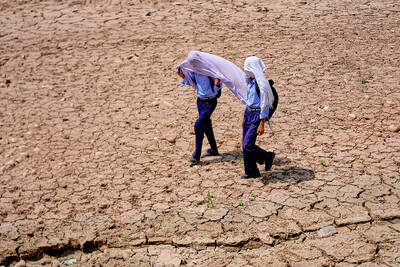
HOTTER: While Indians are accustomed to summer heat, climate change has caused northwestern India to warm faster than other parts of the country, an academic said Roads and markets have emptied during afternoons and some farmers have switched to nighttime work to avoid scorching temperatures as a heat wave grips large parts of India. The India Meteorological Department forecast maximum temperatures for yesterday of about 45°C in the capital, New Delhi, where authorities have opened temporary “cooling zones” to help people cope. The weather department warned that conditions would likely persist across several northern regions in the coming days, with temperatures staying well above seasonal averages. Authorities urged people to stay indoors during the hottest hours and take precautions against heat-related illnesses. India declares a heat wave whenever maximum temperatures

BIGGER ROLE: Beijing has said it maintains an impartial stance on the war in Ukraine, but by training Russian troops, China is far more involved than previously known China’s armed forces secretly trained about 200 Russian military personnel in China late last year, and some have since returned to fight in Ukraine, according to three European intelligence agencies and documents seen by Reuters. While China and Russia have held a number of joint military exercises since Moscow’s full-scale invasion of Ukraine in 2022, Beijing has repeatedly said that it is neutral in the conflict and presents itself as a peace mediator. The covert training sessions, which predominantly focused on the use of drones, were outlined in a dual-language Russian-Chinese agreement signed by senior Russian and Chinese officers in Beijing on


 RSS
RSS