


With the words of William Wordsworth on his lips and riding on a black stallion, Eugene Terre'Blanche trotted out of jail and back into South African politics yesterday.
A few dozen supporters greeted the white extremist leader with salutes, but they were outnumbered by a jeering crowd of black people.
The Afrikaner Resistance Movement (AWB) billed the rally as the start of a revival: It had waited five years for its leader's release after his conviction for beating up two black men. But just two trucks of members turned up to greet him at the parole office in Potchefstroom, a conservative town 40km west of Johannesburg.
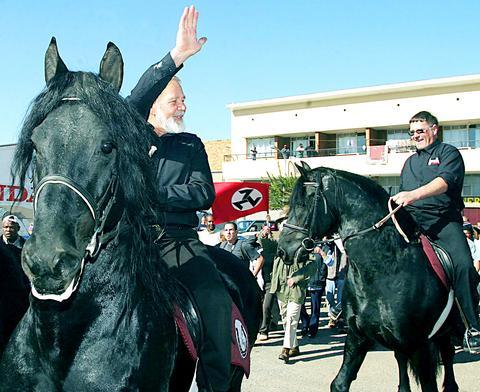
PHOTO: REUTERS
"There is no future for them; I'm just here for the show," said Steven Tsolo, 43, as about 100 black people jogged after Terre'Blanche, chanting, laughing and offering handshakes -- which he declined.
moses
The 60-year-old, trimmer than the stout figure who threatened a race war a decade ago, put on a brave face and cast himself as a reborn Christian who would shun parliamentary politics in favor of leading a cultural crusade to defend the Afrikaans language from encroaching English in post-apartheid South Africa.
"Moses led his people from Egypt into the desert because his people were slaves and God said to take them to freedom ... I am deeper in the knowledge that I am only a man, and that from now on my creator will give the right commands."
From a podium framed by two swastika-like flags, Terre'Blanche said he was a humble citizen who knew his duty to his volk -- his people. "I was never wrong to honor my heritage and answer them when they called me," he said.
Terre'Blanche, a poet who once released a CD of verse, switched to English to regale a press conference with Wordsworth's poem I Wandered Lonely As a Cloud. Reminiscing about his primary school English teacher, he said: "You may think I don't talk English, but English is the most powerful language in the entire world."
fiasco
As apartheid gave way to multiracial elections in 1994, AWB members planted bombs that killed and wounded dozens, but their campaign for an independent white homeland collapsed in ignominy, and the fear inspired by the movement turned to ridicule. A sex scandal further diminished Terre'Blanche's credibility even before he was jailed for assaulting a petrol attendant and attempting to murder a farm worker.
At one point yesterday his horse reared up, but he avoided a repeat of his infamous tumble from the saddle which came to symbolize the AWB's decline.
The rally verged on a fiasco. The brass band consisted of two buglers and the turnout of supporters, dressed in khaki, camouflage and black, was disappointing.
Instead of the 10,000 he once drew, there were closer to 30, bolstered by dozens of journalists.
But in front of the microphone it was vintage Terre'Blanche, orating fluently without notes in a 30-minute speech peppered with references to the volk, Jesus and the Old Testament. He was a master of acoustics: his voice would swell, then suddenly stop, flooding the hall with silence. "Thank you for being a wonderful audience," he said, without apparent irony.
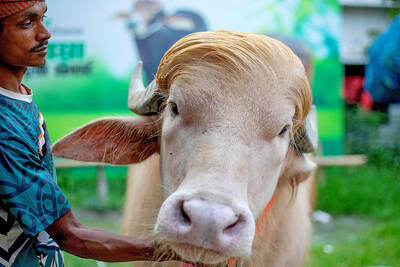
Crowds in Bangladesh are flocking to snap photographs with an unlikely social media star — an albino buffalo with flowing blond hair nicknamed “Donald Trump” that is due to be sacrificed within days. Owner Zia Uddin Mridha, 38, said his brother named the 700kg bull over its flowing helmet of hair resembling the signature look of the US president. “My younger brother picked this name because of the buffalo’s extraordinary hair,” he said at his farm in Narayanganj, just outside the capital, Dhaka. Mridha said that a constant stream of curious visitors — social media fans, onlookers and children — have come throughout

It began as a satirical online project. Now millions of young people in India are flocking to it as an outlet for their frustration. A parody political party called the Cockroach Janta Party, with the insect as its symbol, has exploded across India’s social media by turning absurdist humor into protest. Memes and short videos mocking corruption, joblessness and political dysfunction have flooded social media sites, where millions of users are embracing the cockroach — known for its ability to survive harsh conditions — as a tongue-in-cheek symbol of endurance. The online movement’s rise has been unusually rapid. The Cockroach Janta Party (CJP)
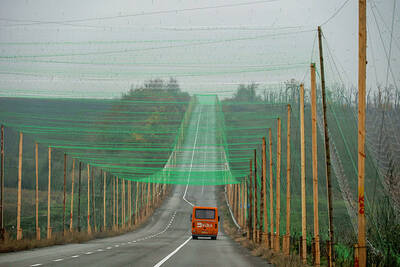
BIGGER ROLE: Beijing has said it maintains an impartial stance on the war in Ukraine, but by training Russian troops, China is far more involved than previously known China’s armed forces secretly trained about 200 Russian military personnel in China late last year, and some have since returned to fight in Ukraine, according to three European intelligence agencies and documents seen by Reuters. While China and Russia have held a number of joint military exercises since Moscow’s full-scale invasion of Ukraine in 2022, Beijing has repeatedly said that it is neutral in the conflict and presents itself as a peace mediator. The covert training sessions, which predominantly focused on the use of drones, were outlined in a dual-language Russian-Chinese agreement signed by senior Russian and Chinese officers in Beijing on
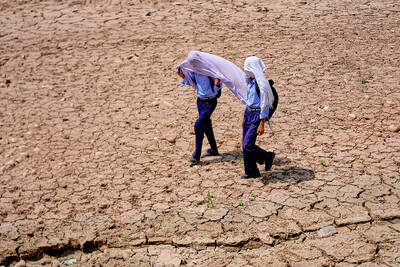
HOTTER: While Indians are accustomed to summer heat, climate change has caused northwestern India to warm faster than other parts of the country, an academic said Roads and markets have emptied during afternoons and some farmers have switched to nighttime work to avoid scorching temperatures as a heat wave grips large parts of India. The India Meteorological Department forecast maximum temperatures for yesterday of about 45°C in the capital, New Delhi, where authorities have opened temporary “cooling zones” to help people cope. The weather department warned that conditions would likely persist across several northern regions in the coming days, with temperatures staying well above seasonal averages. Authorities urged people to stay indoors during the hottest hours and take precautions against heat-related illnesses. India declares a heat wave whenever maximum temperatures


 RSS
RSS