


Egypt's religious authorities raided book stores and stands on Saturday, confiscating hundreds of publications as well as audio and video tapes they claim do not conform to Islamic teachings.
The raid came only three days after Justice Minister Faruq Seif al-Nasr granted Al-Azar, Sunni Islam's most prestigious institution, wide-ranging powers to ban and confiscate material it deems violate religious principles.
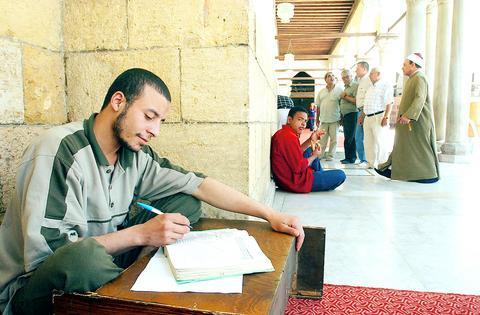
PHOTO: AP
Novels by secular writers and even unorthodox versions of the Islamic holy book, the Koran, were seized in the raids, raising concerns the religious establishment might use its new powers to suppress free thought.
Human rights groups and the liberal intelligentsia condemned the move, spearheaded by Al-Azhar's Islamic Research Center (IRC), as an attempt to stifle freedom of expression and warned that it could encourage violence against secular writers.
They mentioned two individuals in particular whose publications were targeted in the raids: Egyptian feminist writer Nawal Saadawi and researcher Ahmed Ismail.
According to the Egyptian Human Rights Center for Legal Aid, Ismail was assaulted by members of the extremist Salafist group, who denounced him as being an infidel.
The IRC demanded the confiscation of Saadawi's The Fall of the Imam, published nearly 20 years ago, for allegedly violating Islamic precepts.
The novel tells the story of a dictator surrounded by Islamic scholars, who use the Koran to justify the dictator's actions, even if that means giving false interpretations of verses in the holy book.
Alaa Abd El-Zaher, head of the IRC's videotape department, however, argued that the confiscations were only "limited to religious publications" and did not cover "literary works."
In the mid 1990s, the IRC recommended the suspension of renowned Egyptian film director Yussef Shahine's Al-Mohageer (The Emigre) and the banning of author Alaa Hamed's Voyage into the Human Mind, a philosophical reflection on faith and atheism.
The author was later jailed for six months.
Islamists also filed a case in court against Cairo University professor Hamed Abu Zeid, demanding that he be divorced from his wife.
They alleged that anti-Islamic writings had made him an apostate and therefore could not remain married to his Muslim wife, Ibtehal Yunis, a Spanish lecturer at Cairo university.
The couple was later forced to flee the country and live in exile in the Netherlands.
The Egyptian Organization for Human Rights expressed fear on Tuesday that the Justice Ministry's decision would lead to violations of freedoms, including of thought and expression, which are enshrined in the constitution.

SPEAKING OUT: After Siranudh Scott’s allegations surfaced, celebrities and public figures took to social media to share their own experiences of sexual misconduct and abuse A high-profile alleged sexual abuse case within a wealthy Thai beer brewing family has prompted a wave of painful accounts from survivors of unconnected abuse in the conservative nation. Siranudh Scott, a member of the billionaire Thai family that founded the ubiquitous Singha beer brand, posted an emotional video this month accusing his elder brother Sunit of repeatedly abusing him when he was a teenager. Sunit, who is in his 30s, later denied the allegations in a video posted online, but Singha parent Boonrawd dismissed him from his executive role with the company on Tuesday last week. “I felt I needed to speak

SEEKING ORDER: Rodrigo Paz said that ‘anyone who wants to destroy the nation will have to deal with this president and the full force of the constitution’ Bolivian President Rodrigo Paz on Wednesday said that the nation was at a “breaking point” after nearly a month of protests that have caused shortages of food, fuel and medicine. Paz, who took office six months ago amid the worst economic crisis there in four decades, is battling a groundswell of fury over his policies. The political capital, La Paz, has been besieged by low-income workers and members of the indigenous majority calling for his resignation. “The country needs order and is reaching breaking point,” the 58-year-old said at a public event in La Paz, renewing his appeal for dialogue. On Tuesday, the Bolivian

COMMUNITY CONFLICT: Concerns about disease spread from corpses has run up against friends and families’ desire to bury their dead as infection spreads in the area Angry residents of a town at the epicenter of the Ebola outbreak in the Democratic Republic of the Congo (DR Congo) attacked and burned a tent that was part of a health center where people are being treated for the virus, the staff there said Saturday. It was the second such attack in the region in a week. No one was hurt in the attack, according to reports but as patients ran out to escape the fire, 18 people with suspected Ebola infections fled the facility and are unaccounted for, a hospital director said. Angry residents arrived at the clinic in the

Forecasters in Europe yesterday warned of exceptional heat as record temperatures driven by a “heat dome” push temperatures well above seasonal norms across the continent. The surge follows a record-breaking Monday, with France logging its hottest day in the month of May on record, its weather agency said, and the UK also posting unprecedented highs. A so-called “heat dome” of warm air from northern Africa trapped under a high-pressure system over western Europe is behind the high temperatures not usually seen until high summer. Restrictions on outdoor work were imposed in parts of Italy, beaches in southwest France filled earlier than usual and


 RSS
RSS