


More than 1,000 police occupied two major Rio shantytowns on Monday in an effort to end a brimming drug war that has killed 10 people since Friday.
Hillsides echoed with fireworks and gunfire above the Rocinha favela, or shantytown, early Monday as police entered the slum. Two alleged drug dealers were killed in a shootout with police and five men were arrested, police said.
Police also moved into the Vidigal slum, which, like Rocinha, overlooks the city's wealthiest neighborhoods and trendy beaches.
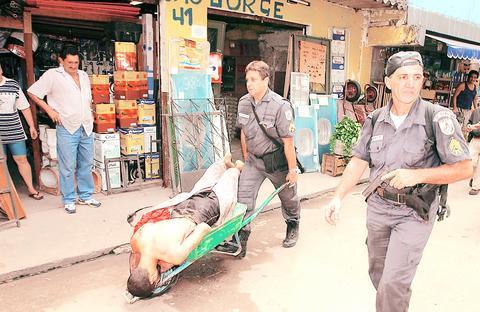
PHOTO: AP
"We're going to tighten the belt around the favela more and more. We're going to push them deeper and deeper, point by point, and soon we'll have the area totally controlled," said Rio state police Colonel Renato Hottz, who is in charge of the operation.
Meanwhile, drug gangs fired on a helicopter that was flying over a slum on the city's north side, injuring two policemen and forcing an emergency landing, the state security office said. Police said the shooting was unrelated to the crackdown in Vidigal and Rocinha.
The drug war broke out Friday, when gang members from Vidigal attempted to invade Rocinha to wrest control of the trade in illegal narcotics, mainly cocaine and marijuana.
Sporadic shootouts between drug gangs and police have erupted since then and the violence in the slums -- which straddle the main roads dividing the city's south and west sides -- cut Rio in two.
On Friday, a female motorist was killed in the crossfire between the two gangs. Two other bystanders also were killed, while police said the remaining victims were drug traffickers.
Some 40 heavily armed drug gang members escaped a police dragnet on Sunday by hiding in the forest that surrounds the Rocinha slum, police said.
Many of Rocinha's 56,000 residents fled to avoid the violence. The slum, which is usually relatively calm despite its thriving drug trade, is the largest of Rio's 600-plus shantytowns.
Guests at the beach front Intercontinental Hotel were shocked to see red and blue tracer bullets streaking across the night sky, according to the O Globo newspaper.
Rio's Mayor Cesar Maia criticized state police officials on Monday, and called for federal intervention to help keep the peace.
"I think the federal government should consider declaring a state of alert in Rio de Janeiro, the state security department has shown itself incapable of controlling the situation," Maia told reporters.
Rio de Janeiro state Governor Rosinha Matheus and state security secretary Anthony Garotinho, who is Matheus' husband, declined to comment on the situation.
Federal Justice Minster Marcio Thomaz Bastos said he had spoken twice with Matheus on Monday and was sending an aide to Rio to discuss the situation.
"The federal government will use all means necessary to maintain order and peace," Bastos said at a news conference in Brasilia, the nation's capital. He added that the federal government had not ruled out sending in the army.
Lieutenant-Governor Luiz Paulo Conde said the state was considering building walls 3m high around the two slums to contain the violence.

SPEAKING OUT: After Siranudh Scott’s allegations surfaced, celebrities and public figures took to social media to share their own experiences of sexual misconduct and abuse A high-profile alleged sexual abuse case within a wealthy Thai beer brewing family has prompted a wave of painful accounts from survivors of unconnected abuse in the conservative nation. Siranudh Scott, a member of the billionaire Thai family that founded the ubiquitous Singha beer brand, posted an emotional video this month accusing his elder brother Sunit of repeatedly abusing him when he was a teenager. Sunit, who is in his 30s, later denied the allegations in a video posted online, but Singha parent Boonrawd dismissed him from his executive role with the company on Tuesday last week. “I felt I needed to speak

A Hong Kong astronaut is to join a Chinese space mission for the first time as part of a three-person crew launching today, as Beijing edges closer to its goal of landing people on the moon. The Tiangong space station — crewed by teams of three astronauts that are typically rotated every six months — is the crown jewel of China’s space program, boosted by billions in state investment in a bid to catch up with the US and Russia. The Shenzhou-23 mission is to blast off at 11:08pm from the Jiuquan Satellite Launch Center in northwestern China, carrying three astronauts to

UPGRADED ALERT: The risk inside DR Congo is now considered ‘very high,’ while neighboring countries face a ‘high’ threat as the outbreak continues, the WHO said Ebola is spreading faster than responders can track it in eastern Congo, where health workers managed to follow up with barely one in five identified contacts in a single day. Authorities in the Democratic Republic of the Congo (DR Congo) reported 83 confirmed infections, 746 suspected cases and 1,603 identified contacts as of Thursday, but health workers were able to follow up on only 342 contacts that day — about 21 percent of the total under monitoring — data released by the DR Congo Ministry of Public Health on Friday showed. The figures suggest the response is falling behind the outbreak itself,

SEEKING ORDER: Rodrigo Paz said that ‘anyone who wants to destroy the nation will have to deal with this president and the full force of the constitution’ Bolivian President Rodrigo Paz on Wednesday said that the nation was at a “breaking point” after nearly a month of protests that have caused shortages of food, fuel and medicine. Paz, who took office six months ago amid the worst economic crisis there in four decades, is battling a groundswell of fury over his policies. The political capital, La Paz, has been besieged by low-income workers and members of the indigenous majority calling for his resignation. “The country needs order and is reaching breaking point,” the 58-year-old said at a public event in La Paz, renewing his appeal for dialogue. On Tuesday, the Bolivian


 RSS
RSS