


Indonesia launched campaigning yesterday for parliamentary elections with two big secular parties and a host of smaller Islamic ones competing for votes against a backdrop of possible attacks by militants.
Stocks in the world's most populous Muslim nation eased, with investors cautious about the threat of violence by Islamic radicals or between party supporters, but by midday a huge parade of colorful floats in Jakarta was under way peacefully.
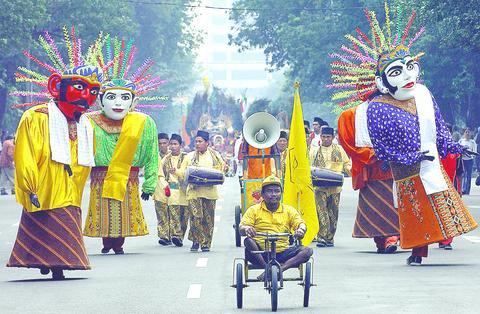
PHOTO: AFP
The April 5 vote in Indonesia, a sprawling archipelago of 17,000 islands and 220 million people, will be a test of the popularity of conservative Islamic parties in the wake of bomb attacks by militants linked to Osama bin Laden.
The performance of President Megawati Sukarnoputri's party, and its rivals, will set the scene for her bid to retain the top job in the country's first direct presidential election in July.
Many analysts expect she will ultimately triumph as head of a coalition of secular and moderate Muslim parties.
Twenty-four parties are competing for 550 parliament seats.
Megawati's Indonesia Democratic Party-Struggle (PDI-P) and Golkar, the former political vehicle of ex-autocrat Suharto, are close in some polls. Both are secular-nationalist.
The atmosphere in Jakarta and elsewhere was festive yesterday. In Indonesia's nascent democracy, having a good time often matters more than issues.
"I made myself like this because I love PDI-P," shouted 35-year-old street vendor Jamhari, his body painted in the party's colors of black and white, and his hair slicked into two horns in honor of the PDI-P bull logo.
"Nobody is paying me. I love democracy and Megawati loves us all," he said, punching his fist in the air from a truck roof.
Added popular TV commentator Andi Mallarangeng, sweating heavily as he walked beside a float for his tiny Nationhood Democratic Party: "This is real euphoria."
One main question is how well Muslim parties will fare in the wake of bombings in Bali and Jakarta blamed on the Jemaah Islamiah militant group that killed more than 200 people.
Most Indonesian Muslims are moderate and analysts expect the biggest share of votes to go to secular parties. The leading Muslim parties also have a moderate outlook.
Nevertheless, police have said militants might be planning to disrupt the polls.
Meanwhile Indonesia's top security minister, who is also planning to run for the presidency, offered to resign yesterday after accusing Megawati of sidelining him.
"I have sent a letter to the president in which I ask her permission to resign from the Cabinet," Security Minister Susilo Bambang Yudhoyono told reporters.
"It has become difficult to perform my duties."
In the past several days, Yudhoyono has questioned his role as the government's minister for security, saying Megawati had taken over most of his duties.
The retired four-star general, who has held the security post since 2000, has been nominated as the presidential candidate of the newly formed Democratic Party in elections on July 5. Recent public opinion polls have indicated that he enjoys marginal support among the electorate.
Analysts have said Yudhoyono's bid for the presidency has caused rifts with Megawati, whose politically powerful husband has publicly attacked him in recent days.


Through the noise of rushing papers and whirring belts at a print factory in Kyoto, two creators watch their photo essay come to life in broadsheet form — part of an effort to win new audiences in the age of artificial intelligence (AI). Despite the decline of the publishing industry, self-publication and handmade “zine” magazines are growing in popularity in Japan, reflecting the nation’s enduring love of paper in the digital era. While speaking to Agence France-Presse at the plant, his hands black with ink, one of the creators, Kazuma Obara, said: “I think [paper] is a medium that engages all five
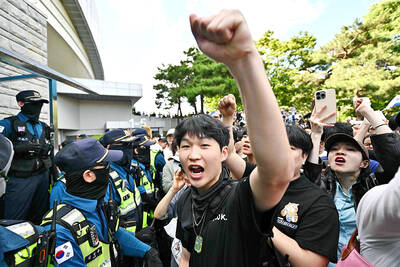
‘ABSURD MISTAKE’: The election commission said that there had been a failure to anticipate turnout after 14 polling stations ran short of ballot papers South Korean riot police yesterday cleared protesters from a Seoul polling station after a 35-hour blockade sparked by a shortage of ballot papers during local elections earlier this week. Wednesday’s election was the first nationwide vote since South Korean President Lee Jae-myung took office following the ouster of Yoon Suk-yeol over his short-lived martial law declaration. Lee’s ruling Democratic Party swept most races, but failed to flip the crucial Seoul mayoral seat. The South Korean National Election Commission apologized, blaming a failure to anticipate turnout after 14 polling stations in Seoul ran short of ballot papers. Some polling stations stayed open until 10pm to

France experienced its hottest spring on record, the French weather service said on Tuesday, after an exceptional early heat wave that also broke highs for the season in England and Wales. Meteo-France said the average nationwide temperature over March to May was 13.8°C — about 1.7°C above the norm, and surpassing records set in 2011 and 2020. “The warmest spring since records began in 1900,” it said in a bulletin. All three months were warmer than average, but the onset of an “unprecedented heatwave” late last month pushed the mercury to highs typically seen at the height of the summer. “Our country had never

A Sherpa guide was found crawling to base camp on Mount Everest a week after he went missing and was reunited with his family, who had given up hope he would return. Dawa Sherpa was last seen on Friday last week descending the mountain, but he did not reach base camp even though his client did. The pair were among the last climbers on the mountain as the climbing season came to an end and the route was dismantled. Dawa was located by a cleaning crew on Thursday morning as he was crawling down the snowy slopes around the Khumbu Icefall, just above


 RSS
RSS