


North Korea dismissed any idea it wanted US President George W. Bush to lose November's US presidential election, saying yesterday the key for the winner -- Democrat or Republican -- would be to change policy towards Pyongyang.
A day earlier, the secretive communist state threatened to boost the nuclear deterrent it says it has and blamed the US stance in recent six-party talks for forcing its hand. Washington dismissed the apparently tougher line from Pyongyang as rhetoric.
Analysts say little progress on curbing North Korea's nuclear programs was now likely before the US presidential elections in November, thus giving Pyongyang more time to try to develop a nuclear capability.
Pyongyang denied it could be stalling in six-way talks over its nuclear ambitions to see whether a more amenable Democratic US president is elected, saying it did not care which party's candidate triumphed in the US presidential election.
"Whoever [is] elected US president should be willing to make a switchover in its policy toward the DPRK, drop the hostile policy toward it and express readiness to coexist with it," the official KCNA news agency said. The initials DPRK stand for the North's official name, the Democratic People's Republic of Korea.
"This is a main point," it said.
"If the US makes a switchover in its policy toward the DPRK, though belatedly, progress will be made in the settlement of the nuclear issue," KCNA said.
In Seoul, South Korea's chief nuclear negotiator voiced hopes that initial working group meetings, which were agreed at the Beijing talks, could be held between April and June before a new round of six-party talks.
"We will make our best efforts to get the North Korean nuclear issue to a settlement phase through a third round of talks after holding one or two working group meetings during the second quarter of the year," Yonhap news agency quoted Deputy Foreign Minister Lee Soo-hyuck as saying.
The US has demanded the "complete, verifiable and irreversible dismantlement" of the North's nuclear programs that are believed to involve plutonium and uranium.
The North Korean statement on Wednesday voiced anger at such demands and followed similar shows of defiance since six-way talks involving the two Koreas, China, the US, Japan and Russia in Beijing last month.
"The reckless US stance only pushes the DPRK to further increase its nuclear deterrent force," the state-run KCNA news agency on Wednesday cited a Foreign Ministry spokesman as saying.
The impasse "does nothing bad to the DPRK as it will have time to take more necessary steps with increased pace", he said.
In Washington, Deputy Secretary of State Richard Armitage said North Korea's latest statement did not reflect the position Pyongyang took at the negotiations.
US officials say they believe North Korea already possesses one or two nuclear weapons and could be making more.
The US has said it is in no hurry to put together a deal because it wants to take time to come up with an accord that will stick.
However, analysts on North Korea said the administration of Bush, who has branded North Korea part of an "axis of evil" with Iran and pre-war Iraq, may prefer to intensify the pressure.
"The administration seems incapable of making any kind of deal or doing serious negotiations," said Daniel Pinkston, a North Korean expert at the Monterey Institute's Center for Non-Proliferation Studies in California.
Pinkston said he saw small signs of gradual convergence on the plutonium program, although he expected no progress before the US elections.
"The North Koreans are going to wait until after the election because they saw a big policy reverse after Clinton," he said.


Through the noise of rushing papers and whirring belts at a print factory in Kyoto, two creators watch their photo essay come to life in broadsheet form — part of an effort to win new audiences in the age of artificial intelligence (AI). Despite the decline of the publishing industry, self-publication and handmade “zine” magazines are growing in popularity in Japan, reflecting the nation’s enduring love of paper in the digital era. While speaking to Agence France-Presse at the plant, his hands black with ink, one of the creators, Kazuma Obara, said: “I think [paper] is a medium that engages all five
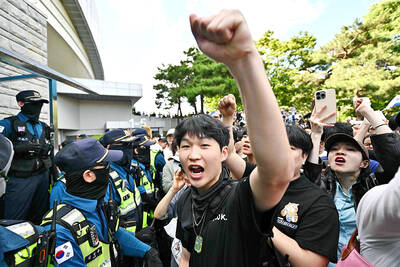
‘ABSURD MISTAKE’: The election commission said that there had been a failure to anticipate turnout after 14 polling stations ran short of ballot papers South Korean riot police yesterday cleared protesters from a Seoul polling station after a 35-hour blockade sparked by a shortage of ballot papers during local elections earlier this week. Wednesday’s election was the first nationwide vote since South Korean President Lee Jae-myung took office following the ouster of Yoon Suk-yeol over his short-lived martial law declaration. Lee’s ruling Democratic Party swept most races, but failed to flip the crucial Seoul mayoral seat. The South Korean National Election Commission apologized, blaming a failure to anticipate turnout after 14 polling stations in Seoul ran short of ballot papers. Some polling stations stayed open until 10pm to

France experienced its hottest spring on record, the French weather service said on Tuesday, after an exceptional early heat wave that also broke highs for the season in England and Wales. Meteo-France said the average nationwide temperature over March to May was 13.8°C — about 1.7°C above the norm, and surpassing records set in 2011 and 2020. “The warmest spring since records began in 1900,” it said in a bulletin. All three months were warmer than average, but the onset of an “unprecedented heatwave” late last month pushed the mercury to highs typically seen at the height of the summer. “Our country had never

A Sherpa guide was found crawling to base camp on Mount Everest a week after he went missing and was reunited with his family, who had given up hope he would return. Dawa Sherpa was last seen on Friday last week descending the mountain, but he did not reach base camp even though his client did. The pair were among the last climbers on the mountain as the climbing season came to an end and the route was dismantled. Dawa was located by a cleaning crew on Thursday morning as he was crawling down the snowy slopes around the Khumbu Icefall, just above


 RSS
RSS