


For much of the past century, Asia has been the cradle of influenza, including two of the three major human flu pandemics.
Experts say that given the right conditions, influenza can emerge anywhere, but they say Asia has all the ingredients for spawning flu, such as the outbreak of bird flu now afflicting 10 Asian countries.
All flu viruses probably originate in birds, and the best environment for making the jump to humans is one where densely packed people live closely with birds and animals.
"In Asia we have a huge animal population, a huge bird population and two-thirds of the world's people living there," said Klaus Stohr, chief influenza scientist at the World Health Organization (WHO).
The population of China alone is bigger than that of the whole of Africa, and 80 percent of the new human flu strains the last few decades appeared in China first.
With health officers already leery about a return of SARS, experts are keeping watch on the bird flu in Asia, where the virus has killed millions of chickens, and millions more have been slaughtered in an effort to prevent its spread.
Nine people have died in Vietnam and three in Thailand.
Asia's traditional situation of peasant farmers keeping ducks, chickens and pigs together with the family has long created opportunities for influenza to jump the species barrier.
And now industrial-scale commercial chicken farming is exacerbating the problem, said Robin Weiss, a professor of virology at University College in London.
"We've had nothing like this gigantic chicken breeding in the world before," he said.
As Asia has become not only more populous but also richer and more urbanized, its wealthy citizens demand a more diversified diet, favoring more meat, eggs and dairy products.
To meet that demand, agriculture has undergone a fundamental change, so that even backyard farms have turned almost industrial, filling every square inch with chickens.
"As soon as you have that many animals in one spot you are likely to get into trouble with disease," said Dr. Samuel Jutzi, director of animal production and health at the UN Food and Agriculture Organization (FAO).
From the early 1970s to the early 1990s, per capita consumption of meat, eggs and milk grew about 50 percent in developing countries, leading to big increases in animal herds. Over the last 25 years, the fastest growth has been in the numbers of chickens and pigs, the FAO says.
Asians' fondness for shopping at live animal markets also adds to the chances for flu jumping species, experts say.
And climate may play a role.
"Respiratory viruses, like orchids, do seem to like the Asian climate, because they have influenza viruses nearly all year round. It's not so seasonal as it is in the rest of the world," said John Oxford, a flu expert from Queen Mary School of Medicine in London.
Many scientists believe a major bird migratory pathway from Siberia across Asia could keeps the continent's poultry seeded with the flu virus, which lives naturally in the gut of waterfowl.
Despite Asia's prominent role in spawning flu outbreaks, experts say strains do crop up in other parts of the world.
Scientists are convinced the 1957 Asian flu and 1968 Hong Kong flu pandemics originated in Asia, but there is much debate about where the biggest killer of them all -- the 1918 to 1819 Spanish flu pandemic -- came from.
That flu, which killed an estimated 40 million to 50 million people, was so named because the king of Spain got it, not because it originated in Spain.
"We've got a huge amount of information which tells us this virus arose in Europe, not Asia," Oxford said.
"If it is the case that it started in Europe, that tells us that these new outbreaks could happen anywhere in the world where the circumstances are right," he said.
The Europe theory holds that the Spanish flu began in the crowded World War I army camps around Etaples in northern France.
There were 100,000 soldiers on any one day there, and they raised chickens, geese and possibly pigs for food, Oxford said.
Those conditions mimic what naturally occurs in Asia.
A bird flu strain also arose in the Netherlands last year, albeit of a milder strain. The Dutch may have averted an epidemic by slaughtering their entire chicken population within one week.
"I don't think anyone should always assume that these new outbreaks are exclusive to Asia," Oxford said.
He also warned against judging the seriousness of the Asia's current outbreak too quickly.
While the WHO said Friday that testing indicates the strain so far has not been very successful at jumping to humans, Oxford said flu strains may take a year before they really take off.
"We think these outbreaks in these army camps started in 1917, then it took another year of an extra few mutations before it really exploded into the great wide world," he said.
"That's what could happen in Asia. It could be another year before it really gets moving," he said.
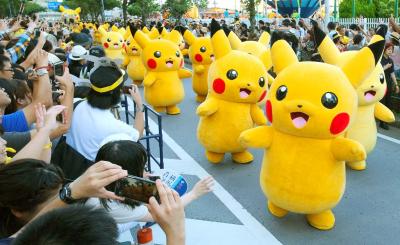
China’s military news agency yesterday warned that Japanese militarism is infiltrating society through series such as Pokemon and Detective Conan, after recent controversies involving events at sensitive sites. In recent days, anime conventions throughout China have reportedly banned participants from dressing as characters from Pokemon or Detective Conan and prohibited sales of related products. China Military Online yesterday posted an article titled “Their schemes — beware the infiltration of Japanese militarism in culture and sports.” The article referenced recent controversies around the popular anime series Pokemon, Detective Conan and My Hero Academia, saying that “the evil influence of Japanese militarism lives on in

DIPLOMATIC THAW: The Canadian prime minister’s China visit and improved Beijing-Ottawa ties raised lawyer Zhang Dongshuo’s hopes for a positive outcome in the retrial China has overturned the death sentence of Canadian Robert Schellenberg, a Canadian official said on Friday, in a possible sign of a diplomatic thaw as Canadian Prime Minister Mark Carney seeks to boost trade ties with Beijing. Schellenberg’s lawyer, Zhang Dongshuo (張東碩), yesterday confirmed China’s Supreme People’s Court struck down the sentence. Schellenberg was detained on drug charges in 2014 before China-Canada ties nosedived following the 2018 arrest in Vancouver of Huawei chief financial officer Meng Wanzhou (孟晚舟). That arrest infuriated Beijing, which detained two Canadians — Michael Spavor and Michael Kovrig — on espionage charges that Ottawa condemned as retaliatory. In January
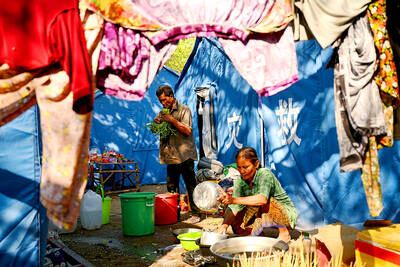
A sign hanging from a rusty ice-green shipping container installed by Thai forces on what they say is the border with Cambodia reads: “Cambodian citizens are strictly prohibited from entering this area.” On opposite sides of the makeshift barricade, fronted by coils of barbed wire, Cambodians lamented their lost homes and livelihoods as Thailand’s military showed off its gains. Thai forces took control of several patches of disputed land along the border during fighting last year, which could amount to several square kilometers in total. Cambodian Kim Ren said her house in Chouk Chey used to stand on what is now the Thai
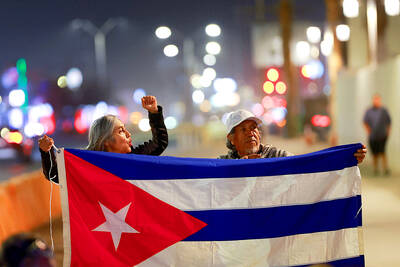
NEW RULES: There would be fewer school days, four-day workweeks, and a reduction in transportation services as the country battles a crisis exacerbated by US pressure The Cuban government on Friday announced emergency measures to address a crippling energy crisis worsened by US sanctions, including the adoption of a four-day work week for state-owned companies and fuel sale restrictions. Cuban Deputy Prime Minister Oscar Perez-Oliva Fraga blamed Washington for the crisis, telling Cuban television the government would “implement a series of decisions, first and foremost to guarantee the vitality of our country and essential services, without giving up on development.” “Fuel will be used to protect essential services for the population and indispensable economic activities,” he said. Among the new measures are the reduction of the working week in


 RSS
RSS