


A senior British judge said yesterday that Prime Minister Tony Blair's government did not act in a "dishonorable, underhand or duplicitous" way in its handling of a British expert on Iraqi weapons who committed suicide.
Appeals judge Lord Hutton strongly criticized the BBC for inaccurately reporting that Blair's government had "sexed up" a dossier on Iraq's weapons before the war with intelligence information it knew to be exaggerated or unreliable. The judge said the BBC report was unfounded, and he criticized BBC editors and officials for failing to fully investigate after the government had complained about it.
The nationally televised decision by Hutton after gathering months of evidence regarding the death of weapons expert David Kelly appeared to exonerate Blair after the biggest crisis of his seven years in office. The BBC report had challenged his integrity and the case he had made for British forces joining the war against Iraq.
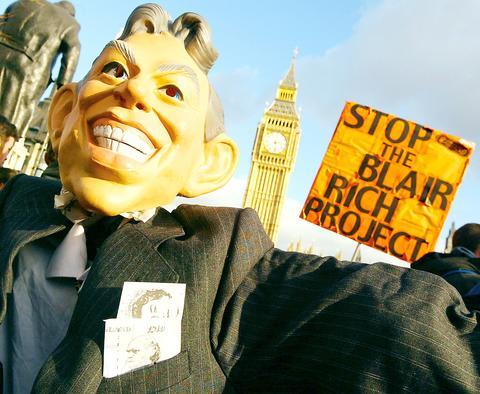
PHOTO: REUTERS
Hutton sharply criticized the publicly funded BBC's "defective" handling of BBC reporter Andrew Gilligan's story, saying the network's editors had failed to properly check his allegations and did not properly investigate the government's complaints about his report.
Hutton criticized the governors of the BBC for failing to make their own detailed investigation to discover whether Gilligan's notes supported his report.
"If they'd had done this, they would probably have discovered that the notes did not support the allegation that the government probably knew that the 45-minutes claim was probably wrong," Hutton said.
Hutton criticized the board "for failing to give proper and adequate consideration to whether the BBC should publicly acknowledge that this very grave allegation should not have been broadcast."
The BBC report had claimed that a government statement that Iraqi forces could deploy weapons of mass destruction within 45 minutes was based on false intelligence that officials knew was unreliable. The report suggested the government "sexed up" or exaggerated its claims about Iraqi weapons to boost the case for war at a time when many people in Britain opposed going to war.
Blair's government denounced the report and demanded a retraction, setting off a huge public dispute with the nation's largest broadcaster.
Critics had accused the government and Blair personally of cynically exposing Kelly to massive media scrutiny, thereby contributing to his death. Kelly's body was found near his home in a rural area in July, his left wrist slashed.
Hutton said the government acted "reasonably" in confirming Kelly's identity after he told his superiors he was probably the source of Gilligan's story. Kelly, however, denied telling Gilligan that the 45-minute claim was false.
The judge said the government would have been guilty of a cover up if it had tried to conceal Kelly's identity.
"The issuing of the statement was not part of a dishonorable or underhand or duplicitous strategy to leak Dr. Kelly's name covertly in order to assist the government in its battle with the BBC," Hutton said.
While largely exonerating the government's handling of the matter, Hutton said Ministry of Defense officials could have given Kelly more help when they confirmed his identity to the media. But Hutton said Kelly was an intensely private man and "not easy to help."
The judge agreed with an expert witness at the inquiry that a loss of self esteem and feelings of hopelessness and despair might have contributed to Kelly's suicide.
Hutton said he was satisfied that nobody involved in the matter could have foreseen that Kelly would take his own life after he was named as the anonymous source of the controversial BBC report.
"I am satisfied that none of the persons whose decisions and actions I later describe ever contemplated that Dr. Kelly might take his own life. I'm further satisfied that none of those persons was at fault in not contemplating that Dr. Kelly might take his own life," Hutton said.
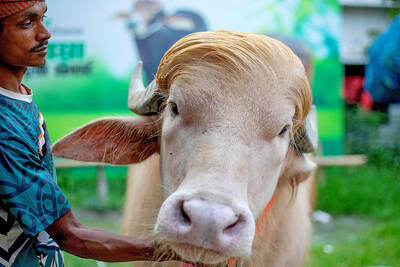
Crowds in Bangladesh are flocking to snap photographs with an unlikely social media star — an albino buffalo with flowing blond hair nicknamed “Donald Trump” that is due to be sacrificed within days. Owner Zia Uddin Mridha, 38, said his brother named the 700kg bull over its flowing helmet of hair resembling the signature look of the US president. “My younger brother picked this name because of the buffalo’s extraordinary hair,” he said at his farm in Narayanganj, just outside the capital, Dhaka. Mridha said that a constant stream of curious visitors — social media fans, onlookers and children — have come throughout
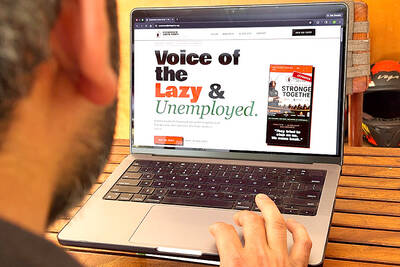
It began as a satirical online project. Now millions of young people in India are flocking to it as an outlet for their frustration. A parody political party called the Cockroach Janta Party, with the insect as its symbol, has exploded across India’s social media by turning absurdist humor into protest. Memes and short videos mocking corruption, joblessness and political dysfunction have flooded social media sites, where millions of users are embracing the cockroach — known for its ability to survive harsh conditions — as a tongue-in-cheek symbol of endurance. The online movement’s rise has been unusually rapid. The Cockroach Janta Party (CJP)
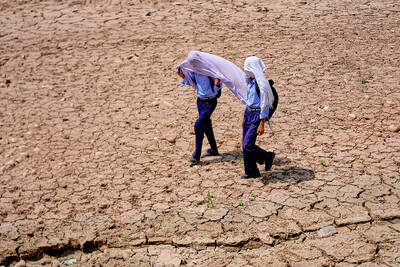
HOTTER: While Indians are accustomed to summer heat, climate change has caused northwestern India to warm faster than other parts of the country, an academic said Roads and markets have emptied during afternoons and some farmers have switched to nighttime work to avoid scorching temperatures as a heat wave grips large parts of India. The India Meteorological Department forecast maximum temperatures for yesterday of about 45°C in the capital, New Delhi, where authorities have opened temporary “cooling zones” to help people cope. The weather department warned that conditions would likely persist across several northern regions in the coming days, with temperatures staying well above seasonal averages. Authorities urged people to stay indoors during the hottest hours and take precautions against heat-related illnesses. India declares a heat wave whenever maximum temperatures
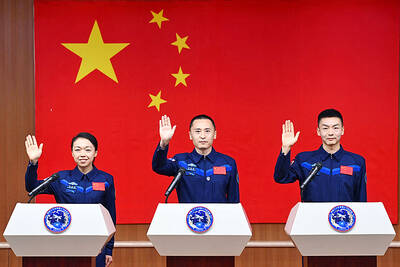
A Hong Kong astronaut is to join a Chinese space mission for the first time as part of a three-person crew launching today, as Beijing edges closer to its goal of landing people on the moon. The Tiangong space station — crewed by teams of three astronauts that are typically rotated every six months — is the crown jewel of China’s space program, boosted by billions in state investment in a bid to catch up with the US and Russia. The Shenzhou-23 mission is to blast off at 11:08pm from the Jiuquan Satellite Launch Center in northwestern China, carrying three astronauts to


 RSS
RSS