


Six coalition soldiers and two CNN employees were killed in Iraq, as the UN said it was returning staff to study the feasibility of swift elections.
And in Washington, the White House denied ever warning that the Iraqi leader posed an "imminent" threat to the US.
Three US soldiers were killed on Tuesday and another critically wounded when a large explosion rocked the restive Euphrates valley town of Khaldiya, patrolled by the 82nd Airborne Division, the US military said.
The attack brought to 243 the number of US soldiers killed in Iraq since US President George W. Bush declared an end to major combat on May 1.
Three coalition soldiers were also killed and three injured by a homemade bomb that hit a night patrol south of Baghdad. A US military spokesman refused to confirm their nationalities.
And a translator/producer and a driver working for the Cable News Network were killed in an ambush in Iraq on Tuesday, the US television company said.
A witness in Khaldiya, 95km west of Baghdad, said US troops also shot dead one Iraqi and wounded another after the explosion halted their convoy.
One Iraqi also died and "several" were hurt in the incident. And in Haditha, 250km west of Baghdad, an Iraqi policeman and an assailant were killed in an attack on a police station.
Despite the latest violence, UN Secretary General Kofi Annan said in a statement released in Paris that he had concluded "that the UN can play a constructive role in helping to find a way out from the current impasse.
"As soon as I have been persuaded that the Coalition Provisional Authority will take adequate measures to assure security, I will send a mission to Iraq as I have been requested," he said.
Annan pulled UN expatriate staff out of Iraq after an August bombing killed his envoy Sergio Vieira de Mello and 21 others at the world body's Baghdad headquarters.
Coalition spokesman Charles Heatly told AFP that security measures demanded by the UN would be met.
The coalition has been placed on the defensive over its plan to hand over sovereignty by June 30 to an unelected government by growing support for a leading Shiite cleric's campaign for immediate polls.
Grand Ayatollah Ali al-Sistani, the country's most influential Shiite cleric, has indicated he will withdraw threats of civil unrest if a UN team rules there is insufficient time to organize fair elections before the handover.
Meanwhile in Washington, the White House -- smarting from the failure so far to find Saddam Hussein's alleged weapons of mass destruction -- denied it had ever warned that the Iraqi leader posed an "imminent" threat to the US.
Yet US President George W. Bush declined to repeat his prediction that US-led forces scouring Iraq will discover the prohibited weapons he cited as the chief reason for the March 2003 invasion.
"There is no doubt in my mind that Saddam Hussein was a grave and gathering threat to America and the world," Bush said during a brief public appearance with visiting Polish President Aleksander Kwasniewski.
The case for war has drawn election-year scrutiny because the former head of the US-led effort to find banned weapons in Iraq, David Kay, said recently that he did not think such stockpiles existed on the eve of the invasion.
White House spokesman Scott McClellan, who also refused to say he thought Kay's successor would succeed, mounted a defense of the administration's pre-war warnings about the threat posed by Saddam.
"I think some in the media have chosen to use the word `imminent.' Those were not words we used. We used `grave and gathering' threat," he insisted.
But the alleged WMDs are not in Syria, as Kay also suggested, said top Syrian officials.
"Accusations leveled at Syria [in respect to Iraqi WMDs] are unfounded," Syrian Prime Minister Mohammad Naji Otri told Dubai-based Al-Arabiya satellite TV.
Otri also said there was also no basis to charges that foreign fighters were crossing from Syria into Iraq to attack coalition forces.
"We have absolutely nothing to do with what is going on in Iraq now in terms of operations in response to the occupation of Iraq," he said.
Syrian Information Minister Ahmad al-Hassan on Sunday blasted Kay's allegations as "baseless deception and lies."
The aim "is to cover up their failure to find any weapons of mass destruction, the pretext they advanced for going to war," Hassan said.
In London, a judicial inquiry into the suicide of weapons expert David Kelly has cleared British Prime Minister Tony Blair and his government of "dishonorable conduct" or embellishing its September, 2002 dossier on Iraq and weapons of mass destruction, the Sun newspaper reported yesterday.
The tabloid said it had seen extracts of the conclusions of the report which Lord Brian Hutton was to make public at 12:30pm yesterday. Blair was to make a statement in parliament 90 minutes later.
Kelly, a respected Ministry of Defence expert on biological weapons, killed himself last July a few days after he was exposed as the source of a BBC radio report in May which alleged that Blair's government had "sexed up" a September, 2002 dossier on Iraq and weapons of mass destruction.
His suicide hurled Blair into the worst crisis since taking office in 1997.
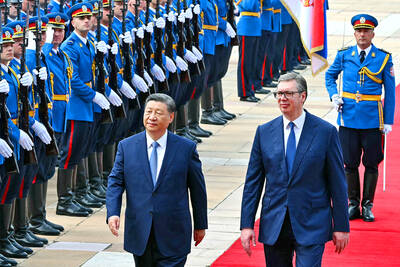
MONEY MATTERS: Xi was to highlight projects such as a new high-speed railway between Belgrade and Budapest, as Serbia is entirely open to Chinese trade and investment Serbian President Aleksandar Vucic yesterday said that “Taiwan is China” as he made a speech welcoming Chinese President Xi Jinping (習近平) to Belgrade, state broadcaster Radio Television of Serbia (RTS) said. “We have a clear and simple position regarding Chinese territorial integrity,” he told a crowd outside the government offices while Xi applauded him. “Yes, Taiwan is China.” Xi landed in Belgrade on Tuesday night on the second leg of his European tour, and was greeted by Vucic and most government ministers. Xi had just completed a two-day trip to France, where he held talks with French President Emmanuel Macron as the
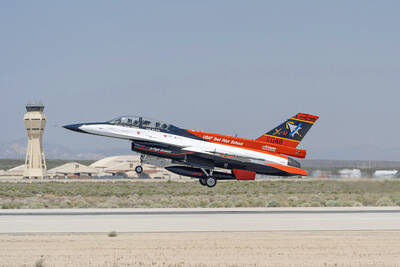
With the midday sun blazing, an experimental orange and white F-16 fighter jet launched with a familiar roar that is a hallmark of US airpower, but the aerial combat that followed was unlike any other: This F-16 was controlled by artificial intelligence (AI), not a human pilot, and riding in the front seat was US Secretary of the Air Force Frank Kendall. AI marks one of the biggest advances in military aviation since the introduction of stealth in the early 1990s, and the US Air Force has aggressively leaned in. Even though the technology is not fully developed, the service is planning
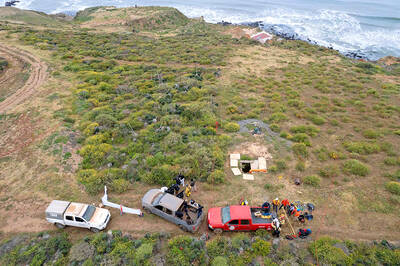
INTERNATIONAL PROBE: Australian and US authorities were helping coordinate the investigation of the case, which follows the 2015 murder of Australian surfers in Mexico Three bodies were found in Mexico’s Baja California state, the FBI said on Friday, days after two Australians and an American went missing during a surfing trip in an area hit by cartel violence. Authorities used a pulley system to hoist what appeared to be lifeless bodies covered in mud from a shaft on a cliff high above the Pacific. “We confirm there were three individuals found deceased in Santo Tomas, Baja California,” a statement from the FBI’s office in San Diego, California, said without providing the identities of the victims. Australian brothers Jake and Callum Robinson and their American friend Jack Carter
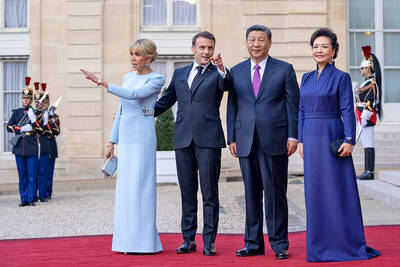
CUSTOMS DUTIES: France’s cognac industry was closely watching the talks, fearing that an anti-dumping investigation opened by China is retaliation for trade tensions French President Emmanuel Macron yesterday hosted Chinese President Xi Jinping (習近平) at one of his beloved childhood haunts in the Pyrenees, seeking to press a message to Beijing not to support Russia’s war against Ukraine and to accept fairer trade. The first day of Xi’s state visit to France, his first to Europe since 2019, saw respectful, but sometimes robust exchanges between the two men during a succession of talks on Monday. Macron, joined initially by EU Commission President Ursula von der Leyen, urged Xi not to allow the export of any technology that could be used by Russia in its invasion


 RSS
RSS