


Twenty-five years ago, China's political elite gathered for a four-day meeting that would eventually turn out to have world-transforming potential.
Although it is not commemorated in the manner of D-Day or the Kennedy assassination, the Third Plenum of the 11th Communist Party Congress, which opened on Dec. 18, 1978, ranks among the most significant events of the 20th century.
The gathering ushered in an era of economic reform, but did not match it with political freedom, leaving many a quarter century later with a painful sense of wasted opportunities.
"Of course, I'm disappointed," said Bao Tong (
"They didn't take the road of democracy, and that's a real pity," he said.
The Third Plenum came as a breath of fresh air at a time when China had exhausted itself in futile ideological struggles over the decade-long Cultural Revolution.
It set in stone the victory of reform champion Deng Xiaoping (
At the end of the plenum, a string of measures were adopted that in retrospect formed the seeds of a revolution that would lift hundreds of millions out of poverty.
The economy was to be run according to what worked in practice, officials were to be rewarded according to their performance, and strongman rule was to be abandoned for collective leadership.
The meeting set in motion events that not only transformed China, but the whole world as it signaled the end of a generation of self-imposed isolation from the global market economy.
"It was a starting point for the rise of China and for the reemergence of China as a global player," said David Zweig, a political scientist at the Hong Kong University of Science and Technology.
"And the reemergence of China is one of the two or three most important events in the latter half of the 20th century. It will have dramatic effects on the entire history of the 21st century," he said.
For China, it was a last chance to take part in the massive expansion of Asian wealth.
Many observers had expected China to also jump on the democracy wave that hit southern Europe in the 1970s and the Soviet bloc a decade later.
But that was not to happen, as the massacre of pro-democracy demonstrators in and around Tiananmen Square in 1989 was to make clear.
"They should have set up a democratic system," Bao said, who became the highest-ranking official to wind up in jail after the Tiananmen crackdown.
"It's very sad," he said.
As good Marxists, many Chinese assumed democracy was inevitable, and that the political system would sooner or later reflect the freed-up economy, said Frank Lu, a Chinese who now heads a rights group based in Hong Kong.
"The idea was that once the economy had been reformed, political reform would follow as a matter of course. But it didn't happen," he said.
With 67 million members, the Chinese Communist Party today is a huge organization vigorously defending its own interests, which do not include the introduction of democracy, Lu said.
"As long as this system persists, it's hard to bring about any change, no matter how much the economy is reformed," he said.
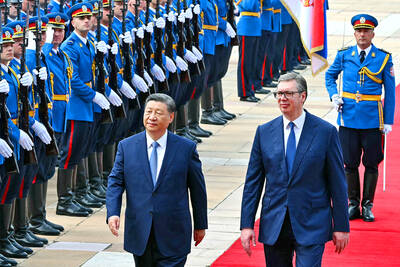
MONEY MATTERS: Xi was to highlight projects such as a new high-speed railway between Belgrade and Budapest, as Serbia is entirely open to Chinese trade and investment Serbian President Aleksandar Vucic yesterday said that “Taiwan is China” as he made a speech welcoming Chinese President Xi Jinping (習近平) to Belgrade, state broadcaster Radio Television of Serbia (RTS) said. “We have a clear and simple position regarding Chinese territorial integrity,” he told a crowd outside the government offices while Xi applauded him. “Yes, Taiwan is China.” Xi landed in Belgrade on Tuesday night on the second leg of his European tour, and was greeted by Vucic and most government ministers. Xi had just completed a two-day trip to France, where he held talks with French President Emmanuel Macron as the

With the midday sun blazing, an experimental orange and white F-16 fighter jet launched with a familiar roar that is a hallmark of US airpower, but the aerial combat that followed was unlike any other: This F-16 was controlled by artificial intelligence (AI), not a human pilot, and riding in the front seat was US Secretary of the Air Force Frank Kendall. AI marks one of the biggest advances in military aviation since the introduction of stealth in the early 1990s, and the US Air Force has aggressively leaned in. Even though the technology is not fully developed, the service is planning
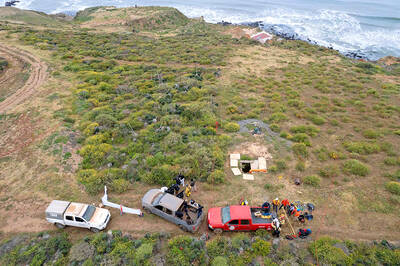
INTERNATIONAL PROBE: Australian and US authorities were helping coordinate the investigation of the case, which follows the 2015 murder of Australian surfers in Mexico Three bodies were found in Mexico’s Baja California state, the FBI said on Friday, days after two Australians and an American went missing during a surfing trip in an area hit by cartel violence. Authorities used a pulley system to hoist what appeared to be lifeless bodies covered in mud from a shaft on a cliff high above the Pacific. “We confirm there were three individuals found deceased in Santo Tomas, Baja California,” a statement from the FBI’s office in San Diego, California, said without providing the identities of the victims. Australian brothers Jake and Callum Robinson and their American friend Jack Carter
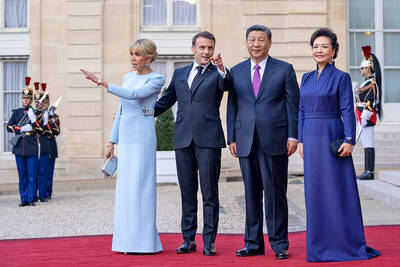
CUSTOMS DUTIES: France’s cognac industry was closely watching the talks, fearing that an anti-dumping investigation opened by China is retaliation for trade tensions French President Emmanuel Macron yesterday hosted Chinese President Xi Jinping (習近平) at one of his beloved childhood haunts in the Pyrenees, seeking to press a message to Beijing not to support Russia’s war against Ukraine and to accept fairer trade. The first day of Xi’s state visit to France, his first to Europe since 2019, saw respectful, but sometimes robust exchanges between the two men during a succession of talks on Monday. Macron, joined initially by EU Commission President Ursula von der Leyen, urged Xi not to allow the export of any technology that could be used by Russia in its invasion


 RSS
RSS