


Scientists launched a scathing attack Saturday on a leading US academic for spending thousands of dollars on newspaper advertisements to denounce the Nobel Prize committee for ignoring his work.
In one of the most vitriolic acts of academic indignation on record, Raymond Damadian -- a pioneer of magnetic resonance imaging -- last week bitterly criticized the committee for giving the prize for medicine to Britain's Peter Mansfield and America's Paul Lauterbur, to be presented in Stockholm on Wednesday.
But the suggestion that the Nobel committee had behaved improperly has infuriated the scientific community. Far from being a maverick genius who created brain and body scanners years ahead of anyone else, Damadian played only a peripheral role in developing magnetic resonance imagers, they argue.
"Damadian's claims have tarnished Peter Mansfield's superb achievements for Britain," said Peter Morris, professor of physics at Nottingham University. "Yes, Damadian did some good work, but he is claiming ownership of the whole field. In fact, it was Mansfield and Lauterbur who did the crucial research."
This view was shared by Mick Brammer, professor of neuro-imaging at King's College, London.
"This is just a very expensive way of expressing sour grapes. He may have done good work, but he didn't develop MRI in the way Mansfield did. Thanks to Mansfield, we can see people's brain centers switch on as they carry out different mental tasks."
Equally dismissive was Colin Blakemore, head of Britain's Medical Research Council.
"Frankly, it is quite extraordinary to petition for a Nobel Prize on your own behalf. The development of these scanners involved input from thousands of scientists. The committee has looked at those and concluded that Mansfield and Lauterbur stand out, and I trust their decision and expertise."
As another MRI expert put it: "This is simply an attempt to buy a Nobel Prize. You can't do that."
No one doubts the importance of Damadian's work. In 1970, he discovered that differences between cancerous and normal tissue could be identified using nuclear magnetic resonance. But it was the work of Lauterbur and Mansfield which allowed the development of machines that used radio waves to "tune" hydrogen atoms in different parts of the body and detect the resulting emissions in scanners, thus allowing doctors to monitor mental and bodily functions in living patients.
The first MRI scanners were made in the 1980s. Last year, 22,000 were used to perform 60 million operations.
Damadian owns several patents for scanners, which have made him a rich man. His company, Fonar Corporation, has paid an estimated ?290,000 (US$502,000) for his adverts, in which he claimed the omission was "a flagrant violation" of the principles of the Nobel award. "Had I never been born, there would be no MRI today," he said.
However, his prospects of changing the committee's minds are remote. Despite a history of furious condemnations of awards, it has never rescinded a decision. The row adds a chapter to the already bulging book of controversies that have dogged the Nobel Prize.
British cosmologist Fred Hoyle played a key role in explaining how elements formed in the early universe. He was excluded from a Nobel Prize, even though his co-workers, who played less pivotal roles, were honored.
Hoyle was famously intemperate in his views about the committee and they repaid this by ignoring him. Now Damadian -- a creationist who believes the world is only 6,000 years old -- is claiming he is also being shunned for his beliefs.
Few scientists sympathize. As one said on Saturday: "He should practise what he preaches and turn the other cheek."
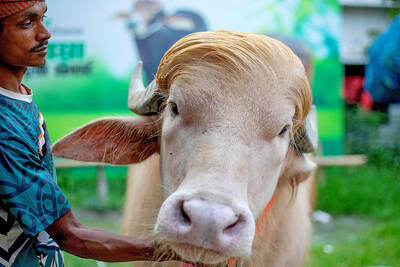
Crowds in Bangladesh are flocking to snap photographs with an unlikely social media star — an albino buffalo with flowing blond hair nicknamed “Donald Trump” that is due to be sacrificed within days. Owner Zia Uddin Mridha, 38, said his brother named the 700kg bull over its flowing helmet of hair resembling the signature look of the US president. “My younger brother picked this name because of the buffalo’s extraordinary hair,” he said at his farm in Narayanganj, just outside the capital, Dhaka. Mridha said that a constant stream of curious visitors — social media fans, onlookers and children — have come throughout

It began as a satirical online project. Now millions of young people in India are flocking to it as an outlet for their frustration. A parody political party called the Cockroach Janta Party, with the insect as its symbol, has exploded across India’s social media by turning absurdist humor into protest. Memes and short videos mocking corruption, joblessness and political dysfunction have flooded social media sites, where millions of users are embracing the cockroach — known for its ability to survive harsh conditions — as a tongue-in-cheek symbol of endurance. The online movement’s rise has been unusually rapid. The Cockroach Janta Party (CJP)

HOTTER: While Indians are accustomed to summer heat, climate change has caused northwestern India to warm faster than other parts of the country, an academic said Roads and markets have emptied during afternoons and some farmers have switched to nighttime work to avoid scorching temperatures as a heat wave grips large parts of India. The India Meteorological Department forecast maximum temperatures for yesterday of about 45°C in the capital, New Delhi, where authorities have opened temporary “cooling zones” to help people cope. The weather department warned that conditions would likely persist across several northern regions in the coming days, with temperatures staying well above seasonal averages. Authorities urged people to stay indoors during the hottest hours and take precautions against heat-related illnesses. India declares a heat wave whenever maximum temperatures
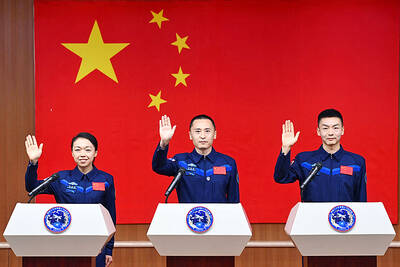
A Hong Kong astronaut is to join a Chinese space mission for the first time as part of a three-person crew launching today, as Beijing edges closer to its goal of landing people on the moon. The Tiangong space station — crewed by teams of three astronauts that are typically rotated every six months — is the crown jewel of China’s space program, boosted by billions in state investment in a bid to catch up with the US and Russia. The Shenzhou-23 mission is to blast off at 11:08pm from the Jiuquan Satellite Launch Center in northwestern China, carrying three astronauts to


 RSS
RSS