


In America the relationship between big business and politics may be cozy; in Russia it is fast becoming intimate.
The nation's largest businesses -- from oil giants to banks to manufacturers -- have not only poured money into the parliamentary elections to be held on Sunday, but have also filled party tickets with dozens of their executives.
Yukos Oil, whose former chairman, Mikhail Khodorkovsky, is in prison on charges widely viewed as politically motivated, has executives running as candidates not only for the liberal Yabloko party, but also for the communists and for United Russia, the party loyal to President Vladimir Putin.
The prosecutorial assault on Khodorkovsky -- one of a cadre of wealthy businessmen know derisively as oligarchs -- has been seen as a broader assault on big business in Russia. But in fact big business has become more closely intertwined with politics than ever.
While the popularity of Putin and United Russia appear to have been strengthened by the investigation of Khodorkovsky, the party has its own candidates from prominent companies controlled by other oligarchs as well.
Two oil companies, TNK and Lukoil, have executives running on the party's ticket, as do Russian Aluminum and the steel giant Severstal. An analysis of United Russia's federal and regional party lists by The Moscow Times showed that more than a quarter of United Russia's parliamentary candidates represented big businesses.
Perhaps to hedge its bet, TNK also has a spot on the communist ticket, while Russian Aluminum's deputy general director is running as a candidate of the Liberal Democratic Party, led by the strident nationalist Vladimir Zhirinovsky.
Twelve years after the collapse of the Soviet one-party state, big business has now become by far the most influential force in Russia's elections, providing money and candidates but also profoundly altering party platforms and, in some cases, turning upside down traditional ideologies.
The election on Sunday -- in which 23 parties are vying for all 450 seats of the lower house of parliament -- represents a critical turn for Russia and for Putin, who is universally expected to win a second term in the presidential election next March.
Although not officially a member of any party, Putin has thrown his power and popularity behind United Russia, mostly recently in remarks broadcast on Friday, saying that a centrist majority led by the party was essential to the economic and bureaucratic reforms he vowed to pursue in a second term.
Regardless of which party wins the most seats, the nation's largest companies appear certain to be well represented in the new parliament, wielding enough influence to propose or block legislation affecting corporate interests, from taxes to regulation of natural resources.
Dmitri Orlov, deputy director of the Center for Political Technologies in Moscow, predicted that executives would win more than 20 percent of parliament's 450 seats. Another 40 percent could end up in the hands of what he called "hidden lobbyists," candidates supported by businesses to protect the interests of specific industries.
"It is not a new phenomenon," Orlov said of the role of big business in Russia's politics. "It was known in 1995 and 1999, but it has only achieved such a scale in this election."
Khodorkovsky's efforts to influence parliament, particularly in blocking a new law on oil production earlier this year, are widely viewed as a catalyst for the sweeping investigation of alleged tax evasion and fraud that has put him in a Moscow prison.
Khodorkovsky also openly contributed money to two liberal parties, Yabloko and the Union of Right Forces, to try to create a solid bloc of legislators opposed to Putin.
Grigory Yavlinsky, the leader of Yabloko, acknowledged in a recent television interview that the party had included three Yukos executives on its federal list of candidates as a condition of Khodorkovsky's contributions.
Khodorkovsky's many critics have accused him of trying to buy a controlling majority.
The extent of executives' participation in the election is a result of a new law requiring candidates to declare their incomes and employers. If elected, executives are required to resign from their companies, but they can keep their shares and other holdings, and analysts say that many severe their ties to business only nominally.
The Communist Party has found itself on the defensive because of its embrace of business. State-controlled television has featured critical stories of the executives on its ticket.
One of them is Aleksei Kondaurov, who occupies the 13th spot on the Communist Party's federal list. Since half of the parliament's seats are proportioned based on parties' total votes, with the other half chosen by districts, Kondaurov is virtually assured election. He is also an executive of Yukos-Moscow, the oil company's main subsidiary.
It is one measure of the ideological upheaval in Russian politics that he argues that the Communist Party is now the party of business.
"Today's Communist Party does not reject private property," he said. "It does not reject the mechanisms for market development. The Communist Party is for the strengthening of democratic institutions and the development of civil society."
Kondaurov's candidacy and that of other executives have exposed deep divisions within a party still struggling to formulate a post-Soviet message.
Leonid Mayevsky, a communist deputy in the current Parliament, publicly criticized the party at a news conference earlier this month, saying that 28 percent of its candidates were millionaires.
"Is this the party of the people or of the millionaires?" he asked.
He was promptly expelled from the party.
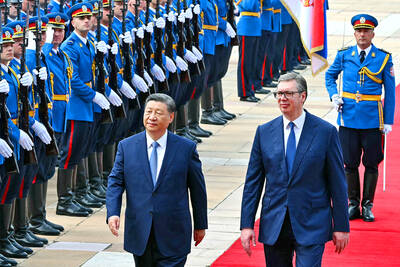
MONEY MATTERS: Xi was to highlight projects such as a new high-speed railway between Belgrade and Budapest, as Serbia is entirely open to Chinese trade and investment Serbian President Aleksandar Vucic yesterday said that “Taiwan is China” as he made a speech welcoming Chinese President Xi Jinping (習近平) to Belgrade, state broadcaster Radio Television of Serbia (RTS) said. “We have a clear and simple position regarding Chinese territorial integrity,” he told a crowd outside the government offices while Xi applauded him. “Yes, Taiwan is China.” Xi landed in Belgrade on Tuesday night on the second leg of his European tour, and was greeted by Vucic and most government ministers. Xi had just completed a two-day trip to France, where he held talks with French President Emmanuel Macron as the

With the midday sun blazing, an experimental orange and white F-16 fighter jet launched with a familiar roar that is a hallmark of US airpower, but the aerial combat that followed was unlike any other: This F-16 was controlled by artificial intelligence (AI), not a human pilot, and riding in the front seat was US Secretary of the Air Force Frank Kendall. AI marks one of the biggest advances in military aviation since the introduction of stealth in the early 1990s, and the US Air Force has aggressively leaned in. Even though the technology is not fully developed, the service is planning
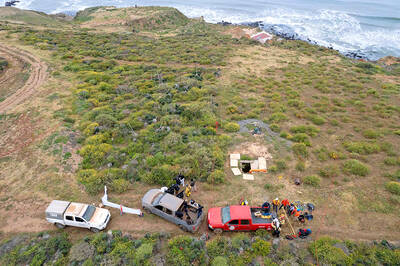
INTERNATIONAL PROBE: Australian and US authorities were helping coordinate the investigation of the case, which follows the 2015 murder of Australian surfers in Mexico Three bodies were found in Mexico’s Baja California state, the FBI said on Friday, days after two Australians and an American went missing during a surfing trip in an area hit by cartel violence. Authorities used a pulley system to hoist what appeared to be lifeless bodies covered in mud from a shaft on a cliff high above the Pacific. “We confirm there were three individuals found deceased in Santo Tomas, Baja California,” a statement from the FBI’s office in San Diego, California, said without providing the identities of the victims. Australian brothers Jake and Callum Robinson and their American friend Jack Carter
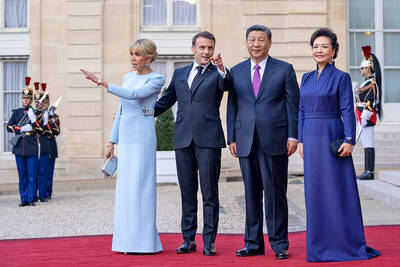
CUSTOMS DUTIES: France’s cognac industry was closely watching the talks, fearing that an anti-dumping investigation opened by China is retaliation for trade tensions French President Emmanuel Macron yesterday hosted Chinese President Xi Jinping (習近平) at one of his beloved childhood haunts in the Pyrenees, seeking to press a message to Beijing not to support Russia’s war against Ukraine and to accept fairer trade. The first day of Xi’s state visit to France, his first to Europe since 2019, saw respectful, but sometimes robust exchanges between the two men during a succession of talks on Monday. Macron, joined initially by EU Commission President Ursula von der Leyen, urged Xi not to allow the export of any technology that could be used by Russia in its invasion


 RSS
RSS