


Should you be walking around the streets of Vietnam's major cities late at night, don't be surprised if you are nearly bowled over by a pack of youths speeding past on motorbikes.
Over the past decade, Vietnam's younger generation have satisfied their rebellious streak and quenched their frustration at living in a controlled communist society by taking part in death-defying high-speed races.
Sometimes racing in pairs or as part of a larger group, they reach terrifying speeds on their Japanese motorbikes as they tear around city streets that during the day are usually gridlocked with slow-moving traffic.
Crash helmets are shunned, fawning girls often ride pillion, and brakes are sometimes deliberately disabled to add spice to the proceedings.
Gambling stakes on the races can reach thousands of dollars, and not surprisingly, accidents, when they occur, are often fatal.
Racing has grown hand-in-hand with rising disposable incomes, particularly in Vietnam's big cities of Hanoi and Ho Chi Minh City where fast motorbikes have become a status symbol among well-to-do youths wanting to show off their wealth and virility.
"Apart from girls, music and karaoke, they have nothing to do in their free time," said a Ho Chi Minh City-based diplomat.
"They feel a strong need to get rid of their energy in the face of high-pressure school and university studies ... and the suffocating closeness of the family. There comes a time when it is necessary to burst," he said.
Last month, seven men aged between 18 and 22 were given 10 to 30 month prison sentences for taking part in a race around the streets of Hanoi to cap a day of celebrations marking the communist nation's Sept. 2 National Day.
In the lead up to the Southeast Asian Games, which Vietnam is hosting in December for the first time, authorities have launched a nationwide campaign to stamp out the phenomenon.
"The fight against illegal motorbike races is part of a plan by the city's police force to restore order and road safety during the SEA Games," said Lieutenant-Colonel Nguyen Duc Chung, deputy head of Hanoi's police investigations department.
But the fight is far from being won as information on where races are going to take place often comes too late for police to stop them. Even then, the participants are sometimes able to speed off, leaving exasperated policemen trailing in their wake.
To address the problem, the deputy director of Hanoi police, Colonel Nguyen Duc Nhanh, has recently said that discussions were underway about equipping police with special South Korean-made guns that fire rubber pellets.
When fired, racers and their motorbikes would be daubed in a special chemical, traces of which can only be removed by police, he said.

MONEY MATTERS: Xi was to highlight projects such as a new high-speed railway between Belgrade and Budapest, as Serbia is entirely open to Chinese trade and investment Serbian President Aleksandar Vucic yesterday said that “Taiwan is China” as he made a speech welcoming Chinese President Xi Jinping (習近平) to Belgrade, state broadcaster Radio Television of Serbia (RTS) said. “We have a clear and simple position regarding Chinese territorial integrity,” he told a crowd outside the government offices while Xi applauded him. “Yes, Taiwan is China.” Xi landed in Belgrade on Tuesday night on the second leg of his European tour, and was greeted by Vucic and most government ministers. Xi had just completed a two-day trip to France, where he held talks with French President Emmanuel Macron as the

With the midday sun blazing, an experimental orange and white F-16 fighter jet launched with a familiar roar that is a hallmark of US airpower, but the aerial combat that followed was unlike any other: This F-16 was controlled by artificial intelligence (AI), not a human pilot, and riding in the front seat was US Secretary of the Air Force Frank Kendall. AI marks one of the biggest advances in military aviation since the introduction of stealth in the early 1990s, and the US Air Force has aggressively leaned in. Even though the technology is not fully developed, the service is planning
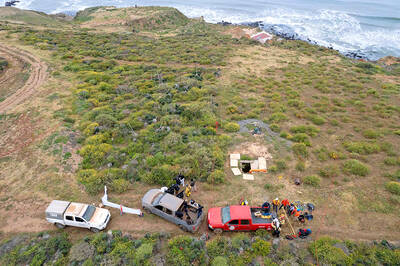
INTERNATIONAL PROBE: Australian and US authorities were helping coordinate the investigation of the case, which follows the 2015 murder of Australian surfers in Mexico Three bodies were found in Mexico’s Baja California state, the FBI said on Friday, days after two Australians and an American went missing during a surfing trip in an area hit by cartel violence. Authorities used a pulley system to hoist what appeared to be lifeless bodies covered in mud from a shaft on a cliff high above the Pacific. “We confirm there were three individuals found deceased in Santo Tomas, Baja California,” a statement from the FBI’s office in San Diego, California, said without providing the identities of the victims. Australian brothers Jake and Callum Robinson and their American friend Jack Carter

CUSTOMS DUTIES: France’s cognac industry was closely watching the talks, fearing that an anti-dumping investigation opened by China is retaliation for trade tensions French President Emmanuel Macron yesterday hosted Chinese President Xi Jinping (習近平) at one of his beloved childhood haunts in the Pyrenees, seeking to press a message to Beijing not to support Russia’s war against Ukraine and to accept fairer trade. The first day of Xi’s state visit to France, his first to Europe since 2019, saw respectful, but sometimes robust exchanges between the two men during a succession of talks on Monday. Macron, joined initially by EU Commission President Ursula von der Leyen, urged Xi not to allow the export of any technology that could be used by Russia in its invasion


 RSS
RSS