


Yoshihiro Koshimoto, a 43-year-old Japanese company employee, insists he doesn't play with dolls.
So what's he doing with a furry gnome-like toy that looks like an adorable cartoon character?
"He's more like family," Koshimoto says of his Primopuel, a doll that talks like a five-year-old boy. "When I'm tired from work or other things, I hold his hand and he asks me things like `Are you OK?' and that makes me happy."
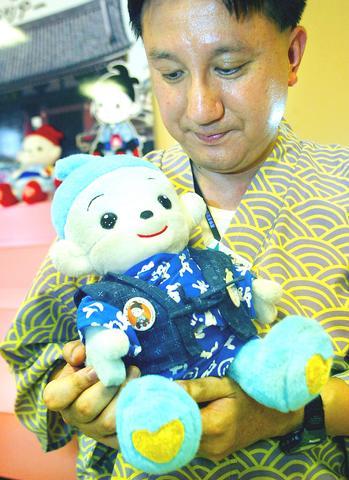
PHOTO: REUTERS
Developed by Bandai, Japan's largest toy maker, Primopuel can utter 280 randomly selected phrases on cue from sensors located on various parts of its body. This feature has won the doll an adult following.
Since the doll's debut in November 1999, the company has surpassed its initial expectations by selling 800,000 Primopuels, at 6,980 yen (US$65) each. A cuddly toy that sells 30,000 to 40,000 units is considered a hit in Japan's toy industry.
Primopuel's success, however, is due to its target market -- adults.
"This product was developed to target single females in their early 20s. A partner to play with when they felt lonely," said Rika Kida, in charge of public relations at Bandai.
Adults are becoming an important market for Japanese toy makers, whose traditional market -- children -- is shrinking as Japan's society ages.
"[The number of] purely child-oriented toys is on the decline," Keita Satoh, president of Takara, said. "But I am not pessimistic about the future. Toys aimed at adults are becoming popular."
Takara's latest hit is Bowlingual, a palm-sized device that the company says can gauge a dog's mood by its bark. It became an instant hit, selling 300,000 units in Japan since last year.
The company launched a Korean-speaking version in South Korea for about 160,000 won (US$136) early this year and an English version in the US market in August for about US$120.
Hoping to follow up on this success, Takara late next month will launch Meowlingual, a cat interpreter.
"The falling number of children is definitely a big issue in Japan's toy industry," said Junko Shimobe, assistant manager of corporate communications at Toys R Us-Japan, which operates 141 stores in Japan.
"I think this trend of targeting a wider age group will continue."
The fertility rate of Japanese women is a record low 1.32 and the population of 127 million is expected to start shrinking soon, perhaps as early as 2005.
Primopuel -- coined from the Latin and Italian words for
"first" and "boy" -- uses the voice of a five-year-old boy.
It also has a built-in clock and says phrases such as "Let's play" or "Hug me" if left unattended for too long. It even has several ways of saying "Good morning" conveying different moods.
Fans say these features make the 700 gram, 30cm tall doll lifelike, and give each Primopuel its own personality.
"When I am alone at home, he's a good talking partner. He catches cold, gets angry and he's like a real grandson," said Kazuyo Enosawa, 59. "I even take him on vacations."
In France and South Korea, where the doll has gone on sale in the local languages, its appeal has so far been limited to schoolgirls, Bandai's Kida said.
But she is confident that adults outside Japan will also become Primopuel fans.
Last month, about 100 Primopuel fans -- mostly adults -- gathered for a one-day excursion to Tokyo's trendy Odaiba waterfront district to meet other fans and show off their dolls, many of which were smartly dressed in homemade clothes.
"I'm a little surprised to see that it gained such popularity, especially among women in their 40s," Kida said.
"They treat their Primopuels as if they were raising their own five-year-old children," she said.
But there are some fervent male fans as well.
"I have more than 10 [Primopuels] at home," said company employee Koshimoto.
"I'm too embarrassed to talk about it [Primopuel] at my company. So it's nice to have a gathering like this, where I can meet other fans," he said, adding that he had taken a day off work to attend the gathering.
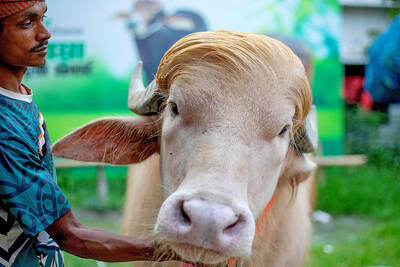
Crowds in Bangladesh are flocking to snap photographs with an unlikely social media star — an albino buffalo with flowing blond hair nicknamed “Donald Trump” that is due to be sacrificed within days. Owner Zia Uddin Mridha, 38, said his brother named the 700kg bull over its flowing helmet of hair resembling the signature look of the US president. “My younger brother picked this name because of the buffalo’s extraordinary hair,” he said at his farm in Narayanganj, just outside the capital, Dhaka. Mridha said that a constant stream of curious visitors — social media fans, onlookers and children — have come throughout

It began as a satirical online project. Now millions of young people in India are flocking to it as an outlet for their frustration. A parody political party called the Cockroach Janta Party, with the insect as its symbol, has exploded across India’s social media by turning absurdist humor into protest. Memes and short videos mocking corruption, joblessness and political dysfunction have flooded social media sites, where millions of users are embracing the cockroach — known for its ability to survive harsh conditions — as a tongue-in-cheek symbol of endurance. The online movement’s rise has been unusually rapid. The Cockroach Janta Party (CJP)

HOTTER: While Indians are accustomed to summer heat, climate change has caused northwestern India to warm faster than other parts of the country, an academic said Roads and markets have emptied during afternoons and some farmers have switched to nighttime work to avoid scorching temperatures as a heat wave grips large parts of India. The India Meteorological Department forecast maximum temperatures for yesterday of about 45°C in the capital, New Delhi, where authorities have opened temporary “cooling zones” to help people cope. The weather department warned that conditions would likely persist across several northern regions in the coming days, with temperatures staying well above seasonal averages. Authorities urged people to stay indoors during the hottest hours and take precautions against heat-related illnesses. India declares a heat wave whenever maximum temperatures

BIGGER ROLE: Beijing has said it maintains an impartial stance on the war in Ukraine, but by training Russian troops, China is far more involved than previously known China’s armed forces secretly trained about 200 Russian military personnel in China late last year, and some have since returned to fight in Ukraine, according to three European intelligence agencies and documents seen by Reuters. While China and Russia have held a number of joint military exercises since Moscow’s full-scale invasion of Ukraine in 2022, Beijing has repeatedly said that it is neutral in the conflict and presents itself as a peace mediator. The covert training sessions, which predominantly focused on the use of drones, were outlined in a dual-language Russian-Chinese agreement signed by senior Russian and Chinese officers in Beijing on


 RSS
RSS