


The Pentagon and White House on Wednesday defended a memorandum from Secretary of Defense Donald Rumsfeld to top defense officials questioning progress in the war on terrorism and warning that the US faced "a long, hard slog" in Iraq and Afghanistan.
Sharply diverging from more upbeat public comments, Rumsfeld wrote it was not possible to transform the Defense Department quickly enough to effectively fight the anti-terrorism war.
US President George W. Bush seized on the overall message of the memo -- that the war on terrorism will be long and hard -- to say that he could not agree more.
"I haven't seen the secretary's comments, but somebody told me they thought he said we need to make sure our military's intelligence services are focused on the war on terror. And I couldn't agree more with you. That's exactly what we're doing," Bush told reporters who asked him about the memo in Canberra, Australia.
Posing challenging questions to the military Joint Chiefs of Staff and others in the memo, dated Oct. 16 and released on Wednesday, Rumsfeld said the US had no yardstick for measuring progress in the anti-terrorism war launched after September 2001 attacks.
The Pentagon and the White House said the memo properly raised issues for Pentagon leaders to consider.
Rumsfeld, speaking to reporters after a closed briefing for senators, said the memo was an effort to raise questions.
"Sometimes one needs to say to a big institution: Hey, wait a minute. Let's lift our eyes up and look out across the horizon and say, `Are there questions that we ought to be asking ourselves? Are there things that we ought to think about ways to do differently?'" he said.
He said the memo stemmed from reports he had received from combatant commanders around the world, and was sent to "three or four of my closest associates."
In the report, he wrote it was "pretty clear the coalition can win in Afghanistan and Iraq in one way or another, but it will be a long, hard slog."
"My impression is that we have not yet made truly bold moves, although we have made many sensible, logical moves in the right direction, but are they enough?" Rumsfeld wrote, referring to the war on terrorism.
He challenged Pentagon leaders to consider and discuss troubling issues, including whether or not the US was capturing or killing terrorists at a faster rate than they were being created by extremists.
"Are we winning or losing the global war on terrorism? Does the US need to fashion a broad, integrated plan to stop the next generation of terrorists?" he asked.
"The US is putting relatively little effort into a long-range plan, but we are putting a great deal of effort into trying to stop terrorists. The cost-benefit ratio is against us! Our cost is billions against the terrorists' costs of millions."
Rumsfeld cited "mixed results" against the al-Qaeda guerrilla network blamed for the 2001 attacks, "reasonable progress tracking down top Iraqis" and "somewhat slower progress" in apprehending Taliban leaders in Afghanistan.
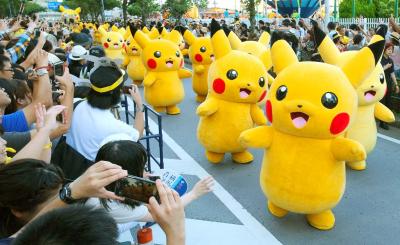
China’s military news agency yesterday warned that Japanese militarism is infiltrating society through series such as Pokemon and Detective Conan, after recent controversies involving events at sensitive sites. In recent days, anime conventions throughout China have reportedly banned participants from dressing as characters from Pokemon or Detective Conan and prohibited sales of related products. China Military Online yesterday posted an article titled “Their schemes — beware the infiltration of Japanese militarism in culture and sports.” The article referenced recent controversies around the popular anime series Pokemon, Detective Conan and My Hero Academia, saying that “the evil influence of Japanese militarism lives on in
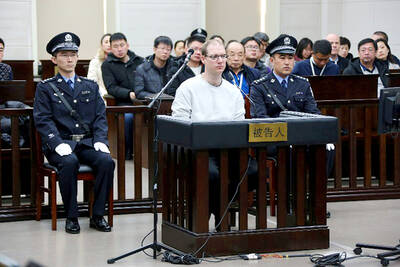
DIPLOMATIC THAW: The Canadian prime minister’s China visit and improved Beijing-Ottawa ties raised lawyer Zhang Dongshuo’s hopes for a positive outcome in the retrial China has overturned the death sentence of Canadian Robert Schellenberg, a Canadian official said on Friday, in a possible sign of a diplomatic thaw as Canadian Prime Minister Mark Carney seeks to boost trade ties with Beijing. Schellenberg’s lawyer, Zhang Dongshuo (張東碩), yesterday confirmed China’s Supreme People’s Court struck down the sentence. Schellenberg was detained on drug charges in 2014 before China-Canada ties nosedived following the 2018 arrest in Vancouver of Huawei chief financial officer Meng Wanzhou (孟晚舟). That arrest infuriated Beijing, which detained two Canadians — Michael Spavor and Michael Kovrig — on espionage charges that Ottawa condemned as retaliatory. In January

A sign hanging from a rusty ice-green shipping container installed by Thai forces on what they say is the border with Cambodia reads: “Cambodian citizens are strictly prohibited from entering this area.” On opposite sides of the makeshift barricade, fronted by coils of barbed wire, Cambodians lamented their lost homes and livelihoods as Thailand’s military showed off its gains. Thai forces took control of several patches of disputed land along the border during fighting last year, which could amount to several square kilometers in total. Cambodian Kim Ren said her house in Chouk Chey used to stand on what is now the Thai
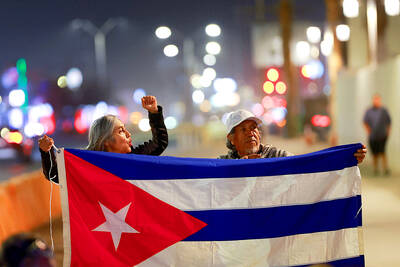
NEW RULES: There would be fewer school days, four-day workweeks, and a reduction in transportation services as the country battles a crisis exacerbated by US pressure The Cuban government on Friday announced emergency measures to address a crippling energy crisis worsened by US sanctions, including the adoption of a four-day work week for state-owned companies and fuel sale restrictions. Cuban Deputy Prime Minister Oscar Perez-Oliva Fraga blamed Washington for the crisis, telling Cuban television the government would “implement a series of decisions, first and foremost to guarantee the vitality of our country and essential services, without giving up on development.” “Fuel will be used to protect essential services for the population and indispensable economic activities,” he said. Among the new measures are the reduction of the working week in


 RSS
RSS