


Coalition and Iraqi officials are preparing an arrest warrant for the firebrand Shia cleric Muqtada al-Sadr over his alleged involvement with the brutal murder of a rival cleric last spring, sources close to the Iraqi governing council told reporters on Tuesday.
The warrant, which has yet to be finalized, cites Sadr for instigating a deadly attack on Abdel Majid al-Khoei, who was stabbed to death by a mob in the Shia holy city of Najaf on April 10.
It is said to be signed by Tahir Jalil Habboush -- a senior mukhabarat officer under the former regime who now works with the coalition authorities -- and is based on the confessions of 23 men who were involved in the killing.
"The belief of the coalition is that al-Sadr is not containable," the council source said. "They believe there is enough evidence that Muqtada was involved in the Khoei assassination and want to act to clip his wings before he can cause any more damage."
Since his swift rise to prominence in the days following regime change in Iraq, Sadr, 30, has been a constant thorn in the side of the US-led administration in Iraq. He has been the most vocal opponent of occupation, while his well-organized followers have been involved in armed confrontations with US soldiers. Last week he declared a rival government to the US-appointed authority and urged his supporters on to the streets.
But with tension running high between US forces and Sadr's supporters, Iraqi police fear an explosion of anger in the disaffected areas of Baghdad and Najaf and Karbala if Sadr is seized.
"If they go down to Najaf to arrest him, his house will be surrounded by a human shield, and there would be a massacre before they get him," said Murtadha Nouri, a journalist with the newspaper Al-Adala. He warned that the planned showdown with could backfire: "Given the antipathy towards the US, that could well play into his hands."
Sadr's popularity is based in part on the ability of his supporters to provide basic services and security to parts of Sadr city immediately after the US-led bombing.
With unemployment at between 60 percent and 70 percent in Iraq, his radical rhetoric also resonates with those struggling beneath the poverty line. But observers say Sadr has lost some of his early momentum.
He has been criticized for strongly challenging the Shia religious establishment, represented by Grand Ayatollah Ali Hussein al-Sistani, who has condoned cooperation with Iraq's new government.
"Muqtada's fight is essentially over controlling the donation of the money to the shrines, and people begin to suspect those motives," said a member of the rival Supreme Council for Islamic Revolution in Iraq, which has a seat on the governing council.
Abbas al Robai, a spokesman for Sadr, said yesterday: "Any talk of involvement in violence is just by politically motivated rivals. Al-Khoei happened to be in the wrong place at the wrong time and was the victim of local score settling. Muqtada al-Sadr had nothing to do with it."

‘CROSSING THE LINE’: China’s embassy in Seoul criticized US Forces Korea Commander General Xavier Brunson, asking if his ‘hostile’ remarks were authorized by Washington South Korea and the US are in talks over recent public remarks by the commander of US Forces Korea, Seoul’s presidential office said yesterday, after the comments drew sharp criticism from China. In a recent podcast interview, US Forces Korea Commander General Xavier Brunson described South Korea as “the dagger in the heart of Asia” from China’s east coast, prompting the Chinese embassy in Seoul to say that he had “truly crossed the line.” The interview came amid growing speculation that Washington might seek to expand the role of US Forces Korea in countering the growing regional influence of China, a key
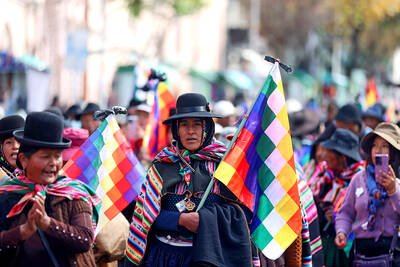
SEEKING ORDER: Rodrigo Paz said that ‘anyone who wants to destroy the nation will have to deal with this president and the full force of the constitution’ Bolivian President Rodrigo Paz on Wednesday said that the nation was at a “breaking point” after nearly a month of protests that have caused shortages of food, fuel and medicine. Paz, who took office six months ago amid the worst economic crisis there in four decades, is battling a groundswell of fury over his policies. The political capital, La Paz, has been besieged by low-income workers and members of the indigenous majority calling for his resignation. “The country needs order and is reaching breaking point,” the 58-year-old said at a public event in La Paz, renewing his appeal for dialogue. On Tuesday, the Bolivian

Through the noise of rushing papers and whirring belts at a print factory in Kyoto, two creators watch their photo essay come to life in broadsheet form — part of an effort to win new audiences in the age of artificial intelligence (AI). Despite the decline of the publishing industry, self-publication and handmade “zine” magazines are growing in popularity in Japan, reflecting the nation’s enduring love of paper in the digital era. While speaking to Agence France-Presse at the plant, his hands black with ink, one of the creators, Kazuma Obara, said: “I think [paper] is a medium that engages all five

Australian researchers have trained lab-grown brain cells on a silicon computer chip to play the 1990s shooter game Doom and said they are just scratching the surface of what the neurons could be capable of doing. It is the science-fiction work of biotech boffins at Cortical Labs, who researched and developed the technology that harnesses the workings of the brain’s networking system. Each so-called “biological computer” contains about 200,000 living human brain cells, grown from stem cells that were harvested from blood donations. Having mastered the simple computer game Pong, where a paddle is moved up and down to send a ball


 RSS
RSS