


War in Iraq has swollen the ranks of al-Qaeda and "galvanized its will" by increasing radical passions among Muslims, an authoritative think-tank said Wednesday.
The warning, echoing earlier ones by MI5 and MI6 (British counter-intelligence services), was made in the annual report of the London-based International Institute for Strategic Studies, The Military Balance.
It said US claims after the invasion of Iraq that al-Qaeda was on the run, and that the "war on terror" had turned the corner, were "over-confident."
John Chipman, the institute's director, warned that the full effect of the war might never be known, because of the chaos it had left behind.
"Whatever one may or may not find in the next six months will not be proof of what may or may not have been there ... There will always be a degree of uncertainty," he said.
The report notes that, according to the US, more than 3,000 suspected al-Qaeda operatives have been arrested, including the third in command, Khalid Sheikh Mohammed.
But it adds: "The counter-terrorism effort has also perversely impelled an already highly decentralized and evasive transnational terrorist network to become more 'virtual' and protean and, therefore, harder to identify and neutralize,"
"If al-Qaeda has been compromised since the Afghanistan intervention from an offensive point of view, from a defensive perspective it is better off," the report says.
Al-Qaeda's great advantage, the report says, is its operational flexibility as a result of it not having a state to defend. The institute believes the network is present in more than 60 countries, has a rump leadership intact, and that there are more than 18,000 potential terrorists at large, with recruitment continuing.
Al-Qaeda's cells are taking measures against increasing electronic surveillance, operating semi-autonomously, but "maintaining links through field commanders to [Osama] bin Laden and his shura [council] who can activate networks and give operational orders".
The informal hawala banking system ensured a stream of unregulated cash from diaspora communities to local radical Muslim groups, as the investigation into five suicide bombings in Morocco in May demonstrated.
The failure to find weapons of mass destruction in Iraq will further increase al-Qaeda's recruiting power, says the thinktank.
The network wants to develop its own capability to use weapons of mass destruction, but it probably has not yet done so.
Meanwhile, it is likely to keep hitting soft targets directed at Americans, Europeans and Israelis.
The UK parliamentary intelligence and security committee reported last month that British Prime Minister Tony Blair was warned by his intelligence chiefs on the eve of war that an invasion of Iraq would increase the danger of terrorist attacks.
It disclosed that in February, a month before the invasion, Whitehall's joint intelligence committee said that "al-Qaeda and associated groups continued to represent by far the greatest threat to western interests, and that threat would be heightened by military action against Iraq."
Though al-Qaeda's leadership remains impervious to political compromise, the report says some local affiliates and large numbers of potential recruits are not. The most pressing matter is the Israeli-Palestinian conflict.
Attempts by al-Qaeda to penetrate Hamas have so far failed, mainly because Hamas's objectives are basically local. But "Hamas/al-Qaeda links could materialize if Hamas became desperate and politically marginalized," says the report.
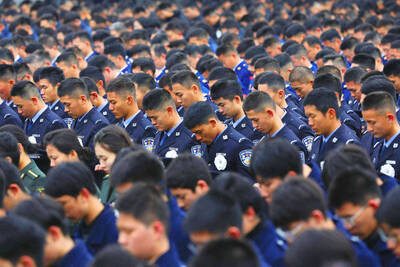
China yesterday held a low-key memorial ceremony for the 1937 Nanjing Massacre, with Chinese President Xi Jinping (習近平) not attending, despite a diplomatic crisis between Beijing and Tokyo over Taiwan. Beijing has raged at Tokyo since Japanese Prime Minister Sanae Takaichi last month said that a hypothetical Chinese attack on Taiwan could trigger a military response from Japan. China and Japan have long sparred over their painful history. China consistently reminds its people of the 1937 Nanjing Massacre, in which it says Japanese troops killed 300,000 people in what was then its capital. A post-World War II Allied tribunal put the death toll
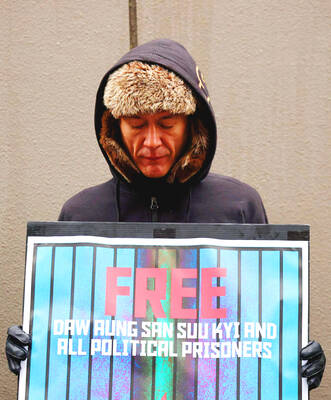
The Burmese junta has said that detained former leader Aung San Suu Kyi is “in good health,” a day after her son said he has received little information about the 80-year-old’s condition and fears she could die without him knowing. In an interview in Tokyo earlier this week, Kim Aris said he had not heard from his mother in years and believes she is being held incommunicado in the capital, Naypyidaw. Aung San Suu Kyi, a Nobel Peace Prize laureate, was detained after a 2021 military coup that ousted her elected civilian government and sparked a civil war. She is serving a
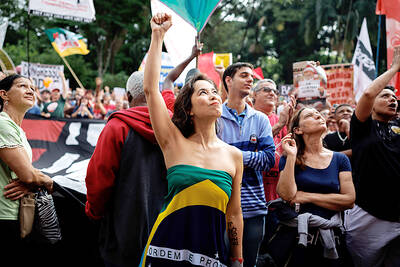
‘NO AMNESTY’: Tens of thousands of people joined the rally against a bill that would slash the former president’s prison term; President Lula has said he would veto the bill Tens of thousands of Brazilians on Sunday demonstrated against a bill that advanced in Congress this week that would reduce the time former president Jair Bolsonaro spends behind bars following his sentence of more than 27 years for attempting a coup. Protests took place in the capital, Brasilia, and in other major cities across the nation, including Sao Paulo, Florianopolis, Salvador and Recife. On Copacabana’s boardwalk in Rio de Janeiro, crowds composed of left-wing voters chanted “No amnesty” and “Out with Hugo Motta,” a reference to the speaker of the lower house, which approved the bill on Wednesday last week. It is
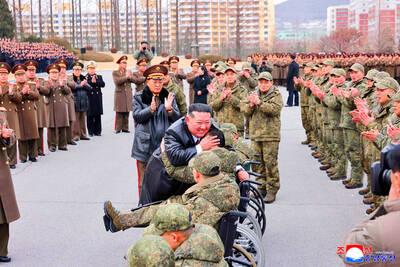
FALLEN: The nine soldiers who were killed while carrying out combat and engineering tasks in Russia were given the title of Hero of the Democratic People’s Republic of Korea North Korean leader Kim Jong-un attended a welcoming ceremony for an army engineering unit that had returned home after carrying out duties in Russia, North Korean state media KCNA reported on Saturday. In a speech carried by KCNA, Kim praised officers and soldiers of the 528th Regiment of Engineers of the Korean People’s Army (KPA) for “heroic” conduct and “mass heroism” in fulfilling orders issued by the ruling Workers’ Party of Korea during a 120-day overseas deployment. Video footage released by North Korea showed uniformed soldiers disembarking from an aircraft, Kim hugging a soldier seated in a wheelchair, and soldiers and officials


 RSS
RSS