


Buoyed by the appointment of a popular young lawmaker to a top party post, voter support for Japanese Prime Minister Junichiro Koizumi's new media-friendly Cabinet soared in surveys released yesterday, an auspicious sign for his ruling party ahead of an expected November election.
Nearly two-thirds of voters surveyed by three newspapers after Koizumi shook up his Cabinet on Monday said that they backed the prime minister and the new line-up, a level of support not seen since his high-profile North Korea summit one year ago.
Key to the jump in popularity -- the cornerstone of the maverick Koizumi's political power -- was his appointment of popular lawmaker Shinzo Abe, 49, as Liberal Democratic Party (LDP) secretary-general, the ruling party's de facto campaign manager and a post traditionally held by a veteran parliamentarian.
Koizumi's decision to retain controversial pro-reform academic Heizo Takenaka in his two key economics and banking posts and a hefty dose of youth in the new Cabinet also helped garner public support, as did signs of an emerging economic recovery and a recent rise in Tokyo share prices.
LDP old-guard barons had pressed for Takenaka, whose strict banking policies they say hurt Japan's economy, to be ousted.
"Personally, I think it's brilliant," said one Western political analyst of Koizumi's personnel choices. "They've set up for a media blitz that will obliterate the opposition."
The shake-up of the Cabinet and the top LDP line-up followed Koizumi's hefty victory in Saturday's election for LDP president, which allowed him to stay on as premier and lead the party into a general election he has all but confirmed for November.
Abe's presence on the campaign trail could well give the LDP an added boost akin to that provided by outspoken lawmaker Makiko Tanaka in a 2001 upper house election, in which the popular Koizumi-Tanaka duo were key to the party's good performance.
Koizumi later tapped Tanaka, known for her brash criticism of the status quo, as foreign minister but then sacked her over a bitter feud with elite diplomats.
She has since resigned from parliament over a scandal involving misuse of an aide's salary.
The appointment of Abe, often tipped as a future prime minister, scored a hefty 75 percent support rate in the Nihon Keizai newspaper survey, while voter backing for the LDP itself jumped to 50 percent for the first time in two years.
The popularity punch packed by Abe and the new Cabinet is an obvious headache for the main opposition Democratic Party, which had hoped to paint the LDP as a party of elderly politicians whose links to vested interests make them incapable of reform.
A junior lawmaker whose political pedigree includes his father, the late foreign minister Shintaro Abe and grandfather, the late prime minister Nobusuke Kishi, Abe is popular both for his fashion sense and his tough stance towards North Korea on the emotional topic of Japanese citizens abducted decades ago.
Other media-friendly Cabinet choices include Environment Minister Yuriko Koike, 51, a former TV broadcaster, and Trade Minister Shoichi Nakagawa, 50, along with Public Safety Minister Kiyoko Ono, 67, a former Olympic gymnast.

Through the noise of rushing papers and whirring belts at a print factory in Kyoto, two creators watch their photo essay come to life in broadsheet form — part of an effort to win new audiences in the age of artificial intelligence (AI). Despite the decline of the publishing industry, self-publication and handmade “zine” magazines are growing in popularity in Japan, reflecting the nation’s enduring love of paper in the digital era. While speaking to Agence France-Presse at the plant, his hands black with ink, one of the creators, Kazuma Obara, said: “I think [paper] is a medium that engages all five
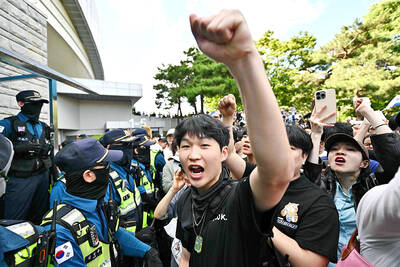
‘ABSURD MISTAKE’: The election commission said that there had been a failure to anticipate turnout after 14 polling stations ran short of ballot papers South Korean riot police yesterday cleared protesters from a Seoul polling station after a 35-hour blockade sparked by a shortage of ballot papers during local elections earlier this week. Wednesday’s election was the first nationwide vote since South Korean President Lee Jae-myung took office following the ouster of Yoon Suk-yeol over his short-lived martial law declaration. Lee’s ruling Democratic Party swept most races, but failed to flip the crucial Seoul mayoral seat. The South Korean National Election Commission apologized, blaming a failure to anticipate turnout after 14 polling stations in Seoul ran short of ballot papers. Some polling stations stayed open until 10pm to

Australian researchers have trained lab-grown brain cells on a silicon computer chip to play the 1990s shooter game Doom and said they are just scratching the surface of what the neurons could be capable of doing. It is the science-fiction work of biotech boffins at Cortical Labs, who researched and developed the technology that harnesses the workings of the brain’s networking system. Each so-called “biological computer” contains about 200,000 living human brain cells, grown from stem cells that were harvested from blood donations. Having mastered the simple computer game Pong, where a paddle is moved up and down to send a ball

France experienced its hottest spring on record, the French weather service said on Tuesday, after an exceptional early heat wave that also broke highs for the season in England and Wales. Meteo-France said the average nationwide temperature over March to May was 13.8°C — about 1.7°C above the norm, and surpassing records set in 2011 and 2020. “The warmest spring since records began in 1900,” it said in a bulletin. All three months were warmer than average, but the onset of an “unprecedented heatwave” late last month pushed the mercury to highs typically seen at the height of the summer. “Our country had never


 RSS
RSS