


Supporters and opponents of Hong Kong leader Tung Chee-hwa (
"The Article 23 evil law withdrawn,'' declared a front-page headline in the Apple Daily, an anti-Tung Chinese-language newspaper. Article 23 is a provision of Hong Kong's mini-constitution that requires the territory to enact a national security law.

PHOTO: AP
"The move is a testament to the priority Tung is giving to public opinion," hailed an editorial in the Hong Kong edition of China's official China Daily newspaper.
After putting the proposal on hold in July when its passage became doubtful, Tung announced on Friday he would withdraw the bill from the legislature altogether and focus more on reviving Hong Kong's battered economy.
Despite welcoming the decision, about 30 activists marched to government headquarters yesterday calling for Tung's resignation and full democracy.
"Tung Chee-hwa has lost the people's faith, step down immediately to atone for your mistakes," the protesters chanted.
Tung remains widely unpopular in Hong Kong amid allegations of economic mismanagement, and his popularity plummeted further over his initially tough stance on the anti-subversion proposal.
Political opponents have questioned Tung's sincerity in scrapping the bill, suggesting he was merely providing cover to legislative allies contesting next year's elections
Several newspaper editorials also cast doubt on Tung's motivations yesterday.
"Is it yet another move that has been forced on it by political expediency?" The Standard business newspaper wrote in an editorial titled "Strategic Withdrawal."
Tung reiterated that anti-subversion legislation was a constitutional responsibility, but said he would revisit the issue only when there was greater public support for it.
Hong Kong was guaranteed Western-style freedoms when it reverted to mainland communist rule in 1997, but terms of the handover also stipulated the territory must outlaw various crimes against the state.
Accustomed to the freewheeling ways of this thriving capitalist economy, many Hong Kongers expressed outrage at the inclusion of offenses such as subversion and sedition in the proposed bill -- crimes that China has used to punish political dissenters.
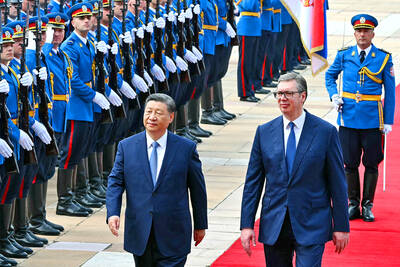
MONEY MATTERS: Xi was to highlight projects such as a new high-speed railway between Belgrade and Budapest, as Serbia is entirely open to Chinese trade and investment Serbian President Aleksandar Vucic yesterday said that “Taiwan is China” as he made a speech welcoming Chinese President Xi Jinping (習近平) to Belgrade, state broadcaster Radio Television of Serbia (RTS) said. “We have a clear and simple position regarding Chinese territorial integrity,” he told a crowd outside the government offices while Xi applauded him. “Yes, Taiwan is China.” Xi landed in Belgrade on Tuesday night on the second leg of his European tour, and was greeted by Vucic and most government ministers. Xi had just completed a two-day trip to France, where he held talks with French President Emmanuel Macron as the

With the midday sun blazing, an experimental orange and white F-16 fighter jet launched with a familiar roar that is a hallmark of US airpower, but the aerial combat that followed was unlike any other: This F-16 was controlled by artificial intelligence (AI), not a human pilot, and riding in the front seat was US Secretary of the Air Force Frank Kendall. AI marks one of the biggest advances in military aviation since the introduction of stealth in the early 1990s, and the US Air Force has aggressively leaned in. Even though the technology is not fully developed, the service is planning
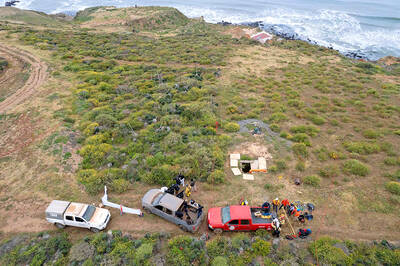
INTERNATIONAL PROBE: Australian and US authorities were helping coordinate the investigation of the case, which follows the 2015 murder of Australian surfers in Mexico Three bodies were found in Mexico’s Baja California state, the FBI said on Friday, days after two Australians and an American went missing during a surfing trip in an area hit by cartel violence. Authorities used a pulley system to hoist what appeared to be lifeless bodies covered in mud from a shaft on a cliff high above the Pacific. “We confirm there were three individuals found deceased in Santo Tomas, Baja California,” a statement from the FBI’s office in San Diego, California, said without providing the identities of the victims. Australian brothers Jake and Callum Robinson and their American friend Jack Carter
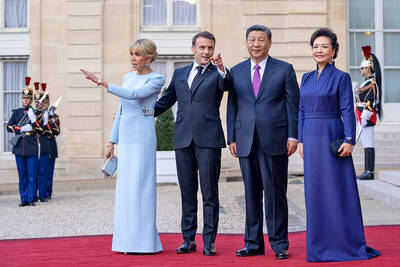
CUSTOMS DUTIES: France’s cognac industry was closely watching the talks, fearing that an anti-dumping investigation opened by China is retaliation for trade tensions French President Emmanuel Macron yesterday hosted Chinese President Xi Jinping (習近平) at one of his beloved childhood haunts in the Pyrenees, seeking to press a message to Beijing not to support Russia’s war against Ukraine and to accept fairer trade. The first day of Xi’s state visit to France, his first to Europe since 2019, saw respectful, but sometimes robust exchanges between the two men during a succession of talks on Monday. Macron, joined initially by EU Commission President Ursula von der Leyen, urged Xi not to allow the export of any technology that could be used by Russia in its invasion


 RSS
RSS