


Japan looked set to allow a North Korean ferry to return home yesterday, after a delay in its departure for safety checks that had threatened to raise tensions ahead of crucial talks on Pyongyang's nuclear program.
Japanese government inspectors boarded the Mangyongbong-92 and were expected to give it the go-ahead to depart soon, after the ferry crew agreed to fix minor safety flaws discovered when officials scoured the ship on Monday.
Further delay in the sailing of the Mangyongbong-92 from the northern port of Niigata, where it arrived to raucous protests on Monday, could risk chilling already frosty ties as Japan prepares to stick to its tough stance in the six-country talks in Beijing set to begin today.
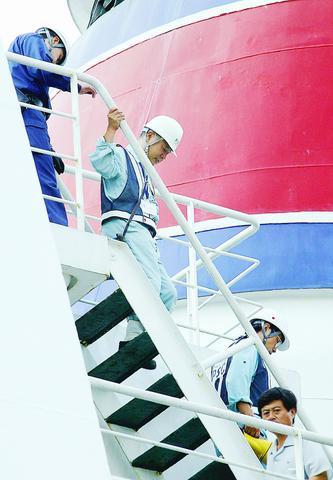
PHOTO: AFP
Japan, which will join the US, South Korea, China and Russia in the talks, wants North Korea to resolve an emotional feud over Japanese citizens abducted decades ago as well as to abandon its nuclear arms program and halt its ballistic missile development.
Tokyo says that a "comprehensive solution" is a prerequisite for normalizing ties with North Korea and providing it with the economic aid Pyongyang desperately needs.
"There is no way we will not bring up the human-rights issue of the abductions, which is a major part of a comprehensive solution, at the six-way talks," Chief Cabinet Secretary Yasuo Fukuda told a news conference in Tokyo.
Inspectors who on Monday checked the ferry, suspected of past involvement in drug running, spying and the smuggling of illicit missile parts, found no signs of illegal activity.
Transport Ministry officials said the ship had submitted a plan to meet certain international safety standards, such as those requiring certain types of fire extinguishers and evacuation signs.
Kyodo news agency said the Transport Ministry would approve the ship's departure with certain unspecified conditions.
Transport Minister Chikage Ogi told her cabinet colleagues she thought the ferry -- the only passenger link between Japan and its communist neighbor -- could depart in the evening, Fukuda said. It was originally scheduled to leave yesterday morning.
Anti-North Korean sentiment has risen in Japan since Pyongyang admitted last September to kidnapping 13 Japanese citizens in the 1970s and 1980s to train spies.
Five abductees, three of whom are from Niigata, have since returned, but their seven North Korean-born children remain in the communist state. The government wants them to be allowed to come to Japan to be reunited with their parents and wants answers to questions about eight abductees Pyongyang says are dead.
The strict inspections of the ferry follow an agreement by Japan and the US in May to clamp down on the illegal trade in drugs that helps fund North Korea and on the export of missile parts to the communist state.
The ferry is set to carry back about 200 North Korean residents, mostly students, and over 60 tonnes of goods.
Pro-Pyongyang ethnic Korean residents of Japan have said the tough inspections and safety checks are a form of harassment.
"I am very sorry about the delay because we didn't do anything wrong," said Cho Sung-ho, 22, an ethnic Korean college student who was waiting to travel to North Korea on the ferry. "It is only natural that we get to visit our homeland."
But the families of the abducted Japanese and supporters want a complete halt to the vessel's visits.
The conservative Yomiuri Shimbun newspaper said North Korea might bring up the issue of the ferry inspections at the Beijing talks but urged the government not to cave in.

An American scientist convicted of lying to US authorities about payments from China while he was at Harvard University has rebuilt his research lab in Shenzhen, China, to pursue technology the Chinese government has identified as a national priority: embedding electronics into the human brain. Charles Lieber, 67, is among the world’s leading researchers in brain-computer interfaces. The technology has shown promise in treating conditions such as amyotrophic lateral sclerosis and restoring movement in paralyzed people. It also has potential military applications: Scientists at the Chinese People’s Liberation Army have investigated brain interfaces as a way to engineer super soldiers by boosting
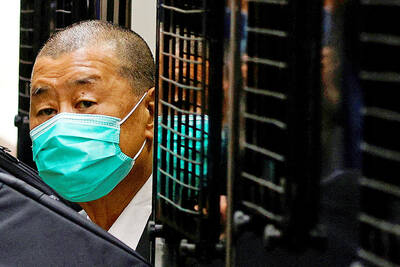
Jailed media entrepreneur Jimmy Lai (黎智英) has been awarded Deutsche Welle’s (DW) freedom of speech award for his contribution to Hong Kong’s pro-democracy movement. The German public broadcaster on Thursday said Lai would be presented in absentia with the 12th iteration of the award on June 23 at the DW Global Media Forum in Bonn. Deutsche Welle director-general Barbara Massing praised the 78-year-old founder of the now-shuttered news outlet Apple Daily for standing “unwaveringly for press freedom in Hong Kong at great personal risk.” “With Apple Daily, he gave journalists a platform for free reporting and a voice to the democracy movement in

PHILIPPINE COMMITTEE: The head of the committee that made the decision said: ‘If there is nothing to hide, there is no reason to hide, there is no reason to obstruct’ A Philippine congressional committee on Wednesday ruled that there was “probable cause” to impeach Philippine Vice President Sara Duterte after hearing allegations of unexplained wealth, misuse of state funds and threats to have the president assassinated. The unanimous decision of the 53-member committee in the Philippine House of Representatives sends the two impeachment complaints to deliberations and voting by the entire lower chamber, which has more than 300 lawmakers. The complaints centered on Duterte’s alleged illegal use and mishandling of intelligence funds from the vice president’s office, and from her time as education secretary under Philippine President Ferdinand Marcos Jr. Duterte and the

As evening falls in Fiji’s capital, a steady stream of people approaches a makeshift clinic that is a first line of defense against one of the world’s fastest-growing HIV epidemics. In the South Pacific nation — a popular tourist destination of just under a million people — more than 2,000 new HIV cases were recorded last year, a 26 percent increase from 2024. The government has declared an HIV outbreak and described it as a national crisis. “It’s spreading like wildfire,” said Siteri Dinawai, 46, who came to be tested. The Moonlight Clinic, a converted minibus parked in a suburban cul-de-sac in Suva, is


 RSS
RSS