


The building of a new terminal at Heathrow airport is providing an unexpected trove of information about the people inhabiting this expanse of land, going back to the hunter gatherers of the stone age 8,000 years ago.
A team of about 80 archaeologists has been working alongside the construction teams preparing the 100-hectare site, where Heathrow airport's fifth terminal will be built.
The archaeologists have found Bronze Age, Iron Age, Roman, Saxon, medieval and later remains as well as traces of stone age culture.
The researchers have identified 80,000 archaeological objects including 18,000 pieces of pottery, 40,000 pieces of worked flint and the only wooden bowl found dating to the Middle Bronze Age, more than 3,000 years ago.
Shedding new light on the development of farming, the archaeologists found that field boundaries laid down as early as 2,000 BC continued to be shown on maps in the 20th century.
The excavations have shown that agriculture on established sites beginning around 2,000 BC dates back at least 500 years earlier than previously estimated, according to Ken Walsh, the director of the project.
The excavation looked at a prehistoric 4km pathway about 20m wide and flanked by ditches. It appeared to have had a religious significance since the first field boundaries ran around it and not across it, as an apparent mark of respect.
But during the Middle Bronze Age, from 1,500 BC, field boundaries were created across the path, a sign that it was no longer venerated.
Access to the local rivers for peoples livestock also became harder because it would mean driving them across others land, so waterholes were dug instead. These then became the focus of religious rituals, with important objects such as pottery and wooden objects placed in them as a sign of their religious significance.
Two long-established units, Oxford Archaeology and Wessex Archaeology, formed a joint venture called Framework Archaeology to work at the site amid the noise and fumes of the worlds busiest international airport.
The project was unusual in the way that it integrated the archaeological dig and the commercial development of the site, which took place simultaneously rather than waiting for the excavation to be completed first.

SPEAKING OUT: After Siranudh Scott’s allegations surfaced, celebrities and public figures took to social media to share their own experiences of sexual misconduct and abuse A high-profile alleged sexual abuse case within a wealthy Thai beer brewing family has prompted a wave of painful accounts from survivors of unconnected abuse in the conservative nation. Siranudh Scott, a member of the billionaire Thai family that founded the ubiquitous Singha beer brand, posted an emotional video this month accusing his elder brother Sunit of repeatedly abusing him when he was a teenager. Sunit, who is in his 30s, later denied the allegations in a video posted online, but Singha parent Boonrawd dismissed him from his executive role with the company on Tuesday last week. “I felt I needed to speak

SEEKING ORDER: Rodrigo Paz said that ‘anyone who wants to destroy the nation will have to deal with this president and the full force of the constitution’ Bolivian President Rodrigo Paz on Wednesday said that the nation was at a “breaking point” after nearly a month of protests that have caused shortages of food, fuel and medicine. Paz, who took office six months ago amid the worst economic crisis there in four decades, is battling a groundswell of fury over his policies. The political capital, La Paz, has been besieged by low-income workers and members of the indigenous majority calling for his resignation. “The country needs order and is reaching breaking point,” the 58-year-old said at a public event in La Paz, renewing his appeal for dialogue. On Tuesday, the Bolivian
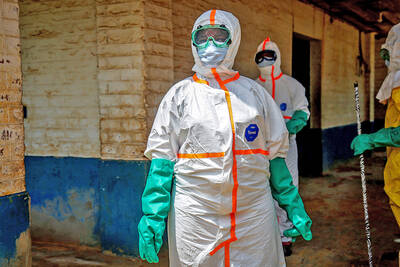
COMMUNITY CONFLICT: Concerns about disease spread from corpses has run up against friends and families’ desire to bury their dead as infection spreads in the area Angry residents of a town at the epicenter of the Ebola outbreak in the Democratic Republic of the Congo (DR Congo) attacked and burned a tent that was part of a health center where people are being treated for the virus, the staff there said Saturday. It was the second such attack in the region in a week. No one was hurt in the attack, according to reports but as patients ran out to escape the fire, 18 people with suspected Ebola infections fled the facility and are unaccounted for, a hospital director said. Angry residents arrived at the clinic in the

Forecasters in Europe yesterday warned of exceptional heat as record temperatures driven by a “heat dome” push temperatures well above seasonal norms across the continent. The surge follows a record-breaking Monday, with France logging its hottest day in the month of May on record, its weather agency said, and the UK also posting unprecedented highs. A so-called “heat dome” of warm air from northern Africa trapped under a high-pressure system over western Europe is behind the high temperatures not usually seen until high summer. Restrictions on outdoor work were imposed in parts of Italy, beaches in southwest France filled earlier than usual and


 RSS
RSS