


For the past half-century, as July's sizzle gave way to August's swelter, the Communist leadership has decamped to a resort on the Bohai Sea known for its gated mansions and dense fog of political intrigue.
Mao Zedong (
But in a move that seems to be equal parts public relations and back-room maneuvering, Hu Jintao (
The decision to end the secretive meetings marks Hu's most formal break with Communist tradition. It is also the strongest signal that he intends to manage party affairs differently from Jiang, his immediate predecessor.
The resort, Beidaihe, is under 300km from Beijing and is popular with sightseers and state workers on vacation. But they have long been consigned to the beaches outside the long white walls and neatly kept lawns of West Mountain Compound, China's Newport and Camp David rolled into one. Its European-influenced summer spreads were built when colonial powers controlled China's major port cities, but they have been used exclusively by the party elite since the 1950s.
Beidaihe offers an unusually conspicuous display of Communist Party perks and power, making it a target for Hu's plain-living campaign. He has already done away with the elaborate send-offs for top leaders going abroad. He has also promised openness and has begun publicizing the dates and topics for Politburo meetings, contrary to the Beidaihe tradition of secrecy.
In a front-page commentary last week, the state-run Science and Technology Daily expected a popular response: "The decision sets a new example for the whole party and is a populist measure for clean government that will stir people's hearts. It is sure to win applause."
It could also have the practical effect of limiting the leeway that Jiang and other retired party leaders have to meddle in politics. Beidaihe provided elders who had given up formal titles with a casual setting to exchange gossip, hobnob with rising officials, and help set the agenda for China's annual plenum, or planning session, which generally takes place in the early fall.
Hu may have seen the retreat as unlikely to offer him many advantages. Hu, 60, holds China's most important positions but is still trying to build political heft to match Jiang, who remains China's military chief and counts many members of the Politburo Standing Committee as close allies.
Hu and Jiang both have assigned homes at Beidaihe, but Jiang's, by tradition, is grander.
"Beidaihe was most popular among the old cadres because it is not always easy for them to participate in decision making in Beijing," said Wu Jiaxiang, a political analyst and former party official. "Doing away with it is mainly about how the new leadership wants to manage party affairs internally."
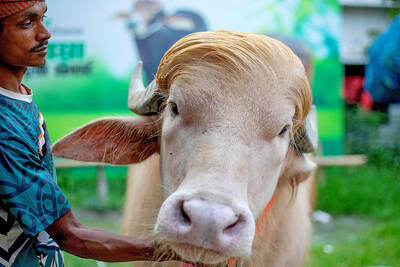
Crowds in Bangladesh are flocking to snap photographs with an unlikely social media star — an albino buffalo with flowing blond hair nicknamed “Donald Trump” that is due to be sacrificed within days. Owner Zia Uddin Mridha, 38, said his brother named the 700kg bull over its flowing helmet of hair resembling the signature look of the US president. “My younger brother picked this name because of the buffalo’s extraordinary hair,” he said at his farm in Narayanganj, just outside the capital, Dhaka. Mridha said that a constant stream of curious visitors — social media fans, onlookers and children — have come throughout

It began as a satirical online project. Now millions of young people in India are flocking to it as an outlet for their frustration. A parody political party called the Cockroach Janta Party, with the insect as its symbol, has exploded across India’s social media by turning absurdist humor into protest. Memes and short videos mocking corruption, joblessness and political dysfunction have flooded social media sites, where millions of users are embracing the cockroach — known for its ability to survive harsh conditions — as a tongue-in-cheek symbol of endurance. The online movement’s rise has been unusually rapid. The Cockroach Janta Party (CJP)
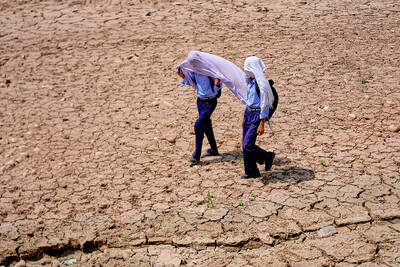
HOTTER: While Indians are accustomed to summer heat, climate change has caused northwestern India to warm faster than other parts of the country, an academic said Roads and markets have emptied during afternoons and some farmers have switched to nighttime work to avoid scorching temperatures as a heat wave grips large parts of India. The India Meteorological Department forecast maximum temperatures for yesterday of about 45°C in the capital, New Delhi, where authorities have opened temporary “cooling zones” to help people cope. The weather department warned that conditions would likely persist across several northern regions in the coming days, with temperatures staying well above seasonal averages. Authorities urged people to stay indoors during the hottest hours and take precautions against heat-related illnesses. India declares a heat wave whenever maximum temperatures
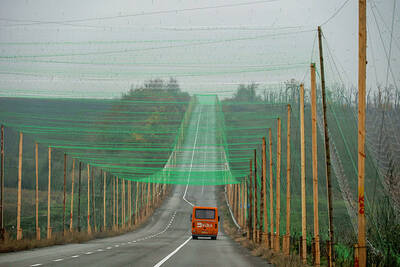
BIGGER ROLE: Beijing has said it maintains an impartial stance on the war in Ukraine, but by training Russian troops, China is far more involved than previously known China’s armed forces secretly trained about 200 Russian military personnel in China late last year, and some have since returned to fight in Ukraine, according to three European intelligence agencies and documents seen by Reuters. While China and Russia have held a number of joint military exercises since Moscow’s full-scale invasion of Ukraine in 2022, Beijing has repeatedly said that it is neutral in the conflict and presents itself as a peace mediator. The covert training sessions, which predominantly focused on the use of drones, were outlined in a dual-language Russian-Chinese agreement signed by senior Russian and Chinese officers in Beijing on


 RSS
RSS