


US-led forces in Iraq were on high alert yesterday, the anniversary of the 1968 seizure of power by Saddam Hussein's Baath party.
The death of a US soldier in an attack Wednesday on a military convoy highlighted the continuing danger. His death was the 147th since US troops invaded Iraq on March 20, tying the number of US dead in the 1990-1991 Gulf War and raising alarm about the occupation's high cost in human life.
A top US general admitted US forces were taken by surprise by the the total disintegration of Iraq's army and police force at the end of the war, while UN Secretary General Kofi Annan called on the world to help stabilize the devastated country.
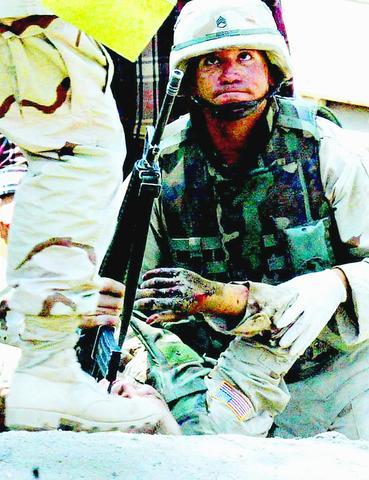
PHOTO: AP
A series of attacks in and around Baghdad Wednesday targeting coalition forces also left at least six US soldiers wounded as troops expressed frustration with a situation in which one soldier said troops were exposed "like walking ducks."
A surface-to-air missile was fired on a US C-130 military transport plane at Baghdad airport but missed its target, in what was thought to be the first attack of its kind since the end of the US-led war.
And a pro-US governor was killed in northeastern Haditha province, as Iraqis linked to coalition forces increasingly become the prey of Saddam loyalists.
US officials had warned regime loyalists might take advantage of anniversaries Wednesday of the date Saddam became president in 1979 and yesterday when the Baathists seized power in 1968 to launch strikes on troops.
Specialist David McCall, in a truck at the back of the line of vehicles attacked west of Baghdad, said operations in Iraq were sapping morale.
"We need to get out of here. We're just walking ducks, sitting in trucks. We can't defend ourselves," he said.
The area west of Baghdad, a restive Sunni Muslim belt, has been gripped by violence against US forces battling hard to restore security since the war to topple Saddam ended, but faced with daily attacks on their patrols.
In Washington, Central Command chief General John Abizaid said the quick collapse of the Baath regime took US leaders by surprise, and acknowledged his troops were facing guerrilla tactics.
"We're seeing a cellular organization of six to eight people armed with [rocket propelled grenades], machine guns, etc., attacking us at some times and places of their choosing and other times we attack them at times and places of our choosing," said Abizaid.
"I think describing it as guerrilla tactics being employed against us is ... proper ... in strictly military terms."
Meanwhile, Annan said responsibility for stabilizing the situation in Iraq rested with all countries.
"All of us should accept the responsibility to stabilize Iraq. It is in the interest not only of Iraq," but of the entire region, he said after closed-door consultations with the Security Council.
And an opinion poll released in Britain found that half the people of Baghdad believe the US and Britain were right to invade Iraq, but most say the city is a more dangerous place since Saddam's regime fell on April 9.
The YouGov survey, commissioned by Britain's independent Channel 4 News network and The Spectator magazine, found 50 percent thought the war was right, as against 27 percent who said it was wrong.
But there was deep suspicion about the motives for invading.
Almost half -- 47 percent -- said that they thought the conflict was about oil, and 41 percent said it was to help Israel, compared with 23 percent who said it was to liberate the Iraqi people and just six percent who thought it was to deal with Iraq's pursuit of nuclear, biological and chemical weapons.
A significant 47 percent expressed no preference for rule by the Americans or rule under Saddam Hussein, with 29 percent saying they preferred the US and nine percent favoring Saddam.
Three-quarters said Baghdad was more dangerous since the US-led invasion.

‘CROSSING THE LINE’: China’s embassy in Seoul criticized US Forces Korea Commander General Xavier Brunson, asking if his ‘hostile’ remarks were authorized by Washington South Korea and the US are in talks over recent public remarks by the commander of US Forces Korea, Seoul’s presidential office said yesterday, after the comments drew sharp criticism from China. In a recent podcast interview, US Forces Korea Commander General Xavier Brunson described South Korea as “the dagger in the heart of Asia” from China’s east coast, prompting the Chinese embassy in Seoul to say that he had “truly crossed the line.” The interview came amid growing speculation that Washington might seek to expand the role of US Forces Korea in countering the growing regional influence of China, a key

SEEKING ORDER: Rodrigo Paz said that ‘anyone who wants to destroy the nation will have to deal with this president and the full force of the constitution’ Bolivian President Rodrigo Paz on Wednesday said that the nation was at a “breaking point” after nearly a month of protests that have caused shortages of food, fuel and medicine. Paz, who took office six months ago amid the worst economic crisis there in four decades, is battling a groundswell of fury over his policies. The political capital, La Paz, has been besieged by low-income workers and members of the indigenous majority calling for his resignation. “The country needs order and is reaching breaking point,” the 58-year-old said at a public event in La Paz, renewing his appeal for dialogue. On Tuesday, the Bolivian

Through the noise of rushing papers and whirring belts at a print factory in Kyoto, two creators watch their photo essay come to life in broadsheet form — part of an effort to win new audiences in the age of artificial intelligence (AI). Despite the decline of the publishing industry, self-publication and handmade “zine” magazines are growing in popularity in Japan, reflecting the nation’s enduring love of paper in the digital era. While speaking to Agence France-Presse at the plant, his hands black with ink, one of the creators, Kazuma Obara, said: “I think [paper] is a medium that engages all five

Australian researchers have trained lab-grown brain cells on a silicon computer chip to play the 1990s shooter game Doom and said they are just scratching the surface of what the neurons could be capable of doing. It is the science-fiction work of biotech boffins at Cortical Labs, who researched and developed the technology that harnesses the workings of the brain’s networking system. Each so-called “biological computer” contains about 200,000 living human brain cells, grown from stem cells that were harvested from blood donations. Having mastered the simple computer game Pong, where a paddle is moved up and down to send a ball


 RSS
RSS