


Lawmakers have tendered proposals calling for income tax breaks to be offered to companies that make an endowment to sports bodies or competitions.
As with the tourism, restaurant and cultural sectors, whose revenues have plunged amid fears of the spread of COVID-19, the sports sector has been hit hard by the epidemic.
The Super Basketball League said that games scheduled for the second half of its 17th season would not be open to the public and tickets would be refunded.
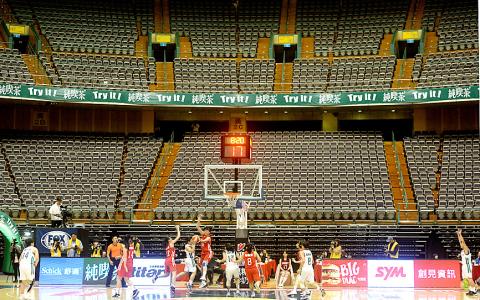
Photo: Lin Cheng-kung, Taipei Times
Independent Legislator Chao Cheng-yu (趙正宇) and Democratic Progressive Party legislators Chang Liao Wan-chien (張廖萬堅) and Huang Kuo-shu (黃國書) have sponsored a proposed amendment to the Sports Industry Development Act (運動產業發展條例).
The proposal would give sports authorities the right to create a dedicated account to receive endowments from firms in the private sector, which would be eligible for an income tax deduction.
In Chao’s draft, profit-seeking enterprises can give endowments to government-designated professional or amateur sports bodies and have income tax deductions of no more than NT$25 million (US$829,738).
In Chang and Huang’s draft, endowments are divided into those for “key sports categories” and “approved sports categories,” and companies giving endowments to the former are exempt from the NT$25 million tax deduction ceiling.
To prevent tax sheltering, the draft proposal includes a provision that states that if the firm and the sports body are affiliated, the tax deduction must not exceed the endowment and would be subject to a NT$10 million upper limit.
In light of an expected fall in tax revenue, the proposals cap the amount that a sports body can receive at NT$3 billion per year.
In addition, those donating funds must request tax deductions within a specified period or forfeit the right to do so, the proposals say.
Professional sports bodies may only receive endowments within 10 years of the amendment’s ratification, while key and amateur sports bodies would be restricted to within five years of the amendment’s ratification, they state.
Chao said that he sponsored the proposal in a bid to improve the sports industry and help amateur sports competitions become professional by encouraging investment in sports, which would incentivize athletes to pursue a career locally and spur development of the industry.

The manufacture of the remaining 28 M1A2T Abrams tanks Taiwan purchased from the US has recently been completed, and they are expected to be delivered within the next one to two months, a source said yesterday. The Ministry of National Defense is arranging cargo ships to transport the tanks to Taiwan as soon as possible, said the source, who is familiar with the matter. The estimated arrival time ranges from late this month to early next month, the source said. The 28 Abrams tanks make up the third and final batch of a total of 108 tanks, valued at about NT$40.5 billion
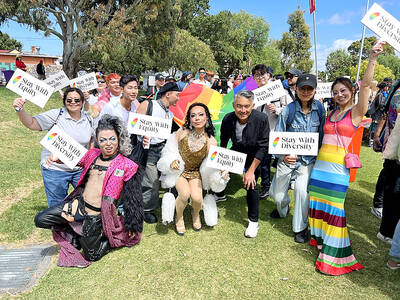
A group from the Taiwanese Designers in Australia association yesterday represented Taiwan at the Midsumma Pride March in Melbourne. The march, held in the St. Kilda suburb, is the city’s largest LGBTQIA+ parade and the flagship event of the annual Midsumma Festival. It attracted more than 45,000 spectators who supported the 400 groups and 10,000 marchers that participated this year, the association said. Taiwanese Designers said they organized a team to march for Taiwan this year, joining politicians, government agencies, professionals and community organizations in showing support for LGBTQIA+ people and diverse communities. As the first country in Asia to legalize same-sex
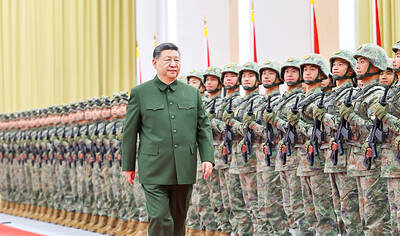
MOTIVES QUESTIONED The PLA considers Xi’s policies toward Taiwan to be driven by personal considerations rather than military assessment, the Epoch Times reports Chinese President Xi Jinping’s (習近平) latest purge of the Chinese People’s Liberation Army (PLA) leadership might have been prompted by the military’s opposition to plans of invading Taiwan, the Epoch Times said. The Chinese military opposes waging war against Taiwan by a large consensus, putting it at odds with Xi’s vision, the Falun Gong-affiliated daily said in a report on Thursday, citing anonymous sources with insight into the PLA’s inner workings. The opposition is not the opinion of a few generals, but a widely shared view among the PLA cadre, the Epoch Times cited them as saying. “Chinese forces know full well that
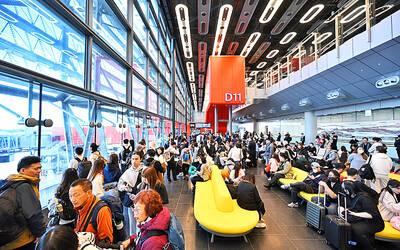
Travel agencies in Taiwan are working to secure alternative flights for travelers bound for New Zealand for the Lunar New Year holiday, as Air New Zealand workers are set to strike next week. The airline said that it has confirmed that the planned industrial action by its international wide-body cabin crew would go ahead on Thursday and Friday next week. While the Auckland-based carrier pledged to take reasonable measures to mitigate the impact of the workers’ strike, an Air New Zealand flight arriving at Taipei from Auckland on Thursday and another flight departing from Taipei for Auckland on Saturday would have to


 RSS
RSS