


The WHO should declare the COVID-19 outbreak a pandemic, health experts at National Taiwan University’s (NTU) College of Public Health said yesterday, adding that the government should bolster disease prevention measures at long-term care centers.
College dean Chan Chang-chuan (詹長權) said that the WHO recently announced that the global death rate for the novel coronavirus is 3.4 percent, higher than previous estimates of about 2 percent, while more than 100 countries have reported confirmed cases.
“The NTU College of Public Health wants to represent the professional point of view and urge the WHO to announce the COVID-19 outbreak a global pandemic,” Chan said. “If these standards do not meet the criteria for a pandemic in international health regulations, then we do not know what else could be called a pandemic.”
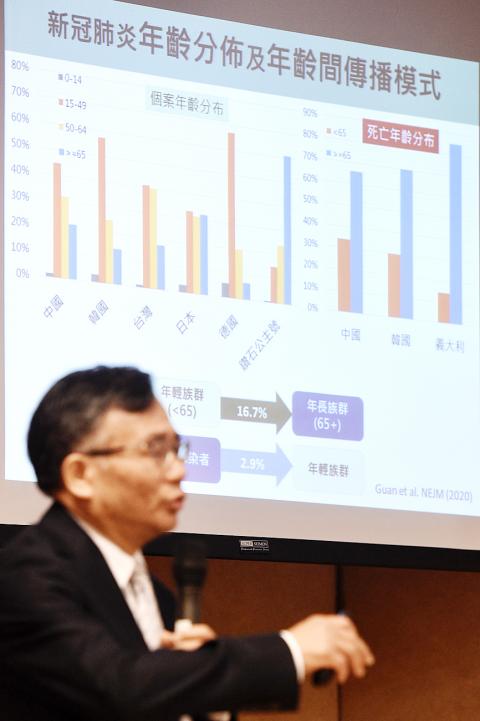
Photo: George Tsorng, Taipei Times
Chan last week said that the COVID-19 global death rate was about 2 percent and its transmissibility — the average number of people one case infects — was about 2.2, so he had suggested control measures of keeping space between people and reserving sufficient medical capacity.
However, the measures he advised last week referenced the 1968 H3N2 flu pandemic, but according to Microsoft cofounder Bill Gates, COVID-19 might be the “once-in-a-century pathogen we’ve been worried about,” meaning it could be as severe as the 1957 H2N2 pandemic, so preparations should be made accordingly, Chan said.
Local transmission of COVID-19 is likely to occur in the near future, which will become the most difficult period of disease prevention, he said, adding that emphasis should be put on the prevention and control measures at hospitals and long-term care centers.
NTU Institute of Health Policy and Management associate professor Chen Ya-mei (陳雅美) said that a Hong Kong study suggests that the COVID-19 incidence and fatality rates among people aged 70 or above are about three times those for the population, while the fatality rate among people aged 80 or above might reach 15 percent.
In addition, clusters of confirmed cases have been reported in long-term care centers in the US and Australia, implying that elderly people are a high-risk group, Chen said.
Referencing guidelines issued by the US Centers for Disease Control and Prevention, Chen said that disease prevention resources provided to long-term care centers should be the same as for hospitals, including protective clothing and masks, as well as offering online disease prevention training courses for caregivers.
The government should offer bonuses for long-term care center personnel and postpone annual assessments of care facilities so that they can focus on disease prevention, she said.
People should keep a social distance of 1.8m to 2m to prevent transmission of the virus, she said.
Taiwan is in the early stage of COVID-19 local transmission, which can easily lead to outbreaks within long-term care facilities, she said, adding that there are about 210,000 people in long-term care, or about 780,000 people if their family members and care facility personnel are included.
The government, academics and industry should cooperate to enhance disease prevention in long-term care facilities, she said.

The manufacture of the remaining 28 M1A2T Abrams tanks Taiwan purchased from the US has recently been completed, and they are expected to be delivered within the next one to two months, a source said yesterday. The Ministry of National Defense is arranging cargo ships to transport the tanks to Taiwan as soon as possible, said the source, who is familiar with the matter. The estimated arrival time ranges from late this month to early next month, the source said. The 28 Abrams tanks make up the third and final batch of a total of 108 tanks, valued at about NT$40.5 billion
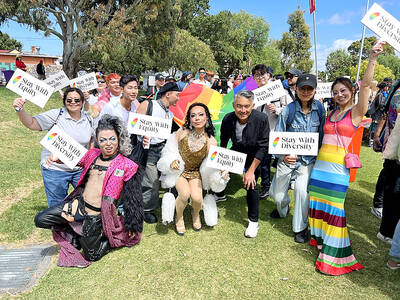
A group from the Taiwanese Designers in Australia association yesterday represented Taiwan at the Midsumma Pride March in Melbourne. The march, held in the St. Kilda suburb, is the city’s largest LGBTQIA+ parade and the flagship event of the annual Midsumma Festival. It attracted more than 45,000 spectators who supported the 400 groups and 10,000 marchers that participated this year, the association said. Taiwanese Designers said they organized a team to march for Taiwan this year, joining politicians, government agencies, professionals and community organizations in showing support for LGBTQIA+ people and diverse communities. As the first country in Asia to legalize same-sex
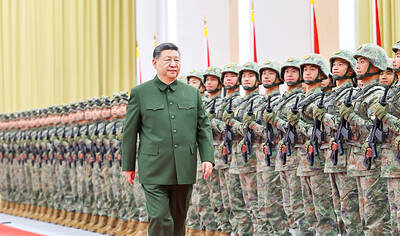
MOTIVES QUESTIONED The PLA considers Xi’s policies toward Taiwan to be driven by personal considerations rather than military assessment, the Epoch Times reports Chinese President Xi Jinping’s (習近平) latest purge of the Chinese People’s Liberation Army (PLA) leadership might have been prompted by the military’s opposition to plans of invading Taiwan, the Epoch Times said. The Chinese military opposes waging war against Taiwan by a large consensus, putting it at odds with Xi’s vision, the Falun Gong-affiliated daily said in a report on Thursday, citing anonymous sources with insight into the PLA’s inner workings. The opposition is not the opinion of a few generals, but a widely shared view among the PLA cadre, the Epoch Times cited them as saying. “Chinese forces know full well that
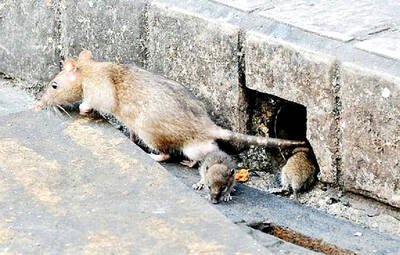
An elderly man with underlying health conditions died in mid-January, eight days after the onset of symptoms, marking Taiwan’s first hantavirus death this year, the Centers for Disease Control (CDC) said yesterday. The man, who was in his 70s and lived in Taipei’s Daan District (大安), tested positive posthumously for hantavirus after passing away on Jan. 13 from sepsis complicated by multiple organ failure and pneumonia, the CDC said in a press release. According to the CDC, the man sought treatment on Jan. 6 for respiratory issues and low blood pressure before returning two


 RSS
RSS