


The Tainan Tourism Bureau is collaborating with local wedding, travel and hospitality companies to promote outdoor wedding services, hoping to boost tourism amid the COVID-19 outbreak.
As people avoid crowded indoor spaces to prevent infection, outdoor tourist destinations are gaining popularity, inspiring the city to launch a special campaign to promote the local wedding and tourism industry, Tainan Mayor Huang Wei-che (黃偉哲) said yesterday.
People interested in taking part in the Tainan Outdoor Weddings Promotional Activity can apply until Nov. 30, with the first 10 approved applicants to receive from the mayor the same 12 wedding gifts that the city government gave to Taiwanese model Lin Chi-ling (林志玲) when she got married in her parents’ hometown in November last year, bureau Director-General Kuo Chen-hui (郭貞慧) said.

Photo: Yang Chin-cheng, Taipei Times
The other approved applicants would receive six of the gifts, Kuo added.
The 12 auspicious gifts Lin received from Huang were bamboo charcoal, rice, sesame oil, salt, soy, vinegar, tea, a silk quilt, longan honey, burdock roots, a rush-woven bag and a wedding cake.
“Tainan has a lot to offer, including tasty food, nice tourist sites and great wedding-related services, so the city hopes that people follow in Lin’s footsteps and choose it as the place they tie the knot,” Huang said.
Information about the promotion is available online at www.twtainan.net/zh-tw/event/activitydetail/3881.

More than half of the bamboo vipers captured in Tainan in the past few years were found in the city’s Sinhua District (新化), while other districts had smaller catches or none at all. Every year, Tainan captures about 6,000 snakes which have made their way into people’s homes. Of the six major venomous snakes in Taiwan, the cobra, the many-banded krait, the brown-spotted pit viper and the bamboo viper are the most frequently captured. The high concentration of bamboo vipers captured in Sinhua District is puzzling. Tainan Agriculture Bureau Forestry and Nature Conservation Division head Chu Chien-ming (朱健明) earlier this week said that the

NAMING SPAT: The foreign ministry called on Denmark to propose an acceptable solution to the erroneous nationality used for Taiwanese on residence permits Taiwan has revoked some privileges for Danish diplomatic staff over a Danish permit that lists “Taiwan” as “China,” Eric Huang (黃鈞耀), head of the Ministry of Foreign Affairs’ Department of European Affairs, told a news conference in Taipei yesterday. Reporters asked Huang whether the Danish government had responded to the ministry’s request that it correct the nationality on Danish residence permits of Taiwanese, which has been listed as “China” since 2024. Taiwan’s representative office in Denmark continues to communicate with the Danish government, and the ministry has revoked some privileges previously granted to Danish representatives in Taiwan and would continue to review

Kenting National Park service technician Yang Jien-fon (楊政峰) won a silver award in World Grand Prix Photography Awards Spring Season for his photograph of two male rat snakes intertwined in combat. Yang’s colleagues at Kenting National Park said he is a master of nature photography who has been held back by his job in civil service. The awards accept entries in all four seasons across six categories: architectural and urban photography, black-and-white and fine art photography, commercial and fashion photography, documentary and people photography, nature and experimental photography, and mobile photography. Awards are ranked according to scores and divided into platinum, gold and
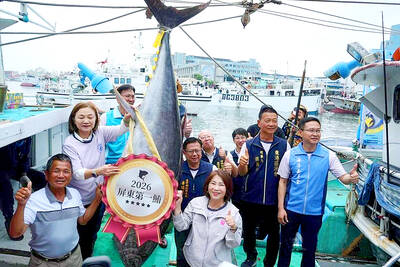
The first bluefin tuna of the season, brought to shore in Pingtung County and weighing 190kg, was yesterday auctioned for NT$10,600 (US$333.5) per kilogram, setting a record high for the local market. The auction was held at the fish market in Donggang Fishing Harbor, where the Siaoliouciou Island-registered fishing vessel Fu Yu Ching No. 2 delivered the “Pingtung First Tuna” it had caught for bidding. Bidding was intense, and the tuna was ultimately jointly purchased by a local restaurant and a local company for NT$10,600 per kilogram — NT$300 ,more than last year — for a total of NT$2.014 million. The 67-year-old skipper


 RSS
RSS