


The High Court yesterday ordered Radio Corp of America (RCA) to pay NT$54.7 million (US$1.82 million) in compensation to only 24 of 246 plaintiffs, sparking an outcry among former workers of the US company and their lawyers, who vowed to appeal the verdict.
The class-action lawsuit was filed by the RCA Self-Help Association, which is made up of former employees and deceased workers’ families. The suit dates back to 2004 and has gone through several trials.
The judges yesterday said that as there was no proof that would clearly establish a correlation between health problems as a direct result of exposure to chemical materials at an RCA plant, it ruled against compensating most of the 246 plaintiffs.
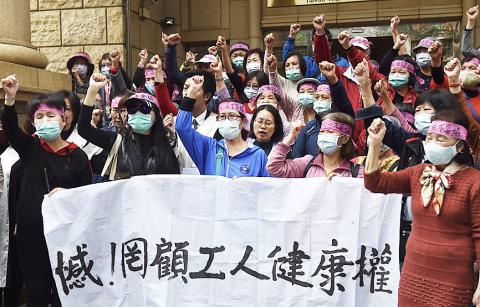
Photo: Chien Jung-fong, Taipei Times
In August 2018, the Supreme Court ordered RCA to pay NT$564.45 million in compensation to 262 of the plaintiffs — either former workers who developed cancer or other illnesses, or family members of deceased workers.
It found the US company liable for the cancer and other illnesses that some employees had contracted while handling organic solvents, which were later found to be carcinogenic, at its factory in then-Taoyuan County.
Investigators had found toxic waste dumped around the factory, contaminating the soil and underground water, and more than 200 employees have since died.
The Supreme Court also ordered the High Court to retry the case for 246 other plaintiffs, because “some plaintiffs have no clear manifestation of illnesses ... and no proof of a clear correlation for cause and effect.”
Elaborating on yesterday’s ruling, High Court judge Tao Ya-chin (陶亞琴) said that the plaintiffs were divided into three groups: A for former employees who had died; B for those who had developed illnesses; and C for those who had no obvious illness.
Compensation was awarded as follows: 10 from group A, eight from group B and six from group C, or a total of 24, Tao said.
Speaking on behalf of the legal team, attorney Lin Yong-song (林永頌) said that for many of the plaintiffs, the ruling was disappointing and unacceptable, and they would file an appeal.
“The litigation has gone through first and second rulings, the Supreme Court and a retrial at the High Court, but during the trial hearing, the judges were deferential to the experts who were called as witnesses, and did not ask questions. We regret that the retrial was not conducted in a more rigorous manner,” said Lin, head of the Judicial Reform Foundation.
“This ruling is unfair to workers. It is a conservative decision, with no forward-looking vision. We regret witnessing such a process and a ruling that is lacking in quality, with the judges unwilling to explain the basis for their ruling on compensation. We need reforms for these judges and this judicial bureaucracy,” he added.
In December last year, the Taipei District Court ruled in favor of 1,115 claimants in a separate class-action lawsuit against RCA and three of its affiliates — General Electric, Thomson Consumer Electronics (Bermuda), and Technicolor SA — awarding them a total of about NT$2.3 billion.
That ruling has been appealed by both sides to the High Court.
Additional reporting by CNA
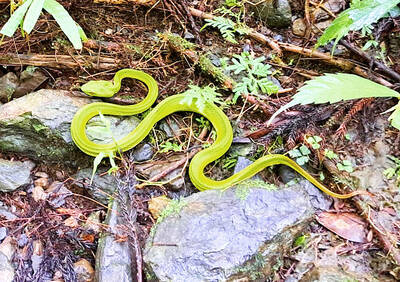
More than half of the bamboo vipers captured in Tainan in the past few years were found in the city’s Sinhua District (新化), while other districts had smaller catches or none at all. Every year, Tainan captures about 6,000 snakes which have made their way into people’s homes. Of the six major venomous snakes in Taiwan, the cobra, the many-banded krait, the brown-spotted pit viper and the bamboo viper are the most frequently captured. The high concentration of bamboo vipers captured in Sinhua District is puzzling. Tainan Agriculture Bureau Forestry and Nature Conservation Division head Chu Chien-ming (朱健明) earlier this week said that the
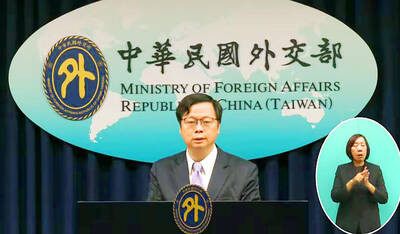
NAMING SPAT: The foreign ministry called on Denmark to propose an acceptable solution to the erroneous nationality used for Taiwanese on residence permits Taiwan has revoked some privileges for Danish diplomatic staff over a Danish permit that lists “Taiwan” as “China,” Eric Huang (黃鈞耀), head of the Ministry of Foreign Affairs’ Department of European Affairs, told a news conference in Taipei yesterday. Reporters asked Huang whether the Danish government had responded to the ministry’s request that it correct the nationality on Danish residence permits of Taiwanese, which has been listed as “China” since 2024. Taiwan’s representative office in Denmark continues to communicate with the Danish government, and the ministry has revoked some privileges previously granted to Danish representatives in Taiwan and would continue to review

Kenting National Park service technician Yang Jien-fon (楊政峰) won a silver award in World Grand Prix Photography Awards Spring Season for his photograph of two male rat snakes intertwined in combat. Yang’s colleagues at Kenting National Park said he is a master of nature photography who has been held back by his job in civil service. The awards accept entries in all four seasons across six categories: architectural and urban photography, black-and-white and fine art photography, commercial and fashion photography, documentary and people photography, nature and experimental photography, and mobile photography. Awards are ranked according to scores and divided into platinum, gold and
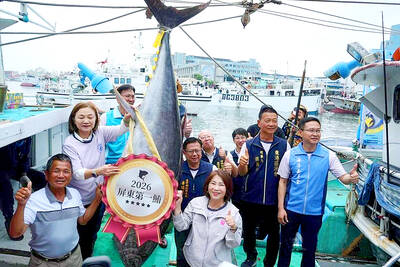
The first bluefin tuna of the season, brought to shore in Pingtung County and weighing 190kg, was yesterday auctioned for NT$10,600 (US$333.5) per kilogram, setting a record high for the local market. The auction was held at the fish market in Donggang Fishing Harbor, where the Siaoliouciou Island-registered fishing vessel Fu Yu Ching No. 2 delivered the “Pingtung First Tuna” it had caught for bidding. Bidding was intense, and the tuna was ultimately jointly purchased by a local restaurant and a local company for NT$10,600 per kilogram — NT$300 ,more than last year — for a total of NT$2.014 million. The 67-year-old skipper


 RSS
RSS