


With several major cultural, religious and sports events postponed or canceled and people spending less time in public due to concerns about COVID-19, online exhibitions are offering people a way of enjoying art and culture while staying home
Several of the nation’s museums, including the National Museum of History in Taipei, the National Palace Museum and the Chimei Museum in Tainan, offer virtual reality (VR) tours of their collections or special exhibitions on their Web sites.
Some of the online exhibitions offered by the history museum, which has been closed since 2018 for renovations, include “From Lines to Network: Chen Cheng-po and His Collection of Painting and Calligraphy” (線條到網絡:陳澄波與他的書畫收藏) and “A Window to Eastern Chou: Eastern Chou Relics Excavated from Honan” (東周實相:河南出土東周文物展).
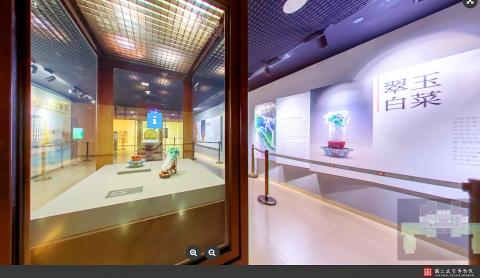
Screen grab from the National Palace Museum Web site
Launched last year, the National Palace Museum’s virtual reality experience lets people see both the inside and outside of the museum and several of its most popular exhibits, including the Meat-shaped Stone (肉形石) and the Jadeite Cabbage (翠玉白菜).
The Chimei Museum, which launched its VR experience in 2017, has made all of its permanent exhibitions available in virtual reality.
Its online tour even allows users to see parts of the museum that are usually closed to regular visitors, such as the Chimei Hall and the roof terrace.
While the Taipei International Book Exhibition, which had been scheduled for last month, was postponed until May, organizers are promoting the sales of books linked to the show via online bookstores.
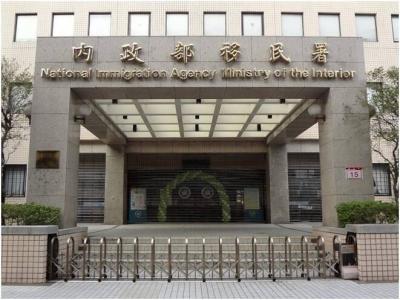
A small number of Taiwanese this year lost their citizenship rights after traveling in China and obtaining a one-time Chinese passport to cross the border into Russia, a source said today. The people signed up through Chinese travel agencies for tours of neighboring Russia with companies claiming they could obtain Russian visas and fast-track border clearance, the source said on condition of anonymity. The travelers were actually issued one-time-use Chinese passports, they said. Taiwanese are prohibited from holding a Chinese passport or household registration. If found to have a Chinese ID, they may lose their resident status under Article 9-1

Taiwanese were praised for their composure after a video filmed by Taiwanese tourists capturing the moment a magnitude 7.5 earthquake struck Japan’s Aomori Prefecture went viral on social media. The video shows a hotel room shaking violently amid Monday’s quake, with objects falling to the ground. Two Taiwanese began filming with their mobile phones, while two others held the sides of a TV to prevent it from falling. When the shaking stopped, the pair calmly took down the TV and laid it flat on a tatami mat, the video shows. The video also captured the group talking about the safety of their companions bathing

PROBLEMATIC APP: Citing more than 1,000 fraud cases, the government is taking the app down for a year, but opposition voices are calling it censorship Chinese Nationalist Party (KMT) Chairwoman Cheng Li-wun (鄭麗文) yesterday decried a government plan to suspend access to Chinese social media platform Xiaohongshu (小紅書) for one year as censorship, while the Presidential Office backed the plan. The Ministry of the Interior on Thursday cited security risks and accusations that the Instagram-like app, known as Rednote in English, had figured in more than 1,700 fraud cases since last year. The company, which has about 3 million users in Taiwan, has not yet responded to requests for comment. “Many people online are already asking ‘How to climb over the firewall to access Xiaohongshu,’” Cheng posted on

A classified Pentagon-produced, multiyear assessment — the Overmatch brief — highlighted unreported Chinese capabilities to destroy US military assets and identified US supply chain choke points, painting a disturbing picture of waning US military might, a New York Times editorial published on Monday said. US Secretary of Defense Pete Hegseth’s comments in November last year that “we lose every time” in Pentagon-conducted war games pitting the US against China further highlighted the uncertainty about the US’ capability to intervene in the event of a Chinese invasion of Taiwan. “It shows the Pentagon’s overreliance on expensive, vulnerable weapons as adversaries field cheap, technologically


 RSS
RSS