


[Editor’s Note: After press time last night, the New Taipei City Government announced it was canceling its marathon.]
Tainan Mayor Huang Wei-che (黃偉哲) yesterday announced that the Tainan Half Marathon scheduled to be held on Sunday would be postponed until October, while the New Taipei City Government said that this year’s New Taipei City Wan Jin Shih Marathon would continue as planned.
Huang’s announcement came only one day after Tainan City Government officials told a media conference what they would do to prevent the spread of COVID-19 at the sports event.
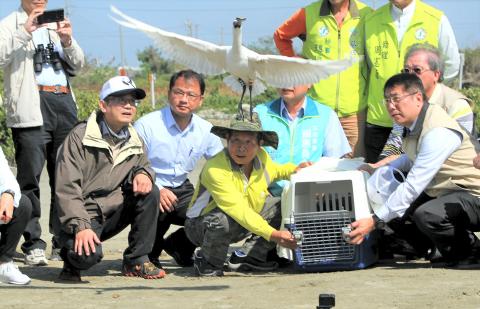
Photo: Yang Chin-cheng, Taipei Times
The Taiwan Medical Alliance for Labor Justice and Patient Safety had urged New Taipei City and Tainan to cancel next month’s marathons.
“We have received comments from many people who urged to city to cancel the event, fearing that it would become a loophole in the nation’s disease-prevention efforts,” Huang said, adding that one of Italy’s confirmed COVID-19 patients reportedly ran in a marathon.
“After consulting medical professionals, we have decided to postpone the event,” he said.
Tainan Bureau of Education Director Cheng Hsin-hui (鄭新輝) said that more than 14,000 people were expected to participate in the half marathon.
The city cannot guarantee that runners would not contract the disease at the event, he said.
If one of the runners was confirmed to have contracted COVID-19, it would impose a tremendous burden on disease-prevention officials, he added.
As such, the city decided to postpone the event to the middle of October, Cheng said, adding that it was a painful decision and that he hoped all runners would understand and cooperate with efforts to prevent the spread of the disease.
People who still plan to take part in the half marathon in October are advised to keep their runner’s bibs and monitor updated information on the event’s Web site, the Tainan Department of Sports said.
On the other hand, the New Taipei City Government said that the city’s Wan Jin Shi Marathon would be held on March 15 as scheduled.
The marathon, which has been certified as a silver-label road race by World Athletics, has over the past several years become one of the biggest sporting events in northern Taiwan, attracting runners from around the world.
About 11,000 runners are expected to participate in the event, which has a full marathon group and a 10K challenger group, New Taipei City Sports Office Director Hung Yu-ling (洪玉玲) said.
Following instructions from the Central Epidemic Command Center, Hung said that the city has disqualified 206 runners from China, South Korea, Hong Kong and Macau, adding that it would adjust the qualifications of runners from other countries based on the center’s instructions.
Participants who have applied to run in next year’s marathon instead due to concern over COVID-19 would not have to pay registration fees again, she said.
About 6,000 runners are to compete in the race next month, the office said, adding that there would not be an opening ceremony, a warm-up session or meal service on the day of the race.
The space where runners are to gather would be larger and shuttle buses to pick up runners who finish the race would set out earlier than scheduled, it said.
New Taipei City Mayor Hou You-yi (侯友宜) said that the race does not have to be canceled if runners can start one group at a time and avoid massing into a large crowd.
The city respects the central government’s suggestions, but local government officials often have a more accurate grasp of the situation, he said.
A small number of Taiwanese this year lost their citizenship rights after traveling in China and obtaining a one-time Chinese passport to cross the border into Russia, a source said today. The people signed up through Chinese travel agencies for tours of neighboring Russia with companies claiming they could obtain Russian visas and fast-track border clearance, the source said on condition of anonymity. The travelers were actually issued one-time-use Chinese passports, they said. Taiwanese are prohibited from holding a Chinese passport or household registration. If found to have a Chinese ID, they may lose their resident status under Article 9-1

Taiwanese were praised for their composure after a video filmed by Taiwanese tourists capturing the moment a magnitude 7.5 earthquake struck Japan’s Aomori Prefecture went viral on social media. The video shows a hotel room shaking violently amid Monday’s quake, with objects falling to the ground. Two Taiwanese began filming with their mobile phones, while two others held the sides of a TV to prevent it from falling. When the shaking stopped, the pair calmly took down the TV and laid it flat on a tatami mat, the video shows. The video also captured the group talking about the safety of their companions bathing

PROBLEMATIC APP: Citing more than 1,000 fraud cases, the government is taking the app down for a year, but opposition voices are calling it censorship Chinese Nationalist Party (KMT) Chairwoman Cheng Li-wun (鄭麗文) yesterday decried a government plan to suspend access to Chinese social media platform Xiaohongshu (小紅書) for one year as censorship, while the Presidential Office backed the plan. The Ministry of the Interior on Thursday cited security risks and accusations that the Instagram-like app, known as Rednote in English, had figured in more than 1,700 fraud cases since last year. The company, which has about 3 million users in Taiwan, has not yet responded to requests for comment. “Many people online are already asking ‘How to climb over the firewall to access Xiaohongshu,’” Cheng posted on

A classified Pentagon-produced, multiyear assessment — the Overmatch brief — highlighted unreported Chinese capabilities to destroy US military assets and identified US supply chain choke points, painting a disturbing picture of waning US military might, a New York Times editorial published on Monday said. US Secretary of Defense Pete Hegseth’s comments in November last year that “we lose every time” in Pentagon-conducted war games pitting the US against China further highlighted the uncertainty about the US’ capability to intervene in the event of a Chinese invasion of Taiwan. “It shows the Pentagon’s overreliance on expensive, vulnerable weapons as adversaries field cheap, technologically


 RSS
RSS