


Premier Su Tseng-chang (蘇貞昌) yesterday at the Legislative Yuan in Taipei touted his Cabinet’s achievements in areas ranging from disease prevention, the cultural and creative sectors, and renewable energy to collaborations with the indigenous defense industry.
Su was giving his administrative report and answered legislators’ questions on the first day of the new legislative session.
An outbreak of COVID-19 has continued to spread since the coronavirus appeared in Wuhan, China, in December last year and because Taiwan is on the front line of disease prevention, the government has introduced a disease-prevention, relief and recovery bill aimed at safeguarding the health of all Taiwanese and helping affected industries over times of hardship, Su said.
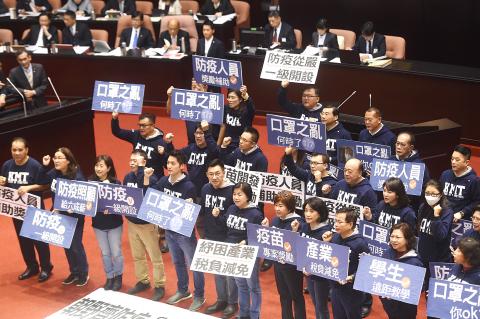
Photo: Chien Jung-fong, Taipei Times
The government has also been implementing policies to transform the nation’s energy mix, Su said, adding that work to install photovoltaic and wind power facilities have begun to bear fruit.
The nation’s electricity operating reserve slumped to 1.64 percent in May 2015, but thanks to the construction of offshore wind farms and solar power facilities, the operating reserve and reserve margin have consistently hit 10 percent and 16 percent respectively since June last year, ensuring stable power supplies, he said.
Photovoltaic electricity generation on Sept. 2 last year reached 2 million kilowatt-hours, exceeding the output capacity of generators at the Guosheng Nuclear Power Plant in New Taipei City’s Wanli District (萬里) or the Ma-anshan Nuclear Power Plant in Pingtung County, he said.
Meanwhile, 22 wind turbines on a wind farm off Miaoli County’s Jhunan Township (竹南) have commenced operations and are expected to produce enough electricity to power 128,000 households — more than half of the number of households in the county, he said.
The government has also been collaborating with the local defense industry on projects to build indigenous planes and ships, Su said.
The T-5 “Brave Eagle” advanced jet trainer debuted last year and is scheduled to make its maiden flight in June, he said, adding that contractor Aerospace Industrial Development Corp plans to deliver all 66 jets ordered by 2026.
Later this year, the Coast Guard Administration is to take ownership of a 4,000-tonne cruiser — the nation’s largest ever — that can carry helicopters, Su said.
The navy is expecting to receive 71 new vessels by 2029, he added.
In an effort to nourish the cultural and creative sectors, the government earmarked a NT$40.3 billion (US$1.33 billion) budget, part of which was used to incorporate technology into the local film industry, he said, adding that the highly successful movie Detention (返校), adapted from a computer game, was a successful example of a collaboration between the video game and film industries.
Meanwhile, the Taiwan Creative Content Agency, which was launched in November last year, is to embark on collaborations with the film, TV and music industries, the publishing industry, the digital publishing industry, the anime, comic and video game industries, as well as the fashion and art sectors, he said.
The collaborations would be driven by two projects approved by the Executive Yuan: The NT$10 billion “mid-term project to develop the film, TV and music industries” and the “Huashan 2.0 cultural content industrial cluster development project,” in the hope of improving the quality and marketing of locally produced cultural and creative content, he said.
Asked by Democratic Progressive Party Legislator Cheng Yun-peng (鄭運鵬) whether the government would extend the life of the Transitional Justice Commission, whose operations are subject to a two-year limit under the Act on Promoting Transitional Justice (促進轉型正義條例), but which can be extended for a year at the discretion of the premier, Su said that he would invoke the extension so that the commission could continue its research and compile more detailed reports on the White Terror era.
It is impossible for the injustices perpetrated by the state over several decades to be redressed within a two-year time frame, he added.
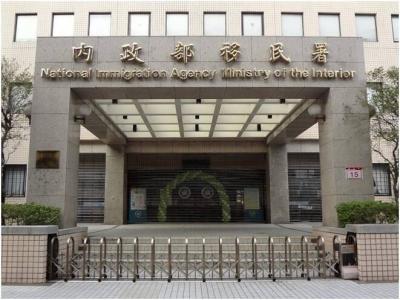
A small number of Taiwanese this year lost their citizenship rights after traveling in China and obtaining a one-time Chinese passport to cross the border into Russia, a source said today. The people signed up through Chinese travel agencies for tours of neighboring Russia with companies claiming they could obtain Russian visas and fast-track border clearance, the source said on condition of anonymity. The travelers were actually issued one-time-use Chinese passports, they said. Taiwanese are prohibited from holding a Chinese passport or household registration. If found to have a Chinese ID, they may lose their resident status under Article 9-1

Taiwanese were praised for their composure after a video filmed by Taiwanese tourists capturing the moment a magnitude 7.5 earthquake struck Japan’s Aomori Prefecture went viral on social media. The video shows a hotel room shaking violently amid Monday’s quake, with objects falling to the ground. Two Taiwanese began filming with their mobile phones, while two others held the sides of a TV to prevent it from falling. When the shaking stopped, the pair calmly took down the TV and laid it flat on a tatami mat, the video shows. The video also captured the group talking about the safety of their companions bathing

PROBLEMATIC APP: Citing more than 1,000 fraud cases, the government is taking the app down for a year, but opposition voices are calling it censorship Chinese Nationalist Party (KMT) Chairwoman Cheng Li-wun (鄭麗文) yesterday decried a government plan to suspend access to Chinese social media platform Xiaohongshu (小紅書) for one year as censorship, while the Presidential Office backed the plan. The Ministry of the Interior on Thursday cited security risks and accusations that the Instagram-like app, known as Rednote in English, had figured in more than 1,700 fraud cases since last year. The company, which has about 3 million users in Taiwan, has not yet responded to requests for comment. “Many people online are already asking ‘How to climb over the firewall to access Xiaohongshu,’” Cheng posted on

A classified Pentagon-produced, multiyear assessment — the Overmatch brief — highlighted unreported Chinese capabilities to destroy US military assets and identified US supply chain choke points, painting a disturbing picture of waning US military might, a New York Times editorial published on Monday said. US Secretary of Defense Pete Hegseth’s comments in November last year that “we lose every time” in Pentagon-conducted war games pitting the US against China further highlighted the uncertainty about the US’ capability to intervene in the event of a Chinese invasion of Taiwan. “It shows the Pentagon’s overreliance on expensive, vulnerable weapons as adversaries field cheap, technologically


 RSS
RSS