

President Tsai Ing-wen (蔡英文) yesterday received Project 2049 Institute chairman Randall Schriver, a former US assistant secretary of defense for Indo-Pacific security affairs, at the Presidential Office in Taipei and thanked him for facilitating the sale of F-16V jets to Taiwan.
Taiwan is Schriver’s “first stop” abroad since he left his post in December last year, Tsai said.
During his tenure as a top US Department of State official, Schriver worked to enhance the Taiwan-US security relationship, and valued Taiwan’s role and position in the Indo-Pacific region, she said.
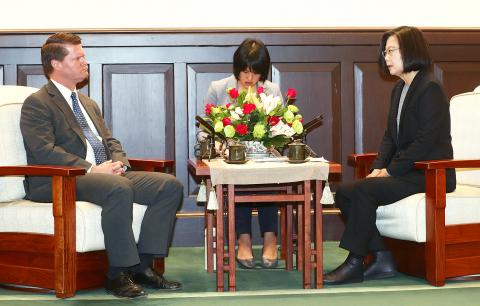
Photo: CNA
“I would like to take this opportunity to especially thank chairman Schriver for his support and contribution to Taiwan’s democracy, freedom and security,” Tsai said.
In the Jan. 11 presidential election, Taiwanese once again showed their commitment to democratic values, she said.
Taiwan’s democratic defense mechanisms would continue to be strengthened, Tsai said, adding that Taipei hoped to work with the US and other like-minded countries toward “peace, stability and prosperity” in the Indo-Pacific region.
Global public health and economies worldwide have been severely affected by an outbreak of COVID-19 in China, she said.
Taiwan is a member of the global community, she said, adding that “disease knows no borders.”
Tsai thanked Washington, the US Congress and Americans for their support and assistance regarding Taiwan’s participation in the WHO.
Taiwan is willing and able to contribute more to the international community, whether it comes to experience in preventing epidemics, healthcare capabilities or even in the peace, stability and prosperity of the overall region, she said.
Taiwan should not be excluded from conversations because of political reasons, she added.
Tsai said that she looked forward to Schriver providing Taiwan with support and advice, and working together for the development of Taiwan-US relations.
Speaking at the Institute for National Defense and Security Research in Taipei on Wednesday, Schriver said that the US is in “an era of strategic competition with China.”
“I think at the most fundamental level, we are competing in order to maintain an advantage and an edge so that we can continue to promote the qualities and characteristics of a free and open Indo-Pacific,” Schriver said.
“Our competition is not for geography,” he said. “It’s not for territory or water or for control. In fact, the United States has no ambition in the Indo-Pacific commons other than to ensure that they remain free and open.”
“Taiwan’s ability to protect itself, to protect its sovereignty, to deal with the emerging challenges of China is really the linchpin to security throughout the Indo-Pacific,” Schriver said. “So our partnership with Taiwan is very focused on helping Taiwan implement its own strategy.”
“Taiwan is in its own way building out its own relationships with other countries who share the same vision beyond the United States,” he said.
“So the United States, I think, can also be a bridge in helping Taiwan strengthen its relations with other key actors in the region,” he added.
A total of 400 foreign “high- level” professionals have been naturalized as Republic of China (Taiwan) citizens over the past decade as the government has eased nationality rules to attract talent from a wider range of fields, the Ministry of the Interior said yesterday. The 400th high-level professional, who works in the electronics industry, was approved for ROC citizenship on Aug. 26, the MOI said. The MOI quoted the newly naturalized citizen as saying that Taiwan is a leader in fields such as semiconductors, electronics manufacturing, artificial intelligence development and energy technology. He also said
China has warned that it could cancel a planned US-China leaders’ summit if Washington approves new arms sales to Taiwan, a Japanese media outlet quoted sources as saying yesterday. US President Donald Trump, “apparently eager to showcase some diplomatic achievements ahead of November’s midterm congressional elections, places great importance on holding the summit with Chinese President Xi Jinping (習近平),” Japan’s Kyodo News reported. “While preparing for Xi’s upcoming trip, China has restated its position that the Taiwan issue is a ‘red line’ in bilateral relations,” the report said. The report said that when Xi met with Trump in Beijing in May, Xi said
A Chinese military drone was spotted conducting reconnaissance off Taitung County as President William Lai (賴清德) visited Pingtung County this morning to inspect a drill of the armed forces’ precision-strike capabilities, prompting the military to closely monitor its actions. Today was the final day of a three-day military exercise at Jioupeng Base (九鵬基地) to test the joint combat capabilities of the armed forces and coast guard. The exercise began on Wednesday simulating air defense interception and yesterday tested long-range strike capabilities and new air defense weapons. This morning, the military conducted a final exercise involving air defense, anti-ship and drone operations. Military sources said
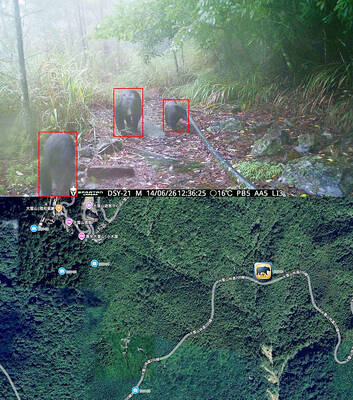
RARE PEEK: The footage released showed one of the bears staying in a cave for as long as 70 days, providing the first record of Formosan black bear’s overwintering The Forestry and Nature Conservation Agency yesterday released tracking records of released Formosan black bears for the first time, showing that they get much closer to human settlements than previously thought. The agency said it had captured two bears, Da Qu-ali (達古阿里) and Aziman (阿里曼), in indigenous villages in Hualien County and began to track them with a camera-mounted satellite collar after releasing them back into the wild. The results confirmed that the bears have moved from deep mountain areas into lowland hills closer to human communities, leading to an increase in human-bear conflicts, it said. The agency has introduced artificial intelligence-assisted early


 RSS
RSS