


The “US-Taiwan Tech Challenge: Countering Disinformation and Propaganda,” opened yesterday in Taipei as part of efforts by the two nations to develop innovative technologies to curtail the spread of disinformation.
Co-organized by the American Institute in Taiwan (AIT) and the US Department of State’s Global Engagement Center, the two-day event aims to advance the development of technologies that offer solutions to help expose, understand or counter misinformation and disinformation, the AIT said.
AIT Deputy Director Raymond Greene and Patricia Watts, who is also the director of the department’s Technology Engagement Team, attended the opening ceremony at the Taipei International Convention Center.
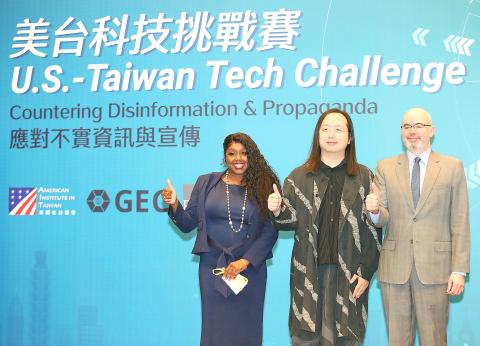
Photo: CNA
“We are confident that the assembled technologists, experts and others at this tech challenge will be able to develop cutting-edge solutions to the challenges posed by disinformation,” Greene said.
Countering disinformation is one of the most complex challenges facing democratic societies around the world, he said.
Taiwan is on the front line in the fight against disinformation, in which China has invested heavily to develop sophisticated ways to anonymously disseminate disinformation through various channels, including social media, he added.
“The US and Taiwan are capable and complementary partners in confronting the challenge of disinformation,” Greene said, adding that the US could learn from Taiwan’s approach, which combines school curriculum reform, technology development, academic research and refined fact-checking methods.
Fabricated news reports and disinformation aimed at influencing election results spread over social media before the elections in 2018 and last month, and most of them were found to have originated from China.
Disinformation about an outbreak of COVID-19 has also spread on Taiwan’s social media.
Minister Without Portfolio Audrey Tang (唐鳳), who is responsible for digital technology, in her keynote speech shared Taiwan’s playbook for countering disinformation, which involves timely response and collaborative fact-checking.
It also requires transparency in campaign expenditures and donations during elections to determine funding sources, she said.
Seven technology companies — five Taiwanese and one each from Australia and Israel — demonstrated the technologies they have developed to address disinformation to a panel of judges on the event’s first day, as they competed for funding totaling US$250,000.
Four interactive panel sessions on the development and implementation of technology to counter disinformation are to be held today.
The panelists are to include representatives from Facebook, Microsoft and Google.
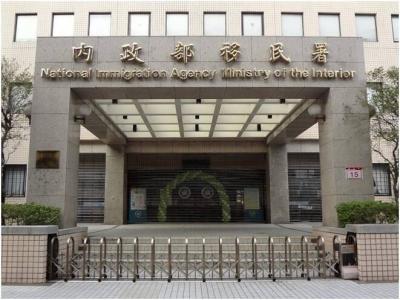
A small number of Taiwanese this year lost their citizenship rights after traveling in China and obtaining a one-time Chinese passport to cross the border into Russia, a source said today. The people signed up through Chinese travel agencies for tours of neighboring Russia with companies claiming they could obtain Russian visas and fast-track border clearance, the source said on condition of anonymity. The travelers were actually issued one-time-use Chinese passports, they said. Taiwanese are prohibited from holding a Chinese passport or household registration. If found to have a Chinese ID, they may lose their resident status under Article 9-1

Taiwanese were praised for their composure after a video filmed by Taiwanese tourists capturing the moment a magnitude 7.5 earthquake struck Japan’s Aomori Prefecture went viral on social media. The video shows a hotel room shaking violently amid Monday’s quake, with objects falling to the ground. Two Taiwanese began filming with their mobile phones, while two others held the sides of a TV to prevent it from falling. When the shaking stopped, the pair calmly took down the TV and laid it flat on a tatami mat, the video shows. The video also captured the group talking about the safety of their companions bathing

PROBLEMATIC APP: Citing more than 1,000 fraud cases, the government is taking the app down for a year, but opposition voices are calling it censorship Chinese Nationalist Party (KMT) Chairwoman Cheng Li-wun (鄭麗文) yesterday decried a government plan to suspend access to Chinese social media platform Xiaohongshu (小紅書) for one year as censorship, while the Presidential Office backed the plan. The Ministry of the Interior on Thursday cited security risks and accusations that the Instagram-like app, known as Rednote in English, had figured in more than 1,700 fraud cases since last year. The company, which has about 3 million users in Taiwan, has not yet responded to requests for comment. “Many people online are already asking ‘How to climb over the firewall to access Xiaohongshu,’” Cheng posted on

A classified Pentagon-produced, multiyear assessment — the Overmatch brief — highlighted unreported Chinese capabilities to destroy US military assets and identified US supply chain choke points, painting a disturbing picture of waning US military might, a New York Times editorial published on Monday said. US Secretary of Defense Pete Hegseth’s comments in November last year that “we lose every time” in Pentagon-conducted war games pitting the US against China further highlighted the uncertainty about the US’ capability to intervene in the event of a Chinese invasion of Taiwan. “It shows the Pentagon’s overreliance on expensive, vulnerable weapons as adversaries field cheap, technologically


 RSS
RSS