


The Travel Quality Assurance Association yesterday published a report that included reference prices for overseas tour packages from April to June, saying that customers can preorder the discounted products while they are still on the market.
Due to COVID-19, tourism has declined, with many scheduled tours getting canceled, the association said.
However, the tourism sector is gearing up for a sales rebound, such as the one after the 2002-2003 SARS epidemic, and readying itself for the first peak travel season after COVID-19 is contained and diminishes, it said.

Photo: Cheng Wei-chi, Taipei Times
The second quarter is typically the peak season for groups traveling to Japan and with a weaker yen, prices for tours during that time are about NT$1,000 to NT$2,000 less than last year, association member Tsai Ching-hui (蔡錦惠) said.
The price of a five-day tour to Kyushu costs between NT$18,800 and NT$61,800; a five-day tour to Keihanshin — a metropolitan region encompassing the cities of Kyoto, Osaka and Kobe — between NT$26,800 and NT$57,800; and a four-day tour to Tokyo between NT$28,800 and NT$45,800, she said.
The prices of tours to South Korea are NT$500 to NT$1,000 cheaper than last year, she said, adding that a five-day tour to Seoul costs between NT$11,800 and NT$26,800, while a five-day tour to Busan or Jeju Island costs between NT$11,800 and NT$22,800.
A five-day tour to the Philippine islands of Boracay, Palawan or Cebu costs between NT$16,900 and NT$31,800, association member Hsiang Chien-lun (向健倫) said.
The prices of tours to Thailand in the second quarter are generally stable, with a five-day tour to Bangkok or Pattaya costing between NT$16,000 and NT$24,000, and a five-day tour to Chiang Mai between NT$19,000 and NT$31,000, he added.
The peak season for tours to the US and Canada starts in April, including popular destinations such as Yellowstone National Park and the Canadian icefields, association member Tsai Chia-hsuan (蔡佳璇) said.
The prices of US tours are NT$1,000 cheaper than last year, whereas tours to Canada are NT$5,000 to NT$10,000 more expensive, Tsai said.
US regulations on COVID-19 state that travelers who have visited China, Hong Kong or Macau must have papers showing that they were placed under home quarantine, but Taiwanese can obtain a certificate from the National Immigration Agency so that they can enter the US, Tsai said.
Many Taiwanese visit Europe in April, but the outbreak has sparked some negative reactions among Europeans toward Asians, prompting several travel agencies to offer special promotions, association member Hsiao Shih-hua (蕭世華) said.
Australia and New Zealand have been less affected by COVID-19 and Australia’s bushfires have been contained, association member Huang Hsien-tsai (黃賢在) said, adding that prices of tours to Australia are about NT$1,000 cheaper than last year, while tours to New Zealand are NT$2,000 cheaper.
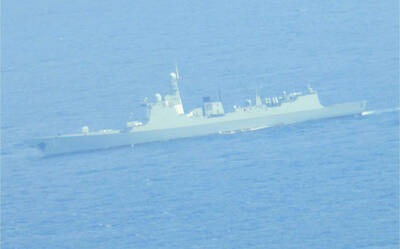
The military has spotted two Chinese warships operating in waters near Penghu County in the Taiwan Strait and sent its own naval and air forces to monitor the vessels, the Ministry of National Defense (MND) said. Beijing sends warships and warplanes into the waters and skies around Taiwan on an almost daily basis, drawing condemnation from Taipei. While the ministry offers daily updates on the locations of Chinese military aircraft, it only rarely gives details of where Chinese warships are operating, generally only when it detects aircraft carriers, as happened last week. A Chinese destroyer and a frigate entered waters to the southwest
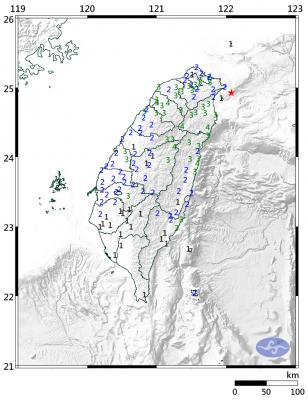
A magnitude 6.1 earthquake struck off the coast of Yilan County at 8:39pm tonight, the Central Weather Administration (CWA) said, with no immediate reports of damage or injuries. The epicenter was 38.7km east-northeast of Yilan County Hall at a focal depth of 98.3km, the CWA’s Seismological Center said. The quake’s maximum intensity, which gauges the actual physical effect of a seismic event, was a level 4 on Taiwan’s 7-tier intensity scale, the center said. That intensity level was recorded in Yilan County’s Nanao Township (南澳), Hsinchu County’s Guansi Township (關西), Nantou County’s Hehuanshan (合歡山) and Hualien County’s Yanliao (鹽寮). An intensity of 3 was
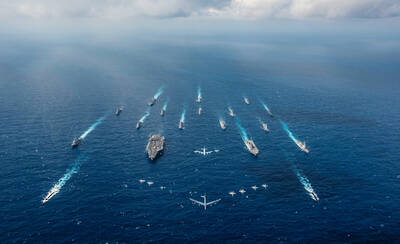
Japanese Prime Minister Sanae Takaichi’s comment last year on Tokyo’s potential reaction to a Taiwan-China conflict has forced Beijing to rewrite its invasion plans, a retired Japanese general said. Takaichi told the Diet on Nov. 7 last year that a Chinese naval blockade or military attack on Taiwan could constitute a “survival-threatening situation” for Japan, potentially allowing Tokyo to exercise its right to collective self-defense. Former Japan Ground Self-Defense Force general Kiyofumi Ogawa said in a recent speech that the remark has been interpreted as meaning Japan could intervene in the early stages of a Taiwan Strait conflict, undermining China’s previous assumptions
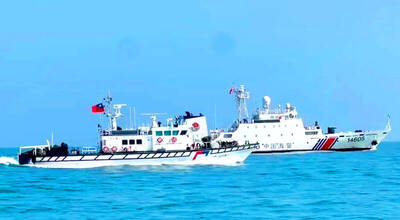
Instead of focusing solely on the threat of a full-scale military invasion, the US and its allies must prepare for a potential Chinese “quarantine” of Taiwan enforced through customs inspections, Stanford University Hoover fellow Eyck Freymann said in a Foreign Affairs article published on Wednesday. China could use various “gray zone” tactics in “reconfiguring the regional and ultimately the global economic order without a war,” said Freymann, who is also a nonresident research fellow at the US Naval War College. China might seize control of Taiwan’s links to the outside world by requiring all flights and ships entering or leaving Taiwan


 RSS
RSS