


The Criminal Investigation Bureau yesterday said that it had identified the suspect behind a Facebook post that said ingesting the highly toxic chemical cyanide could be used to protect against the 2019 novel coronavirus.
The bureau received a report a day earlier that someone in the Facebook group “Taiwan & Japan” had posted potentially harmful misinformation about the virus, and later identified the suspect as a 29-year-old Taiwanese surnamed Yu (游).
The now-deleted post said that “cyanide can be used to kill the novel coronavirus and prevent disease. Chinese people, take it quickly! If you do not have [cyanide] on hand, you can grind up large quantities of apple seeds into powder, and then ingest it.”
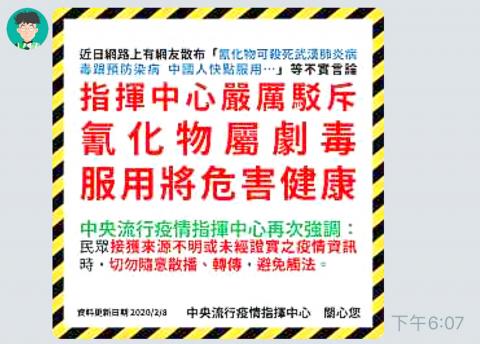
Photo: Yao Yueh-hung, Taipei Times
The bureau said it has asked Yu, who is studying in Japan, to return to Taiwan as soon as possible.
His case would be turned over to prosecutors for further investigation, it said.
Under Taiwan’s Communicable Disease Control Act (傳染病防治法), people who disseminate rumors or false information concerning communicable diseases that result in damage to the public can be fined up to NT$3 million (US$99,582).
Commenting on the case, Democratic Progressive Party Legislator Lin Chun-hsien (林俊憲) wrote on Facebook yesterday, urging people not to repost news stories that seem questionable.
“Spreading this type of deadly fake news? Do they not have a heart?” he asked.
Fake news about the coronavirus is dangerous, because given the havoc wreaked by the epidemic, people are likely to believe anything they read about it, including stories about prevention and treatment, Lin said.
He said that spreading fake news alleging that an infection could be treated with cyanide was obviously intended to harm people.
“Cyanide is highly toxic. Coming into contact with even a small amount of the compound is fatal. There is no need to even mention that it cannot cure a disease,” he said.
Lin advised people to add themselves to the Centers for Disease Control’s official Line account, which provides the latest updates on the coronavirus and dispels rumors found circulating online.
Additional reporting by Hsieh Chun-lin
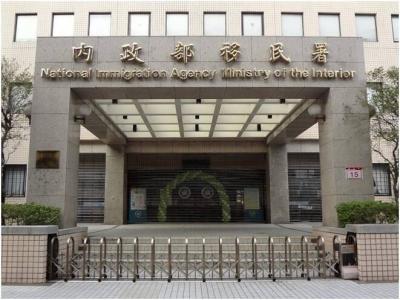
A small number of Taiwanese this year lost their citizenship rights after traveling in China and obtaining a one-time Chinese passport to cross the border into Russia, a source said today. The people signed up through Chinese travel agencies for tours of neighboring Russia with companies claiming they could obtain Russian visas and fast-track border clearance, the source said on condition of anonymity. The travelers were actually issued one-time-use Chinese passports, they said. Taiwanese are prohibited from holding a Chinese passport or household registration. If found to have a Chinese ID, they may lose their resident status under Article 9-1

Taiwanese were praised for their composure after a video filmed by Taiwanese tourists capturing the moment a magnitude 7.5 earthquake struck Japan’s Aomori Prefecture went viral on social media. The video shows a hotel room shaking violently amid Monday’s quake, with objects falling to the ground. Two Taiwanese began filming with their mobile phones, while two others held the sides of a TV to prevent it from falling. When the shaking stopped, the pair calmly took down the TV and laid it flat on a tatami mat, the video shows. The video also captured the group talking about the safety of their companions bathing

PROBLEMATIC APP: Citing more than 1,000 fraud cases, the government is taking the app down for a year, but opposition voices are calling it censorship Chinese Nationalist Party (KMT) Chairwoman Cheng Li-wun (鄭麗文) yesterday decried a government plan to suspend access to Chinese social media platform Xiaohongshu (小紅書) for one year as censorship, while the Presidential Office backed the plan. The Ministry of the Interior on Thursday cited security risks and accusations that the Instagram-like app, known as Rednote in English, had figured in more than 1,700 fraud cases since last year. The company, which has about 3 million users in Taiwan, has not yet responded to requests for comment. “Many people online are already asking ‘How to climb over the firewall to access Xiaohongshu,’” Cheng posted on

A classified Pentagon-produced, multiyear assessment — the Overmatch brief — highlighted unreported Chinese capabilities to destroy US military assets and identified US supply chain choke points, painting a disturbing picture of waning US military might, a New York Times editorial published on Monday said. US Secretary of Defense Pete Hegseth’s comments in November last year that “we lose every time” in Pentagon-conducted war games pitting the US against China further highlighted the uncertainty about the US’ capability to intervene in the event of a Chinese invasion of Taiwan. “It shows the Pentagon’s overreliance on expensive, vulnerable weapons as adversaries field cheap, technologically


 RSS
RSS