


Chinese Nationalist Party (KMT) Legislator Johnny Chiang (江啟臣) yesterday obtained an application form for the party’s chairperson by-election, signaling the start of a face-off between the party’s old guard and younger generation.
Registration for the by-election is set for Monday and Tuesday next week, while the election is to be held on March 7.
Following the party’s defeats in the Jan. 11 presidential and legislative elections, KMT members have been debating how to reform the party.
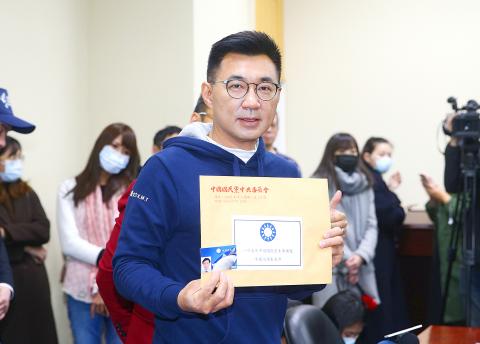
Photo: CNA
Representing the KMT’s younger faction, Chiang was the first to take the application and pay the required NT$2 million (US$66,057) fee, while former KMT vice chairman Hau Lung-bin (郝龍斌), seen as Chiang’s main opponent, is expected to pick up a form today.
If the KMT wants to become the ruling party again, it should adopt reforms and respond quickly to shifts in public opinion, Chiang told a news conference in Taipei.
The party must also adjust its outdated mindset and figure out how to attract more support from young people, he added.
Under his leadership, there would be room in party affairs for the younger generation and his team would recruit more young talent with popular support, he said.
Asked whether Hau has a heart “young” enough for the KMT, Chiang said that although he respects Hau’s different stances and policies, he would only discuss his own goals during the campaign.
Former Taipei County commissioner Chou Hsi-wei (周錫瑋) said on Facebook that he would not seek the chairperson position, and voiced his support for Chiang, saying that those who have already worked as chairman or vice chairman should give younger people an opportunity.
Asked for comment, Hau said that he respects all kinds of individual opinions.
Although including visionary people who are willing to shoulder duties for the party is a good thing, the KMT’s transformation requires cross-generational cooperation, and he is willing to take on the role of coordinator, Hau said.
Having served as the KMT’s vice chairman and Taipei mayor, Hau said that he understands the party and has good execution, and he would never use the post as a springboard for other positions, because the chairman’s responsibility is to complement other party members, giving them enough space to bring their skills into full play.
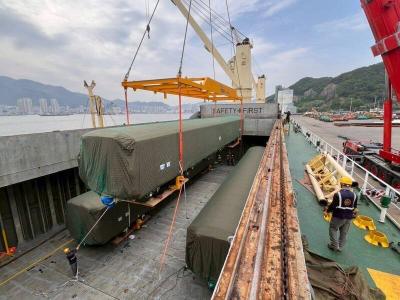
The first of 10 new high-capacity trains purchased from South Korea’s Hyundai Rotem arrived at the Port of Taipei yesterday to meet the demands of an expanding metro network, Taipei Rapid Transit Corp (TRTC) said yesterday. The train completed a three-day, 1,200km voyage from the Port of Masan in South Korea, the company said. Costing NT$590 million (US$18.79 million) each, the new six-carriage trains feature a redesigned interior based on "human-centric" transportation concepts, TRTC said. The design utilizes continuous longitudinal seating to widen the aisles and optimize passenger flow, while also upgrading passenger information displays and driving control systems for a more comfortable
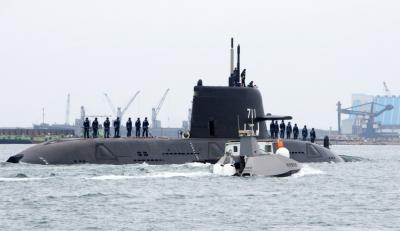
Taiwan's first indigenous defense submarine, the SS-711 Hai Kun (海鯤, or Narwhal), departed for its 13th sea trial at 7am today, marking its seventh submerged test, with delivery to the navy scheduled for July. The outing also marked its first sea deployment since President William Lai (賴清德) boarded the submarine for an inspection on March 19, drawing a crowd of military enthusiasts who gathered to show support. The submarine this morning departed port accompanied by CSBC Corp’s Endeavor Manta (奮進魔鬼魚號) uncrewed surface vessel and a navy M109 assault boat. Amid public interest in key milestones such as torpedo-launching operations and overnight submerged trials,
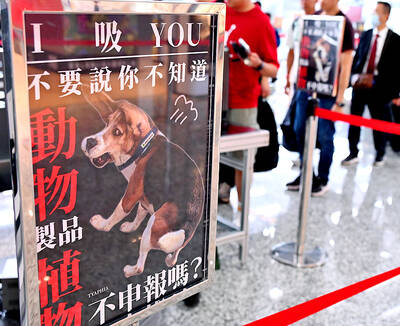
Quarantine awareness posters at Taiwan Taoyuan International Airport have gone viral for their use of wordplay. Issued by the airport branch of the Animal and Plant Health Inspection Agency, the posters feature sniffer dogs making a range of facial expressions, paired with advisory messages built around homophones. “We update the messages for holidays and campaign needs, periodically refreshing materials to attract people’s attention,” quarantine officials said. “The aim is to use the dogs’ appeal to draw focus to quarantine regulations.” A Japanese traveler visiting Taiwan has posted a photo on X of a poster showing a quarantine dog with a

Taiwan’s coffee community has launched a “one-person-one-e-mail” campaign, calling for people to send a protest-e-mail to the World Coffee Championships (WCC) urging it to redesignate Taiwanese competitors as from “Taiwan,” rather than “Chinese Taipei.” The call followed sudden action last week after the WCC changed all references to Taiwanese competitors from “Taiwan” to “Chinese Taipei,” including recent World Latte Art champion Bala (林紹興), who won the World Latte Art Championship in San Diego earlier this month. When Bala received the trophy, he was referred to as representing Taiwan, as well as in the announcement on the WCC’s Web site, until it


 RSS
RSS