


People should wear surgical masks and frequently wash their hands to protect against a new type of coronavirus, doctors said on Tuesday after Taiwan confirmed its first case of the virus earlier in the day.
People should avoid visiting Wuhan, China, where the new novel coronavirus (2019-nCoV) outbreak is believed to have started last month, Huang Ching-tai (黃景泰), chief of the division of infectious diseases at the department of internal medicine at New Taipei City’s Linkou Chang Gung Memorial Hospital, told reporters.
There is limited knowledge about how the virus is transmitted, but as more than a dozen medical workers in China are confirmed to have contracted it, it is highly likely that the virus is spread by contact, meaning that the infected medical workers might have touched surfaces contaminated by respiratory droplets from infected individuals, Huang said.
People in Taiwan should reduce their visits to crowded places and should wear a surgical mask during such visits, he said.
People are advised to frequently wash their hands thoroughly with soap, Huang said adding that they should not touch their face, especially eyes, nose or mouth, before washing their hands.
Surgical masks, if properly worn, are effective at preventing the spread of infections, he said, adding that once a mask is damaged or soiled, the wearer should immediately replace it.
There is no need to wear N95 masks, as they can make it more difficult for wearers to breathe and most people are unable to wear them for a long period, Huang added.
Hwang Kao-pin (黃高彬), director of the division of pediatric infectious diseases at China Medical University in Taichung, said that people who have to visit China should avoid contact with animals.
Wearing surgical masks during long journeys, such as on an airplane or train, also offers better protection, he added.
The government has already raised its travel alert for Wuhan, calling on Taiwanese to avoid visiting it.
Centers for Disease Control (CDC) Deputy Director-General Chuang Jen-hsiang (莊人祥) said that wearing a surgical mask can reduce a healthy person’s risk of getting sick by up to 80 percent.
Chuang also said that there is no need for regular people to wear N95 masks, which are more suitable for medical workers.
Demand for surgical and N95 masks has risen over the past few weeks, retailers have said.
According to health and beauty retail group A.S. Watson Group, sales of face masks increased 30 percent during the first three weeks of this month, compared with the same period last year.
Online shopping site ihergo said that it sold 150,000 face masks from Jan. 1 to Monday, which is nearly three times the amount it sold last month.
The CDC said that it has 44 million surgical masks and 1.9 million N95 masks — more than enough to meet demand.

LOUD AND PROUD Taiwan might have taken a drubbing against Australia and Japan, but you might not know it from the enthusiasm and numbers of the fans Taiwan might not be expected to win the World Baseball Classic (WBC) but their fans are making their presence felt in Tokyo, with tens of thousands decked out in the team’s blue, blowing horns and singing songs. Taiwanese fans have packed out the Tokyo Dome for all three of their games so far and even threatened to drown out home team supporters when their team played Japan on Friday. They blew trumpets, chanted for their favorite players and had their own cheerleading squad who dance on a stage during the game. The team struggled to match that exuberance on the field, with
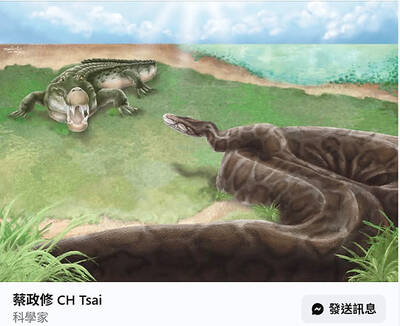
Taiwanese paleontologists have discovered fossil evidence that pythons up to 4m long inhabited Taiwan during the Pleistocene epoch, reporting their findings in the international scientific journal Historical Biology. National Taiwan University (NTU) Institute of Ecology and Evolutionary Biology associate professor Tsai Cheng-hsiu (蔡政修) led the team that discovered the largest snake fossil ever found in Taiwan. The single trunk vertebra was discovered in Tainan at the Chiting Formation, dated to between 400,000 and 800,000 years ago in the Middle Pleistocene, the paper said. The area also produced Taiwan’s first avian fossil, as well as crocodile, mammoth, saber-toothed cat and rhinoceros fossils, it said. Discoveries

Taiwanese paleontologists have discovered fossil evidence that pythons up to 4m long inhabited Taiwan during the Pleistocene epoch, reporting their findings in the international scientific journal Historical Biology. National Taiwan University (NTU) Institute of Ecology and Evolutionary Biology associate professor Tsai Cheng-hsiu (蔡政修) led the team that discovered the largest snake fossil ever found in Taiwan. A single trunk vertebra was discovered in Tainan at the Chiting Formation, dated to between 800,000 to 400,000 years ago in the Middle Pleistocene, the paper said. The area also produced Taiwan’s first avian fossil, as well as crocodile, mammoth, sabre-toothed cat and rhinoceros fossils, it said. Discoveries

Whether Japan would help defend Taiwan in case of a cross-strait conflict would depend on the US and the extent to which Japan would be allowed to act under the US-Japan Security Treaty, former Japanese minister of defense Satoshi Morimoto said. As China has not given up on the idea of invading Taiwan by force, to what extent Japan could support US military action would hinge on Washington’s intention and its negotiation with Tokyo, Morimoto said in an interview with the Liberty Times (sister paper of the Taipei Times) yesterday. There has to be sufficient mutual recognition of how Japan could provide


 RSS
RSS