


Outgoing Control Yuan member Chen Shih-meng (陳師孟) yesterday lashed out at Judicial Yuan President Hsu Tzong-li (許宗力) and former minister of justice Wang Ching-feng (王清峰) for protecting “dinosaur judges” and impeding judicial reform.
Chen was presenting the results of two year-long investigations at a news conference at the Control Yuan when he made the remarks.
He levelled accusations against Hsu, as well as Chinese Nationalist Party (KMT) judiciary figures including Wang and C.V. Chen (陳長文), in a speech taken from his post titled “The Guardian Gods of Dinosaur Judges” that he published on his Pointed Pigtail (尖尾週記) blog in February 2018.
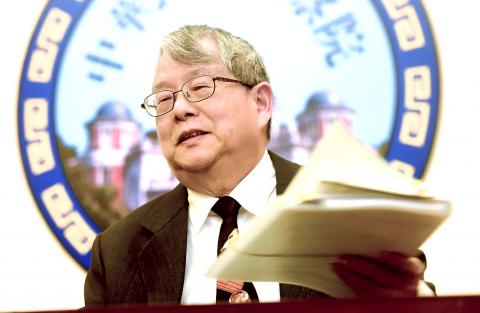
Photo: Lin Cheng-kung, Taipei Times
Chen said his main mission at the Control Yuan was to clean up “dinosaur judges” — a term that refers to judges who are out of touch with society — and judges who had prosecuted pan-green camp figures and government officials, while being lenient toward those from the pan-blue camp.
“I wanted to root out the dinosaur judges from the judiciary, but I found that the ‘guardian gods’ behind them were protecting and defending them, so my mission became difficult,” Chen said.
Members of the judiciary must treat each person with humane consideration, because they have the power to violate the rights of people at society’s lower levels, he said, asking: “Where can those in detention or who are wrongly convicted go to seek justice?”
“To clean up the muck in the judiciary, we would also have to throw these ‘guardian gods’ into the trash bin,” he said.
One of the cases Chen presented was a 2008 case against former Public Construction Commission vice chairman Kuo Ching-chiang (郭清江), while the other was a 2002-2003 case about the Taipei City Government dismantling the century-old Zhongshan Bridge (中山橋).
Kuo was taken for questioning and had travel restrictions imposed on him, which pointed to unfair prosecution, Chen said.
In the Zhongshan Bridge case, the administration of then-Taipei mayor Ma Ying-jeou (馬英九) abused its power to dismantle the bridge, which was designated as a historic monument for preservation.
The move was made without consulting engineers or cultural historians, and 435 slabs from the dismantled bridge still lie abandoned in a nearby park 18 years later, Chen said.

LOUD AND PROUD Taiwan might have taken a drubbing against Australia and Japan, but you might not know it from the enthusiasm and numbers of the fans Taiwan might not be expected to win the World Baseball Classic (WBC) but their fans are making their presence felt in Tokyo, with tens of thousands decked out in the team’s blue, blowing horns and singing songs. Taiwanese fans have packed out the Tokyo Dome for all three of their games so far and even threatened to drown out home team supporters when their team played Japan on Friday. They blew trumpets, chanted for their favorite players and had their own cheerleading squad who dance on a stage during the game. The team struggled to match that exuberance on the field, with
Taiwanese paleontologists have discovered fossil evidence that pythons up to 4m long inhabited Taiwan during the Pleistocene epoch, reporting their findings in the international scientific journal Historical Biology. National Taiwan University (NTU) Institute of Ecology and Evolutionary Biology associate professor Tsai Cheng-hsiu (蔡政修) led the team that discovered the largest snake fossil ever found in Taiwan. The single trunk vertebra was discovered in Tainan at the Chiting Formation, dated to between 400,000 and 800,000 years ago in the Middle Pleistocene, the paper said. The area also produced Taiwan’s first avian fossil, as well as crocodile, mammoth, saber-toothed cat and rhinoceros fossils, it said. Discoveries

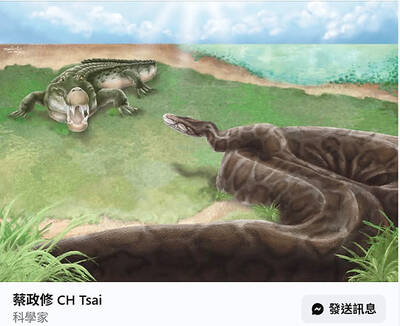
Taiwanese paleontologists have discovered fossil evidence that pythons up to 4m long inhabited Taiwan during the Pleistocene epoch, reporting their findings in the international scientific journal Historical Biology. National Taiwan University (NTU) Institute of Ecology and Evolutionary Biology associate professor Tsai Cheng-hsiu (蔡政修) led the team that discovered the largest snake fossil ever found in Taiwan. A single trunk vertebra was discovered in Tainan at the Chiting Formation, dated to between 800,000 to 400,000 years ago in the Middle Pleistocene, the paper said. The area also produced Taiwan’s first avian fossil, as well as crocodile, mammoth, sabre-toothed cat and rhinoceros fossils, it said. Discoveries

Whether Japan would help defend Taiwan in case of a cross-strait conflict would depend on the US and the extent to which Japan would be allowed to act under the US-Japan Security Treaty, former Japanese minister of defense Satoshi Morimoto said. As China has not given up on the idea of invading Taiwan by force, to what extent Japan could support US military action would hinge on Washington’s intention and its negotiation with Tokyo, Morimoto said in an interview with the Liberty Times (sister paper of the Taipei Times) yesterday. There has to be sufficient mutual recognition of how Japan could provide


 RSS
RSS