


A recent study found four major public safety concerns at large retail stores, the Consumers’ Foundation said yesterday.
As the Lunar New Year holiday approaches, major retailers are filling up with crowds of people shopping for New Year’s goods, the foundation said.
From Jan. 8 to Wednesday last week, foundation volunteers visited 77 stores belonging to 34 businesses across Taiwan, including department stores and supermarkets, it said.
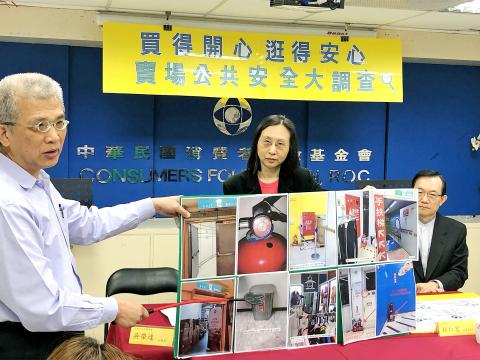
Photo: Lo Chi, Taipei Times
Retail stores in a building’s basement should have two or more entrances and exits, but the study found that five stores located underground only had one, foundation honorary chairman Cheng Jen-hung (程仁宏) said.
If there is a fire near the entrance, people would be in danger, he said.
The study also found that 47 percent of the stores that were visited did not have emergency evacuation maps, or ones that were clearly visible, and 37 percent did not have escape equipment that could easily be seen, foundation chairwoman Lei Li-fen (雷立芬) said.
These findings suggest that if such items are not required by law, then businesses do not install them, she said.
Articles 146 to 156 of the Standard for Installation of Fire Safety Equipments Based on Use and Occupancy (各類場所消防安全設備設置標準) do not require the installation of emergency evacuation maps, she said.
Even if there is escape equipment, it is there because of government inspections, and is often placed in areas that are not easily visible, she said.
Meanwhile, more than 20 stores had emergency exits that were left open, the study found.
Emergency exits must be kept shut to prevent the spread of smoke, Cheng said.
At the same time, the exits must not be blocked and must be left unlocked for emergency evacuations, he added.
At the end of last year, the Taipei and New Taipei City fire departments conducted a public safety investigation targeting department stores and supermarkets, and issued fines on the spot, Lei said.
However, the study, conducted less than a month later, still found many flaws, she added.
According to Article 4 of the Consumer Protection Act (消費者保護法), businesses must emphasize consumers’ health and safety, foundation secretary-general Wu Jung-ta (吳榮達) said.
Under Article 60 of the same act, if the products or services provided could endanger a consumer’s life, body or health, the government may order the business to suspend operations in serious cases and ask consumer protection groups to file a lawsuit on its behalf, he said.
Urging businesses to value public safety, the foundation said that government agencies should also perform consistent and thorough safety checks in public places to protect people’s safety.
A small number of Taiwanese this year lost their citizenship rights after traveling in China and obtaining a one-time Chinese passport to cross the border into Russia, a source said today. The people signed up through Chinese travel agencies for tours of neighboring Russia with companies claiming they could obtain Russian visas and fast-track border clearance, the source said on condition of anonymity. The travelers were actually issued one-time-use Chinese passports, they said. Taiwanese are prohibited from holding a Chinese passport or household registration. If found to have a Chinese ID, they may lose their resident status under Article 9-1
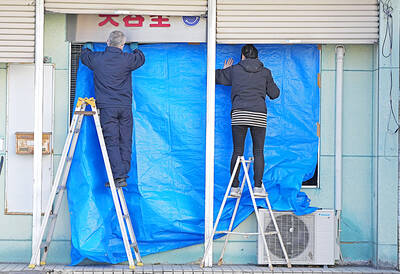
Taiwanese were praised for their composure after a video filmed by Taiwanese tourists capturing the moment a magnitude 7.5 earthquake struck Japan’s Aomori Prefecture went viral on social media. The video shows a hotel room shaking violently amid Monday’s quake, with objects falling to the ground. Two Taiwanese began filming with their mobile phones, while two others held the sides of a TV to prevent it from falling. When the shaking stopped, the pair calmly took down the TV and laid it flat on a tatami mat, the video shows. The video also captured the group talking about the safety of their companions bathing

PROBLEMATIC APP: Citing more than 1,000 fraud cases, the government is taking the app down for a year, but opposition voices are calling it censorship Chinese Nationalist Party (KMT) Chairwoman Cheng Li-wun (鄭麗文) yesterday decried a government plan to suspend access to Chinese social media platform Xiaohongshu (小紅書) for one year as censorship, while the Presidential Office backed the plan. The Ministry of the Interior on Thursday cited security risks and accusations that the Instagram-like app, known as Rednote in English, had figured in more than 1,700 fraud cases since last year. The company, which has about 3 million users in Taiwan, has not yet responded to requests for comment. “Many people online are already asking ‘How to climb over the firewall to access Xiaohongshu,’” Cheng posted on

A classified Pentagon-produced, multiyear assessment — the Overmatch brief — highlighted unreported Chinese capabilities to destroy US military assets and identified US supply chain choke points, painting a disturbing picture of waning US military might, a New York Times editorial published on Monday said. US Secretary of Defense Pete Hegseth’s comments in November last year that “we lose every time” in Pentagon-conducted war games pitting the US against China further highlighted the uncertainty about the US’ capability to intervene in the event of a Chinese invasion of Taiwan. “It shows the Pentagon’s overreliance on expensive, vulnerable weapons as adversaries field cheap, technologically


 RSS
RSS