


Outgoing Control Yuan member Chen Shih-meng (陳師孟) in a detailed post on his Pointed Pigtail (尖尾週記) blog on Saturday explained his reasons for resigning.
Chen announced his resignation on Thursday, after Judicial Yuan President Hsu Tzong-li (許宗力) on Tuesday accused him of interfering in the judicial system.
While President Tsai Ing-wen (蔡英文) had asked him to stay on until his term ends on July 31, Chen said that he would not change his mind.
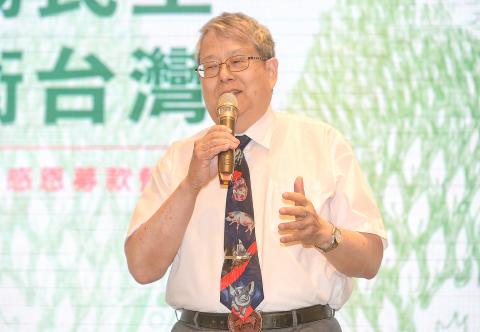
Photo: Chiang Chia-ming, Taipei Times
Chen had sparked controversy with a plan to investigate allegations of misconduct, personal bias and abuse of power by judicial officials, including judges and prosecutors.
He had cited the allegedly unfair prosecution and unequal treatment of the nation’s two previous presidents in corruption cases, as well as their alleged misuse of “slush funds” when in office.
On his blog, Chen said that when he assumed the position in January, 2018, he had given his assurance and made a public declaration that his work would focus on investigating “dinosaur judges” — a term used to describe them as being out of touch with society.
“My contribution was to be to clean up the accumulated muck in the justice system. It was in accord with calls by President Tsai [Ing-wen (蔡英文)] to prioritize judicial reform at the start of her first presidential term,” Chen wrote. “My confidence in judicial reform came from our nation’s Constitution, which grants the Control Yuan the power to balance the power of the judiciary.”
Chen said that his confidence waned over time due to a lack of progress with regard to judicial reform.
He said he went to the Judicial Yuan several times to check up on an issue, but Judicial Yuan President Hsu Tzong-li (許宗力) brushed him off by saying that the push for judicial reform would be perceived as “taking revenge” and would “have a chilling effect” on judges.
“It seems Hsu treated the more than 2,000 court judges like baby silkworms, attentively treating them with care, but a Control Yuan member is the natural enemy of baby silkworms,” Chen wrote.
Hsu overly protected the judges, shielding them from investigations by the Control Yuan, Chen said.
“The only person who has the power to put an end to this farce has clearly chosen not to get involved,” Chen said, without giving a name.
“If this Control Yuan member continues to struggle on, I would get nowhere and we would be back to square one, so why should I go on fighting this battle?” Chen asked.
Chen said that his resignation was not because he was caving in to pressure from the media or public, nor because he was frightened by Hsu accusing him of interfering in the judicial system, nor because he was surrendering to the more than 80 percent of judges who petitioned against his proposed plan to question the judge who had acquitted former president Ma Ying-jeou (馬英九) in a retrial.
He resigned because he no longer knew why he was still fighting, and he could no longer push for judicial reform, Chen said.
Separately yesterday, the Presidential Office said that the Control Yuan and Judicial Yuan would able to resolve any dispute based on the nation’s constitutional framework.
“We believe the two bodies can comply with mechanisms under the constitutional framework, to verify the delineation of power between them,” Presidential Office spokesman Ting Yun-kung (丁允恭) said. “There is no need for politicized consideration [of this dispute].”

LOUD AND PROUD Taiwan might have taken a drubbing against Australia and Japan, but you might not know it from the enthusiasm and numbers of the fans Taiwan might not be expected to win the World Baseball Classic (WBC) but their fans are making their presence felt in Tokyo, with tens of thousands decked out in the team’s blue, blowing horns and singing songs. Taiwanese fans have packed out the Tokyo Dome for all three of their games so far and even threatened to drown out home team supporters when their team played Japan on Friday. They blew trumpets, chanted for their favorite players and had their own cheerleading squad who dance on a stage during the game. The team struggled to match that exuberance on the field, with
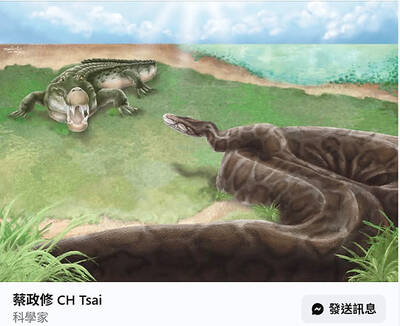
Taiwanese paleontologists have discovered fossil evidence that pythons up to 4m long inhabited Taiwan during the Pleistocene epoch, reporting their findings in the international scientific journal Historical Biology. National Taiwan University (NTU) Institute of Ecology and Evolutionary Biology associate professor Tsai Cheng-hsiu (蔡政修) led the team that discovered the largest snake fossil ever found in Taiwan. The single trunk vertebra was discovered in Tainan at the Chiting Formation, dated to between 400,000 and 800,000 years ago in the Middle Pleistocene, the paper said. The area also produced Taiwan’s first avian fossil, as well as crocodile, mammoth, saber-toothed cat and rhinoceros fossils, it said. Discoveries

Taiwanese paleontologists have discovered fossil evidence that pythons up to 4m long inhabited Taiwan during the Pleistocene epoch, reporting their findings in the international scientific journal Historical Biology. National Taiwan University (NTU) Institute of Ecology and Evolutionary Biology associate professor Tsai Cheng-hsiu (蔡政修) led the team that discovered the largest snake fossil ever found in Taiwan. A single trunk vertebra was discovered in Tainan at the Chiting Formation, dated to between 800,000 to 400,000 years ago in the Middle Pleistocene, the paper said. The area also produced Taiwan’s first avian fossil, as well as crocodile, mammoth, sabre-toothed cat and rhinoceros fossils, it said. Discoveries
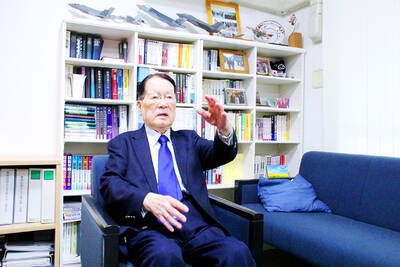
Whether Japan would help defend Taiwan in case of a cross-strait conflict would depend on the US and the extent to which Japan would be allowed to act under the US-Japan Security Treaty, former Japanese minister of defense Satoshi Morimoto said. As China has not given up on the idea of invading Taiwan by force, to what extent Japan could support US military action would hinge on Washington’s intention and its negotiation with Tokyo, Morimoto said in an interview with the Liberty Times (sister paper of the Taipei Times) yesterday. There has to be sufficient mutual recognition of how Japan could provide


 RSS
RSS