


Teachers have reported improved classroom environments after a policy to manage students’ use of mobile phones was implemented, National Hsinchu Senior Industrial Vocational School student affairs division head Liao Tsang-hsiang (廖倉祥) said on Sunday.
Following years of advice from parents, the school in August last year approved regulations to limit students’ use of mobile phones, tablets and cameras.
The 42 classrooms at the school are equipped with special boxes to store electronic devices, dubbed “chicken farms” — a play on the Chinese word for “mobile phone,” as one of the characters has the same pronunciation as “chicken” in Chinese, Liao said.
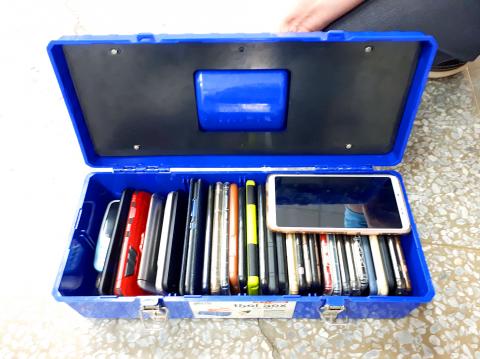
Photo: Hung Mei-hsiu, Taipei Times
Students are required to put their devices in the boxes during school hours, otherwise holiday work or demerits would be handed out, he said.
After about a semester of the policy being implemented, most teachers have reported positive feedback, with students paying more attention in class, while they no longer worry that photographs or videos would be taken without permission, school principal Lee Heng-lin (李恆霖) said.
“Any effect on academic performance has not been determined, but the improved classroom dynamics would undoubtedly benefit students in the long term,” Lee said.
Students spend more time playing basketball or solving Rubik’s cubes outside classtime without their devices, while there is more chatting and laughter on campus, Liao said.
In Taichung, several junior-high and high schools have implemented similar policies, with students only allowed their phones to contact their parents before and after the day’s classes.
However, some students still break the rules, some principals said.
While schools want to install a centralized phone management system using special locked boxes, they do not have enough funds, with one box costing more than NT$1,000, they said.
Some schools leave decisions about phone restrictions to each classroom, while allowing phone use under specific circumstances.
With approval from the student affairs division, students can bring a phone to school that is marked with a sticker, Dahua Junior High School principal Hsu Hsiu-ching (徐秀青) said.
The student can use such a phone to contact their parents or for academic purposes with their teacher’s permission, Hsu said.
Affiliated Senior High School of National Chung Hsing University requires students to turn off their devices at school, unless a teacher says otherwise.
Taichung Municipal Chang-Yie Senior High School keeps its junior-high students’ phones for them and requires senior-high students to turn off devices. Both groups have 30 minutes during their lunch break.
The Ministry of Education said schools have autonomy to define phone use regulations, as long as decisions are made through a democratic process involving teachers, parents and students.
Additional reporting by Chen Chien-chih and Wu Po-hsuan
A small number of Taiwanese this year lost their citizenship rights after traveling in China and obtaining a one-time Chinese passport to cross the border into Russia, a source said today. The people signed up through Chinese travel agencies for tours of neighboring Russia with companies claiming they could obtain Russian visas and fast-track border clearance, the source said on condition of anonymity. The travelers were actually issued one-time-use Chinese passports, they said. Taiwanese are prohibited from holding a Chinese passport or household registration. If found to have a Chinese ID, they may lose their resident status under Article 9-1

Taiwanese were praised for their composure after a video filmed by Taiwanese tourists capturing the moment a magnitude 7.5 earthquake struck Japan’s Aomori Prefecture went viral on social media. The video shows a hotel room shaking violently amid Monday’s quake, with objects falling to the ground. Two Taiwanese began filming with their mobile phones, while two others held the sides of a TV to prevent it from falling. When the shaking stopped, the pair calmly took down the TV and laid it flat on a tatami mat, the video shows. The video also captured the group talking about the safety of their companions bathing

PROBLEMATIC APP: Citing more than 1,000 fraud cases, the government is taking the app down for a year, but opposition voices are calling it censorship Chinese Nationalist Party (KMT) Chairwoman Cheng Li-wun (鄭麗文) yesterday decried a government plan to suspend access to Chinese social media platform Xiaohongshu (小紅書) for one year as censorship, while the Presidential Office backed the plan. The Ministry of the Interior on Thursday cited security risks and accusations that the Instagram-like app, known as Rednote in English, had figured in more than 1,700 fraud cases since last year. The company, which has about 3 million users in Taiwan, has not yet responded to requests for comment. “Many people online are already asking ‘How to climb over the firewall to access Xiaohongshu,’” Cheng posted on

A classified Pentagon-produced, multiyear assessment — the Overmatch brief — highlighted unreported Chinese capabilities to destroy US military assets and identified US supply chain choke points, painting a disturbing picture of waning US military might, a New York Times editorial published on Monday said. US Secretary of Defense Pete Hegseth’s comments in November last year that “we lose every time” in Pentagon-conducted war games pitting the US against China further highlighted the uncertainty about the US’ capability to intervene in the event of a Chinese invasion of Taiwan. “It shows the Pentagon’s overreliance on expensive, vulnerable weapons as adversaries field cheap, technologically


 RSS
RSS