


Liberty Times (LT): Although you have helped draft many of KMT presidential candidate Han Kuo-Yu’s (韓國瑜) policy plans, as his vice president you would not be granted actual power under the Constitution if you win the election. How can you promise that the KMT administration will follow through with your ideas?
Simon Chang (張善政): There is not much I can do about the KMT, but Han is a party member; he has more than once spoken about the need to reform the KMT, especially the need to bring in the younger generations, and I believe in him.
When I agreed to be his running mate, Han promised to implement my policy plans. He also told me that if he is elected president, he would return to Kaohsiung to serve as mayor until May 20 and that during that period [leading up the swearing-in ceremony], we would discuss how to build a government team. I believe he meant what he said. Our team will inevitably include non-KMT members.
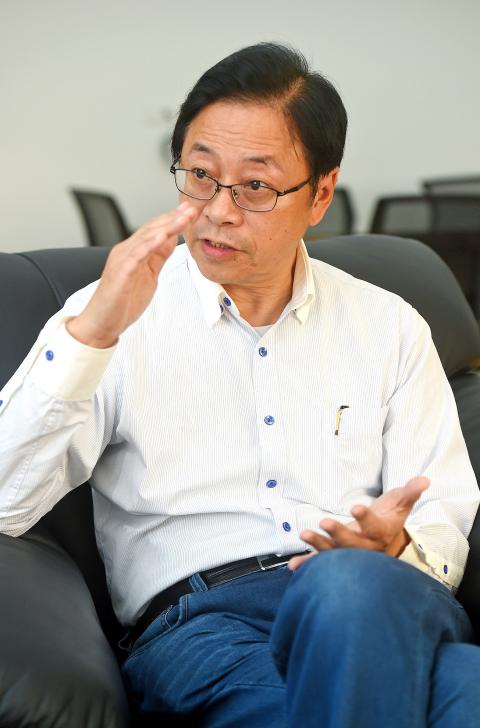
Photo: Chien Jung-fong, Taipei Times
If the KMT wins the presidential election, I hope Han can reform the party and bring in more young people, and I look forward to seeing a method to coordinate the administration and the KMT.
LT: How would you interact with the KMT if party reforms do not lead to satisfactory results?
Chang: I would not interfere with the KMT’s internal reforms. I only care about whether the party would better assist us in running the nation after reforms. Hopefully, as an independent vice president, I would be able to help coordinate things and act as a buffer to ensure harmony in the government.
At the moment I have no plans to join the KMT. I hope to maintain objectivity by remaining an independent. It would also give me more credibility [as a politician].
LT: You have previously recommended that the KMT abandon the “1992 consensus” and adopt “one China according to the Constitution, while prioritizing Taiwan” (憲法一中,台灣優先) as its new model for cross-strait interactions. Have you changed your mind?
Chang: That was my stance when I launched my own presidential bid. To some extent, Han’s cross-strait policy also implies “one China according to the Constitution, while prioritizing Taiwan.”
As it is no longer enough to simply say the “1992 consensus,” we now say the “1992 consensus, with each side having its own interpretation of what one China means,” but we are concerned that the other side of the Taiwan Strait will not accept that, and that is why I originally proposed “one China according to the Constitution, while prioritizing Taiwan.”
When we were discussing the matter with former National Security Bureau director-general Tsai De-sheng (蔡得勝), he said the mainland had not rejected the idea of “one China, with each side having its own interpretation of what that means” in its internal documents, but it was rarely mentioned due to concerns that it could be interpreted as supporting the independence of the Republic of China. So I suggested saying both the “1992 consensus” and “one China, with each side having its own interpretation of what that means” in one sentence.
Simply saying the “1992 consensus” without mentioning “one China, with each side having its own interpretation of what that means” would be risky.
I am glad that the other side of the Strait responded with goodwill and allowed some flexibility, but if something happens, we would go back to “one China according to the Constitution, while prioritizing Taiwan.”
LT: Did Chinese President Xi Jinping’s (習近平) speech last year misinterpret the “1992 consensus”?
Chang: We do not accept part of what he said. I have said that the other side [of the Taiwan Strait] and the DPP are twisting the “1992 consensus” together. We originally said “one China,” and all acknowledged “belonging to one China,” but did not say in the future it would be united. Did the “1992 consensus” say this?
Xi used it to mean achieving unification, but our formulation is very clear: Now is not the time to decide between unification or independence, basically [we] are of the opinion that the “status quo” should be maintained. The two sides [of the Taiwan Strait] do not currently have the conditions to unify or to [declare] independence. The people of this generation do not have the power to limit the choice of the people of the next generation. We give this decision to the next generation.
LT: Was Xi’s speech last year aimed at advancing the process of unification?
Chang: He is accountable to the Chinese Communist Party (CCP). I can understand him saying this, but our stance is: Sorry, [we] do not accept, it is too early to say [anything about unification].”
I could only say that [Xi has] put a bad label on the “1992 consensus.”
LT: Would you be happy to accept the other side [of the Taiwan Strait] promoting the process of unification?
Chang: There are many sides to the process of unification. Is giving us quasi-national treatment part of the process of unification? If it is military, political, diplomatic, we absolutely do not accept. If it is to promote cross-strait exchange, such as allowing Chinese students to come to Taiwan to study, I am very willing to accept.
On the other hand, [we] also do not accept suppression of our international space. The two sides need to have a tacit understanding. Let me go to the WHO, the International Civil Aviation Organization. We would not propose having membership status, but at least need to maintain observer status. If [China] suppresses our international space and does not give us even observer status and compresses our space to zero, I would absolutely object.
LT: Would you want Xi, or the other side [of the Taiwan Strait], to be able to say “one China, with each side having its own interpretation of what that means”?
Chang: I think as long as he does not deny it. There is space for flexibility. In “one China, with each side having its own interpretation of what that means,” he would care a lot about “one China.” We care about “each side having its own interpretation of what that means.” If he does not deny [this], we basically have a tacit understanding. This is the tacit understanding and foundation the two sides [of the Taiwan Strait] would continue to walk along after Han Kuo-yu (韓國瑜) becomes elected.
LT: However, is “you say yours, I say mine” a consensus?
Chang: You need to go back and ask the person who originally invented the term “1992 consensus,” Su Chi (蘇起). The so-called consensus means you do not come and negate me. I am within the Republic of China, I have my stance; you are within your mainland, you have your stance. We need to first stand firmly domestically and not challenge each other’s arguments domestically.
Translated by Ann Maxon and Sherry Hsiao
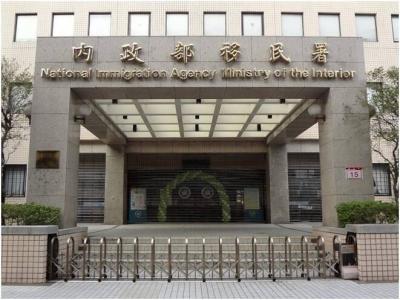
A small number of Taiwanese this year lost their citizenship rights after traveling in China and obtaining a one-time Chinese passport to cross the border into Russia, a source said today. The people signed up through Chinese travel agencies for tours of neighboring Russia with companies claiming they could obtain Russian visas and fast-track border clearance, the source said on condition of anonymity. The travelers were actually issued one-time-use Chinese passports, they said. Taiwanese are prohibited from holding a Chinese passport or household registration. If found to have a Chinese ID, they may lose their resident status under Article 9-1

Taiwanese were praised for their composure after a video filmed by Taiwanese tourists capturing the moment a magnitude 7.5 earthquake struck Japan’s Aomori Prefecture went viral on social media. The video shows a hotel room shaking violently amid Monday’s quake, with objects falling to the ground. Two Taiwanese began filming with their mobile phones, while two others held the sides of a TV to prevent it from falling. When the shaking stopped, the pair calmly took down the TV and laid it flat on a tatami mat, the video shows. The video also captured the group talking about the safety of their companions bathing

PROBLEMATIC APP: Citing more than 1,000 fraud cases, the government is taking the app down for a year, but opposition voices are calling it censorship Chinese Nationalist Party (KMT) Chairwoman Cheng Li-wun (鄭麗文) yesterday decried a government plan to suspend access to Chinese social media platform Xiaohongshu (小紅書) for one year as censorship, while the Presidential Office backed the plan. The Ministry of the Interior on Thursday cited security risks and accusations that the Instagram-like app, known as Rednote in English, had figured in more than 1,700 fraud cases since last year. The company, which has about 3 million users in Taiwan, has not yet responded to requests for comment. “Many people online are already asking ‘How to climb over the firewall to access Xiaohongshu,’” Cheng posted on

A classified Pentagon-produced, multiyear assessment — the Overmatch brief — highlighted unreported Chinese capabilities to destroy US military assets and identified US supply chain choke points, painting a disturbing picture of waning US military might, a New York Times editorial published on Monday said. US Secretary of Defense Pete Hegseth’s comments in November last year that “we lose every time” in Pentagon-conducted war games pitting the US against China further highlighted the uncertainty about the US’ capability to intervene in the event of a Chinese invasion of Taiwan. “It shows the Pentagon’s overreliance on expensive, vulnerable weapons as adversaries field cheap, technologically


 RSS
RSS