


The Chinese Nationalist Party (KMT) yesterday accused the Democratic Progressive Party (DPP) of silencing critics by having law enforcement agencies monitor people’s online activity and summon them for questioning.
“The government being allowed to curtail people’s freedom of speech and freedom of privacy of correspondence, both of which are guaranteed by the Constitution, is something unheard of,” former Taipei County commissioner Chou Hsi-wei (周錫瑋) told a news conference at the KMT headquarters in Taipei.
Chou is the deputy chief campaign officer for Kaohsiung Mayor Han Kuo-yu (韓國瑜), the KMT’s presidential candidate.
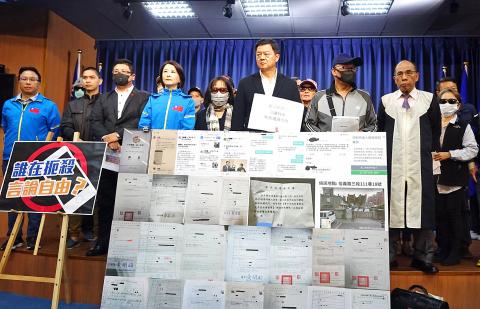
Photo: Wang Yi-sung, Taipei Times
“Some people were summoned by the Criminal Investigation Bureau, the Investigation Bureau and prosecutors just for sharing articles that were critical of the government,” Chou said, adding that some prosecutors allegedly told the people they summoned to “stop talking.”
He asked President Tsai Ing-wen (蔡英文) whether her administration had authorized prosecutors, investigators and police to intrude on people’s private conversations on instant messaging apps and social media.
Some district prosecutors reportedly overstepped their jurisdictions, summoning people from other cities or counties, Chou said, urging agencies to confess to the public if they had ordered prosecutors to target the DPP’s critics.
If Han is elected on Saturday, he would redress the injustices perpetrated against these people, Chou said.
There was a surge in similar cases from October to December last year, when many people had reported being summoned by prosecutors or police, KMT spokeswoman Wang Hong-wei (王鴻薇) said, calling such reports “green terror.”
Some people had said that they were summoned by more than one agency, she said, urging the Tsai administration to come clean about the agencies that had been giving prosecutors commands.
Police often say that they are short-staffed and leave many cases unattended, but they seem to be spending a lot of time investigating people before the elections, she added.
A woman from Kaohsiung said she had to appear in court later this month because she unwittingly shared a false news report.
Most ordinary people are not equipped to distinguish fake news, the woman said, adding that she had never thought that she would have to go to court one day because of a touch of her finger.
She asked why prosecutors had limited her freedom of speech, but have seemingly halted their investigations into a duty-free cigarette scandal that involved National Security Bureau officers.
A man said that a police officer showed up at his door with a snapshot of his Facebook page and asked him whether he had shared a news article and a video criticizing the DPP made by an Internet personality.
When he told the officer that he had, he was told he had breached the Social Order Maintenance Act (社會秩序維護法) and was taken to a police station to give a statement, even though he had shared the article, which contained erroneous information, in defense of the DPP administration, the man said.
He added that he suspected that his conversations on an instant messaging app had been monitored since the incident, as they sounded “echoey” even though neither speaker was on speakerphone.
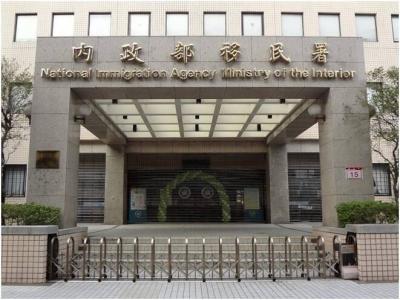
A small number of Taiwanese this year lost their citizenship rights after traveling in China and obtaining a one-time Chinese passport to cross the border into Russia, a source said today. The people signed up through Chinese travel agencies for tours of neighboring Russia with companies claiming they could obtain Russian visas and fast-track border clearance, the source said on condition of anonymity. The travelers were actually issued one-time-use Chinese passports, they said. Taiwanese are prohibited from holding a Chinese passport or household registration. If found to have a Chinese ID, they may lose their resident status under Article 9-1
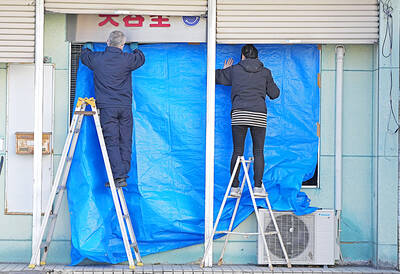
Taiwanese were praised for their composure after a video filmed by Taiwanese tourists capturing the moment a magnitude 7.5 earthquake struck Japan’s Aomori Prefecture went viral on social media. The video shows a hotel room shaking violently amid Monday’s quake, with objects falling to the ground. Two Taiwanese began filming with their mobile phones, while two others held the sides of a TV to prevent it from falling. When the shaking stopped, the pair calmly took down the TV and laid it flat on a tatami mat, the video shows. The video also captured the group talking about the safety of their companions bathing

PROBLEMATIC APP: Citing more than 1,000 fraud cases, the government is taking the app down for a year, but opposition voices are calling it censorship Chinese Nationalist Party (KMT) Chairwoman Cheng Li-wun (鄭麗文) yesterday decried a government plan to suspend access to Chinese social media platform Xiaohongshu (小紅書) for one year as censorship, while the Presidential Office backed the plan. The Ministry of the Interior on Thursday cited security risks and accusations that the Instagram-like app, known as Rednote in English, had figured in more than 1,700 fraud cases since last year. The company, which has about 3 million users in Taiwan, has not yet responded to requests for comment. “Many people online are already asking ‘How to climb over the firewall to access Xiaohongshu,’” Cheng posted on

A classified Pentagon-produced, multiyear assessment — the Overmatch brief — highlighted unreported Chinese capabilities to destroy US military assets and identified US supply chain choke points, painting a disturbing picture of waning US military might, a New York Times editorial published on Monday said. US Secretary of Defense Pete Hegseth’s comments in November last year that “we lose every time” in Pentagon-conducted war games pitting the US against China further highlighted the uncertainty about the US’ capability to intervene in the event of a Chinese invasion of Taiwan. “It shows the Pentagon’s overreliance on expensive, vulnerable weapons as adversaries field cheap, technologically


 RSS
RSS