


The National Taiwan University (NTU) Students’ Association yesterday called on the university administration to back freedom of speech in all cases, instead of only supporting Su Hung-dah (蘇宏達), an NTU professor of political science who has been accused of spreading misinformation.
In a video postsed to Facebook in November 2018, Su accused the Democratic Progressive Party (DPP) of trying to launch a “cultural revolution” to exterminate the National Palace Museum.
In the video, Su said that former National Palace Museum director Chen Chi-nan (陳其南) collaborated with the DPP on a policy to move the museum’s collection.
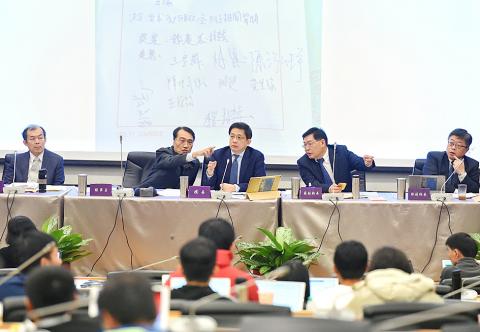
Photo: Fang Pin-chao, Taipei Times
The museum has said that Su’s remarks were false.
He received a notice from the Nangang Precinct (南港) of the Taipei Police Department of an alleged breach of the Social Order Maintenance Act (社會秩序維護法), Su wrote on Tuesday.
NTU on Thursday posted a statement on Facebook, expressing concern that the police were “infringing freedom of speech” and called on authorities to observe Article 11 of the Constitution.
The student association submitted a proposal to a meeting of university administrators, calling on NTU to retract its statement.
NTU did not issue the statement to support all expressions of opinion among students and faculty, the association said.
The proposal was not adopted, with attendees casting 79 votes against it and 30 for, with one blank vote.
NTU president Kuan Chung-ming (管中閔) said that the institute’s statement represents its responsibility to protect the freedom of speech of faculty and students, rather than reflecting whether it agreed with Su’s comments.
The university’s administration seems to be inconsistent when it handles cases involving people linked to different political parties, NTU Graduate Students’ Association chairman Wang Yu-chun (王昱鈞) said.
For example, it did not support a fundraising activity for a memorial site for late democracy activist Chen Wen-chen (陳文成) due to political sensitivity, Wang said, adding that the university should have reasonable and consistent standards for similar cases.
The university would help with the memorial, as the project was approved at a meeting of NTU administrators, with the Chen Wen-chen Memorial Foundation to raise money, Kuan said, adding that it could help if a proposal is approved at a subsequent administrators’ meeting.
The Chen incident is about transitional justice, Students’ Association head Tu Chun-ching (涂峻清) said, adding that hopefully NTU would clarify its stance on Chen’s death.
Chen, who was born in 1950 and graduated from NTU, was an assistant professor at Carnegie Mellon University when he returned to Taiwan on May 20, 1981, to visit family. On July 2, 1981, he was questioned by the former Taiwan Garrison Command.
His body was discovered the next day on the NTU campus.
The then-Chinese Nationalist Party (KMT) government said that Chen committed suicide out of fear of being convicted over his involvement in pro-democracy movements.
His family and friends say he was murdered by the government.

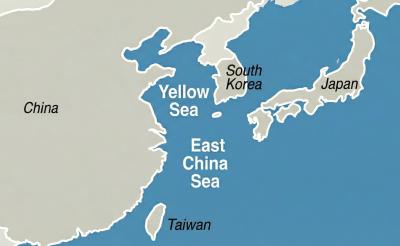
China has reserved offshore airspace in the Yellow Sea and East China Sea from March 27 to May 6, issuing alerts usually used to warn of military exercises, although no such exercises have been announced, the Wall Street Journal (WSJ) reported yesterday. Reserving such a large area for 40 days without explanation is an “unusual step,” as military exercises normally only last a few days, the paper said. These alerts, known as Notice to Air Missions (Notams), “are intended to inform pilots and aviation authorities of temporary airspace hazards or restrictions,” the article said. The airspace reserved in the alert is
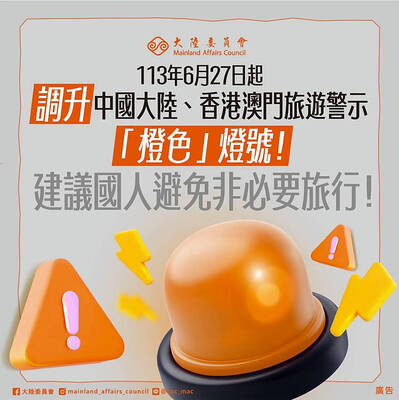
More than 6,000 Taiwanese students have participated in exchange programs in China over the past two years, despite the Mainland Affairs Council’s (MAC) “orange light” travel advisory, government records showed. The MAC’s publicly available registry showed that Taiwanese college and university students who went on exchange programs across the Strait numbered 3,592 and 2,966 people respectively. The National Immigration Agency data revealed that 2,296 and 2,551 Chinese students visited Taiwan for study in the same two years. A review of the Web sites of publicly-run universities and colleges showed that Taiwanese higher education institutions continued to recruit students for Chinese educational programs without
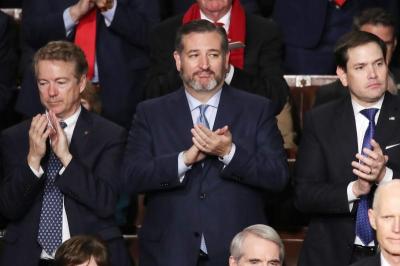
A bipartisan group of US senators has introduced a bill to enhance cooperation with Taiwan on drone development and to reduce reliance on supply chains linked to China. The proposed Blue Skies for Taiwan Act of 2026 was introduced by Republican US senators Ted Cruz and John Curtis, and Democratic US senators Jeff Merkley and Andy Kim. The legislation seeks to ease constraints on Taiwan-US cooperation in uncrewed aerial systems (UAS), including dependence on China-sourced components, limited access to capital and regulatory barriers under US export controls, a news release issued by Cruz on Wednesday said. The bill would establish a "Blue UAS
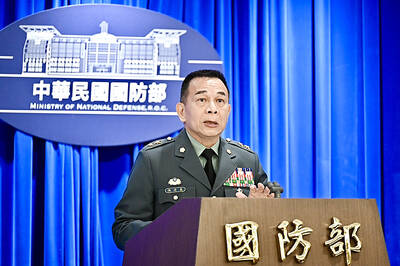
The Republic of China Army Command yesterday relieved Kinmen Defense Battalion commander after authorities indicted the officer on charges connected to using methamphetamine. The Kinmen District Prosecutors’ Office on Wednesday detained Colonel He (何) after the Coast Guard linked him to drug shipments and proceeded to charge him yesterday for using and possessing crystal meth. The man was released on a NT$50,000 bail and banned from leaving Kinmen, the office said. Army Chief of Staff Lieutenant General Chen Chien-yi (陳建義) told a news conference yesterday that He has been removed and another officer is taking over the unit as the acting commander. The military


 RSS
RSS