


The government might hold a second 5G auction sooner than previously planned after the nation’s first 5G auction entered its 15th day yesterday with total bids reaching nearly NT$80 billion (US$2.65 billion).
The National Communications Commission (NCC) said the auction temporarily ended yesterday with the total bids topping NT$79.391 billion, including NT$77.949 billion spent on bandwidth in the 3.5 gigahertz (GHz) frequency band and NT$1.442 billion on the 28GHz band.
The amount far exceeds the budget goals set by the Executive Yuan and the Legislative Yuan, which were NT$40 billion and NT$44 billion respectively.
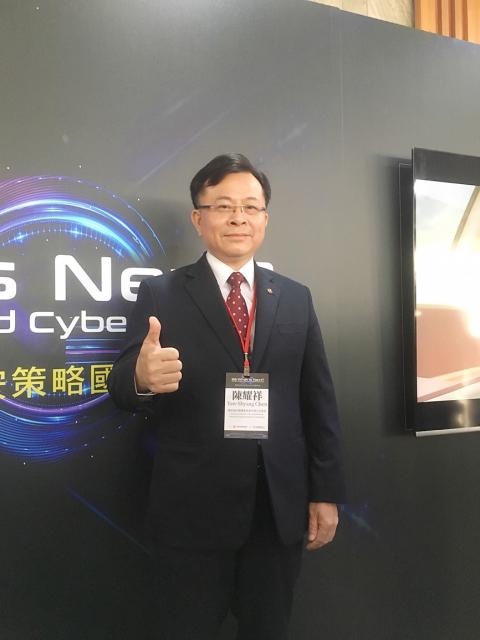
Photo: Yang Mien-chieh, Taipei Times
The bidding war among the nation’s telecoms has prompted some media to describe it as “a car that has gone out of control.”
NCC Acting Chairman Chen Yaw-shyang (陳耀祥) said that before the auction began, the commission had forecast that this situation could arise.
Urging telecoms to remain calm and rational, he said that the Executive Yuan had come to a preliminary decision that, in addition to allowing the telecoms to share the use of the spectrum and telecom networks, and having a dedicated spectrum for 5G system experiments, the nation would host another 5G auction within three years.
“Telecoms appear to have a great demand for the spectrum, which was why the bids went so high,” Chen said.
“Since we have already reached the budget goals set by the Executive Yuan and Legislative Yuan, the Executive Yuan is soon to hold interdepartmental meetings to discuss how the extra funds generated through the first 5G auction should be used, such as assisting telecoms in developing various vertical applications, reinforcing facilities for universal telecommunication services in the country’s remote areas and setting reasonable service fees for consumers,” he said.
Asked if there is a possibility that the second 5G auction could be postponed after telecoms spent so much money bidding in the first auction, Chen said that the bids from the first auction could actually facilitate the second.
The government could use part of the extra money from the bids to relocate the current users of the spectrum that is to be auctioned in the second round, “but the Executive Yuan would have to make a final decision on this matter,” he said.
Hsiao Ching-teng (蕭景燈), director of the Executive Yuan’s Office of Science and Technology, said that after a Cabinet meeting at the beginning of the month, it was decided that the government would release bandwidth between 4.4GHz and 5.5GHz for the development of the 5G system, but the National Police Agency and National Fire Agency are using part of that frequency band.
Previously, the government estimated that it would take two to three years to relocate the two agencies, he said.
“Our office has proposed that part of the funds generated from the 5G auction be used for emergency response purposes in the nation’s remote areas, as the government did with the 4G auction bids,” Hsiao said. “Meanwhile, we can use some of it to help relocate the two agencies and assist telecoms in building networks.”
Regarding the 5G auction, which continues today, Chen said that telecoms should not focus on placing higher bids in the first stage of the auction.
There is still a second stage in which telecoms would be given seven days to negotiate their preferred locations on the frequency band, with another auction to be conducted if they fail to settle the matter, he said.
“We hope that they can consider their demands, the development of the industry in the long term, network construction costs and all possible scenarios in the second stage of the auction,” Chen said. “The bids are high enough already ... The amount has exceeded a reasonable range.”
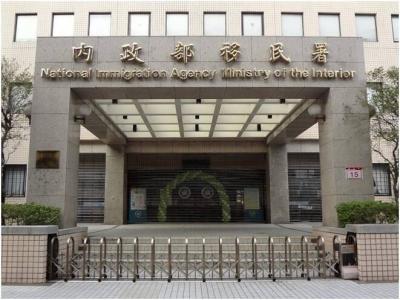
A small number of Taiwanese this year lost their citizenship rights after traveling in China and obtaining a one-time Chinese passport to cross the border into Russia, a source said today. The people signed up through Chinese travel agencies for tours of neighboring Russia with companies claiming they could obtain Russian visas and fast-track border clearance, the source said on condition of anonymity. The travelers were actually issued one-time-use Chinese passports, they said. Taiwanese are prohibited from holding a Chinese passport or household registration. If found to have a Chinese ID, they may lose their resident status under Article 9-1

Taiwanese were praised for their composure after a video filmed by Taiwanese tourists capturing the moment a magnitude 7.5 earthquake struck Japan’s Aomori Prefecture went viral on social media. The video shows a hotel room shaking violently amid Monday’s quake, with objects falling to the ground. Two Taiwanese began filming with their mobile phones, while two others held the sides of a TV to prevent it from falling. When the shaking stopped, the pair calmly took down the TV and laid it flat on a tatami mat, the video shows. The video also captured the group talking about the safety of their companions bathing

PROBLEMATIC APP: Citing more than 1,000 fraud cases, the government is taking the app down for a year, but opposition voices are calling it censorship Chinese Nationalist Party (KMT) Chairwoman Cheng Li-wun (鄭麗文) yesterday decried a government plan to suspend access to Chinese social media platform Xiaohongshu (小紅書) for one year as censorship, while the Presidential Office backed the plan. The Ministry of the Interior on Thursday cited security risks and accusations that the Instagram-like app, known as Rednote in English, had figured in more than 1,700 fraud cases since last year. The company, which has about 3 million users in Taiwan, has not yet responded to requests for comment. “Many people online are already asking ‘How to climb over the firewall to access Xiaohongshu,’” Cheng posted on

A classified Pentagon-produced, multiyear assessment — the Overmatch brief — highlighted unreported Chinese capabilities to destroy US military assets and identified US supply chain choke points, painting a disturbing picture of waning US military might, a New York Times editorial published on Monday said. US Secretary of Defense Pete Hegseth’s comments in November last year that “we lose every time” in Pentagon-conducted war games pitting the US against China further highlighted the uncertainty about the US’ capability to intervene in the event of a Chinese invasion of Taiwan. “It shows the Pentagon’s overreliance on expensive, vulnerable weapons as adversaries field cheap, technologically


 RSS
RSS