


Faculty and students from several universities yesterday protested outside the Ministry of Education to demand that it require public universities to establish budget auditing committees.
The group, which included New Power Party Legislator Cheng Hsiu-ling (鄭秀玲), said that an unbiased system for budget auditing is necessary for a democratic academic environment, and the government should amend the legislation regulating how public universities use academic funds and make establishing a budget auditing committee a legal responsibility.
Legislators should reach an agreement before Monday to guarantee that the draft amendment could clear a third reading and be passed before Tuesday next week, the last day of the current legislative session, they added.
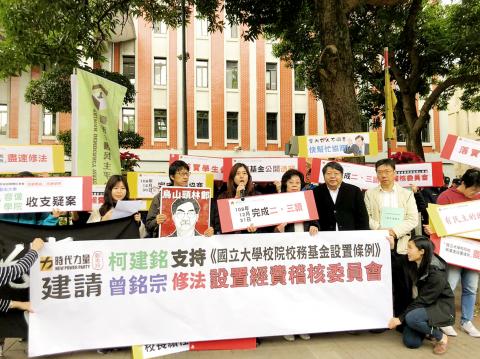
Photo: Rachel Lin, Taipei Times
The fund management authorities and budget auditing committees on campuses should also include student representatives, and the auditing members should belong to the auditing committee, not the fund management authority, Cheng said.
Budget auditing members should not be considered to be in opposition to a university president, National Taiwan University (NTU) professor Wang Li-sheng (王立昇) said, adding that he has worked on the NTU budget auditing committee.
“University presidents should treat the draft amendment with grace and character, because a budget auditing committee can curb corruption and hold them accountable for the use of school funds,” he said.
Tainan National University of the Arts professor Wu Yung-yi (吳永毅) said that he often sees disputes regarding the management of school funds.
A democratic campus needs to come with a democratic system of budget auditing, he said.
“The spirit of democracy extends beyond just elections,” Economic Democracy Union convener and lawyer Lai Chung-chiang (賴中強) said.
“An effective auditing system of university funds can be an example of exercising democracy on campus, as it affects not only faculty and students’ rights, but also the future of national education,” he said.
The ministry said the issue was in cross-party negotiations at the Legislative Yuan, and that it would respect and comply with the lawmakers’ decision.

Chinese spouse and influencer Guan Guan’s (關關) residency permit has been revoked for repeatedly posting pro-China videos that threaten national security, the National Immigration Agency confirmed today. Guan Guan has said many controversial statements in her videos posted to Douyin (抖音), including “the red flag will soon be painted all over Taiwan” and “Taiwan is an inseparable part of China,” and expressing hope for expedited reunification. The agency last year received multiple reports alleging that Guan Guan had advocated for armed reunification. After verifying the reports, the agency last month issued a notice requiring her to appear and explain her actions. Guan

GIVE AND TAKE: Blood demand continues to rise each year, while fewer young donors are available due to the nation’s falling birthrate, a doctor said Blood donors can redeem points earned from donations to obtain limited edition Formosan black bear travel mugs, the Kaohsiung Blood Center said yesterday, as it announced a goal of stocking 20,000 units of blood prior to the Lunar New Year. The last month of the lunar year is National Blood Donation Month, when local centers seek to stockpile blood for use during the Lunar New Year holiday. The blood demand in southern Taiwan — including Tainan and Kaohsiung, as well as Chiayi, Pingtung, Penghu and Taitung counties — is about 2,000 units per day, the center said. The donation campaign aims to boost

The Kaohsiung Tourism Bureau audited six hotels in an effort to prevent price gouging ahead of Korean band BTS’ concert tour in the city scheduled for Nov. 19, 21 and 22 this year. The bureau on Friday said that the audits — conducted in response to allegations of unfair pricing posted on social media — found no wrongdoing. These establishments included the local branches of Chateau de Chine, Hotel Nikko, My Humble House, and Grand Hai Lai, it said, adding that the Consumer Protection Commission would have penalized price gougers had the accusations been substantiated. The bureau said the Tourism Development Act
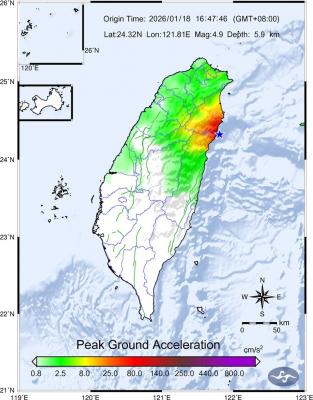
The Central Weather Administration (CWA) said a magnitude 4.9 earthquake that struck off the coast of eastern Taiwan yesterday was an independent event and part of a stress-adjustment process. The earthquake occurred at 4:47pm, with its epicenter at sea about 45.4km south of Yilan County Hall at a depth of 5.9km, the CWA said. The quake's intensity, which gauges the actual effects of a temblor, was highest in several townships in Yilan and neighboring Hualien County, where it measured 4 on Taiwan's seven-tier intensity scale, the CWA said. Lin Po-yu (林柏佑), a division chief at the CWA's Seismological Center, told a news conference


 RSS
RSS